Frequently Asked Questions
Everything you need to know about growing traffic, sales and efficiency with V-Count.
Can a hospital people counter tell patients and visitors apart from staff?
Yes, by geography rather than by recognising anyone. Staff entrances, back-of-house corridors and staff-only doors are set up as their own counting lines, and those lines are excluded from public footfall figures. In mixed doorways the sensor is positioned and zoned so the staff route crosses a different line from the patient route. No one is identified in order to do this — the system never knows who a person is, only which line they crossed and in which direction. The result is department and waiting-room numbers that reflect patients and visitors rather than clinical traffic. V-Count Staff Exclusion can also exclude tagged staff from counts.
How do you measure waiting room occupancy and wait time without a ticket system?
A sensor over the waiting-room entrance counts people in and out, so the live occupancy is simply the difference. Because entries and exits are timestamped, the system can also show how long the room takes to clear after a clinic block ends, which is a practical proxy for wait time. A second sensor over the reception or triage desk shows the queue in front of the service point itself. None of this needs patients to take a ticket, scan anything or be identified, and it captures companions who never appear in a ticketing system at all. V-Count VCare and Queue Management provide this without tickets.
Is people counting in a hospital HIPAA or GDPR compliant?
V-Count sensors produce anonymised counts, not personal data. Nobody is identified, no faces are stored or matched, and no individual is followed between visits or between sites. Processing happens on the sensor and only numbers leave it. Because there is no personal or health information in the output, the data normally sits outside the scope that HIPAA and GDPR govern, which is what makes it straightforward for a privacy team to sign off. We do not claim a healthcare certification on your behalf — we give your privacy team the technical detail of exactly what the sensor emits so they can assess it.
Can we enforce a visitor limit per ward during an outbreak?
Yes. Each ward door becomes its own occupancy area with its own limit, which you can change per ward and per time of day as policy changes. VCare shows the live count and status on a screen at the entrance so visitors can see it before they enter, and BoostBI can alert the nurse station when an area goes over its threshold. Afterwards you have a record of how long each ward spent above its limit, which is far more useful for an infection-control review than an estimate written up from memory.
Which sensor suits a main hospital entrance with a high atrium ceiling?
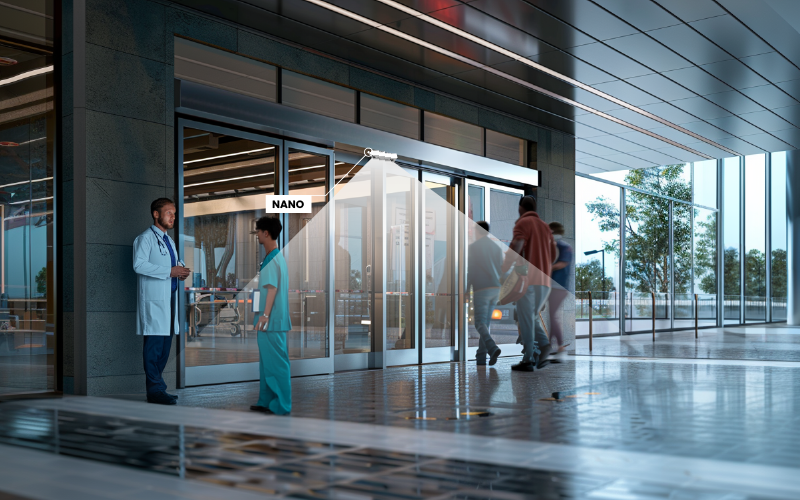
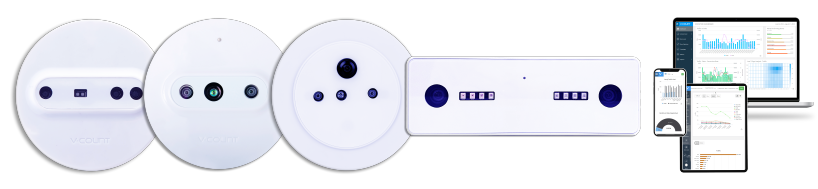
Nano Prime, our 3D stereo sensor, is built for tall mounting heights and for lobbies where daylight through glazing changes through the day and the lighting drops at night. Standard indoor doorways, department entries and waiting rooms are normally covered by Nano AI. Entrances that sit outside the building line — campus gates, car park approaches, ambulance bays — use Nano Outdoor. In practice most hospitals run a mix, and all three feed the same BoostBI dashboards, so the choice per doorway does not fragment the reporting.
Can it measure the outpatient clinic and pharmacy queues across several sites?
Yes. Each clinic waiting area and pharmacy counter is configured as a location with the same definitions everywhere, so queue length and occupancy are comparable between sites rather than locally invented. That is what lets a group see that one hospital’s pharmacy peak lands forty minutes after its clinics close while another’s lands immediately, and staff each accordingly. Our queue management pages cover the alerting and service-point side of this in more detail. V-Count Queue Management reports every site with the same definitions.
Can occupancy data trigger restroom cleaning?
Yes, and it is one of the quickest wins in a hospital. A sensor at the restroom corridor counts visits, and BoostBI raises a task once the count since the last clean passes the threshold you set. Quiet restrooms stop being cleaned on a timetable they do not need, and the busy ones near outpatients and the main entrance get attention when they actually need it. The same trigger logic works for high-traffic lobbies and cafeteria seating areas.
Do we need a sensor in every department to get useful data?
No. Most hospitals start with the main entrance plus the two or three areas where the pain is worst — typically the largest outpatient waiting room, the pharmacy and one ward door. That is enough to prove out the numbers and the staff exclusion setup. Departments are added afterwards as the space-planning questions come up, and because every sensor reports into the same platform, later additions extend the same dashboards rather than starting a new reporting exercise. V-Count Nano AI sensors can be added area by area as the project grows.