What hotel people counting technology measures
Hotel people counting technology answers questions a property management system cannot. The PMS knows how many rooms are sold; it does not know how many bodies are moving through the lobby.
A 180-room hotel at 70% room occupancy can carry far more public-area footfall than the same hotel at 90% if a banquet, a conference and a busy walk-in restaurant land on the same evening. These are the measurements that change hotel decisions:
- Arrival and departure waves. Entries at the main door and at the front-desk approach in 15-minute buckets, so you see the afternoon check-in build and the morning check-out spike as a curve instead of a daily total.
- Front-desk queue length and wait time. How many guests are standing in the check-in line right now and how long that line takes to clear. This is the number that decides whether a second agent opens a desk position or stays on the phones.
- Breakfast-room and restaurant occupancy versus covers. People inside the room compared with the seats and the kitchen capacity behind them, so you know whether the 08:30 crush is a seating problem, a service problem or simply a sitting that runs long.
- Leisure-zone occupancy. Live headcount in the pool deck, gym, sauna and treatment-room waiting area, for both guest comfort and the posted safety limit. The same approach is described in more detail on our spa and wellness centre page.
- Conference and banquet attendance. Entries into each meeting room or ballroom by session, which gives event billing and room-hire negotiation a counted figure rather than an organiser estimate.
- Lift-lobby and floor-access flow. How many people pass the lift lobby per hour at the morning peak, which is what sizes lift waiting time and tells you whether a car should be held on the banquet floor.
- Non-guest footfall into F&B and retail. People entering the bar, restaurant, coffee counter or lobby shop directly from the street rather than from the guest lifts — the outlet trade you are not capturing in room nights.
- Dwell and repeat passes. How long people stay in a zone, which separates a lobby that is busy because guests are enjoying it from a lobby that is busy because they are waiting.
Where the sensors go in a hotel
Hotels are awkward buildings to instrument. Entrances are glass and often revolving, lobbies have double-height atriums, lounges are deliberately dark, pool decks are humid and terraces are outdoors. The sensor choice follows the room, not the other way round.
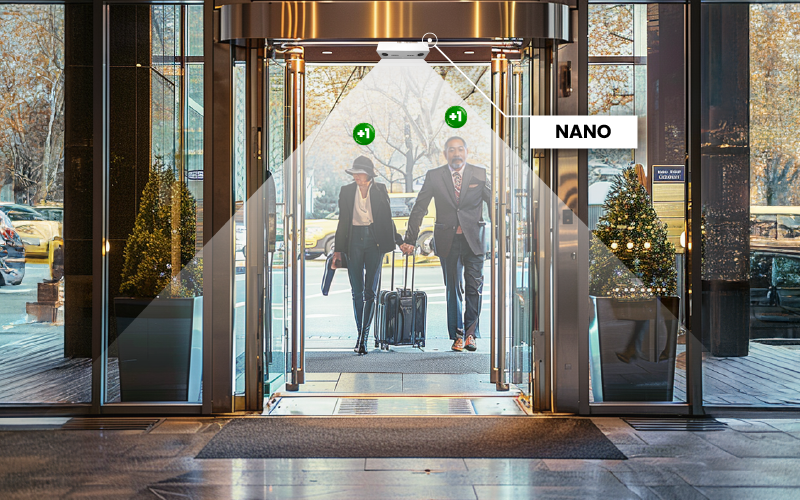
- Main entrance and porte-cochere. Nano AI mounted over the door line counts in and out separately, so you can see the net number of people in the building rather than a single turnstile figure. Where there are several entrances — street door, car-park door, conference entrance — each gets its own count and BoostBI adds them into one building total.
- Front-desk approach and queue area. A counted zone in front of the desk feeds live queue length and wait time into queue management dashboards and alerts, so a growing check-in line raises a notification before guests start commenting on it.
- Atriums and high ceilings. Nano Prime 3D stereo handles tall mounting heights and low, moody lighting — the conditions that defeat simple beam counters in a designer lobby or a dimmed cocktail bar.
- Terraces, pool decks, garden entrances and car parks. Nano Outdoor is built for weather and outdoor light, which is what the beach bar, the rooftop and the resort gate need.
- Leisure and event rooms. Door-mounted counters on the gym, spa reception, pool gate, ballroom and each breakout room give per-room occupancy and per-session attendance.
- Real-time limits. VCare displays live occupancy for a zone and can drive a screen at the spa or pool entrance, so the limit enforces itself instead of relying on an attendant with a clicker.
All of it reports into one BoostBI account, so the general manager sees the whole property and the F&B manager sees only their outlets. If you want the underlying principles rather than the hotel application, the people counting hub covers how the sensors and the platform fit together.
Hotel occupancy sensor versus room occupancy: what we count and what we do not
The phrase “hotel occupancy sensor” means two completely different things in this industry, and mixing them up leads to the wrong purchase. A room occupancy sensor is a presence detector inside a guest bedroom, usually a PIR tied to HVAC or to a housekeeping status board; it tells the building whether someone is in that room. That is not what V-Count does.
A V-Count hotel occupancy sensor counts people in public and shared areas: the lobby, the front-desk queue, the breakfast room, the restaurant and bar, the gym, the pool deck, the spa waiting area, the ballroom, the meeting rooms, the lift lobby and the outlet doors. It produces a headcount and a flow figure for a space, not a presence flag for a bedroom.
We do not install anything in guest rooms, corridors serving bedrooms, bathrooms or changing rooms.
The counting itself is anonymous. The sensors process the scene on the device and output numbers — entries, exits, occupancy, dwell. They do not store video of guests, do not recognise faces and do not build a profile that can be tied back to a named guest or a loyalty number.
For a hotel this matters twice over: it keeps the deployment straightforward under privacy law, and it is a much easier conversation with guests than camera analytics that identify individuals.
How hotels use hotel visitor analytics day to day
Counting is only interesting if it changes a rota, a layout or an invoice. Hotel visitor analytics tends to be used for a short list of very practical decisions:
- Staffing to the arrival wave, not the average. Arrival curves repeat by day of week and by season. Once you can see that Thursday check-ins pile up between 15:30 and 17:00 while Sunday spreads evenly, front-desk shifts and porter cover can be shaped around the peak instead of around a flat headcount.
- Opening a desk position before the queue forms. With a live queue figure from the front-desk zone, a threshold alert reaches the duty manager while the line is still four people long. Hotels that measure this usually discover that most of the wait is created in a handful of 20-minute windows per week.
- Sizing breakfast sittings and restaurant covers. Occupancy against seats over a morning shows whether to extend service, add a second sitting, move the buffet line or re-point staff from the pass to the floor. It also gives a defensible number for how many covers the outlet can genuinely turn.
- Billing and negotiating events honestly. Per-session attendance counts for a ballroom or breakout room support attendance-based catering charges, help price room hire for repeat organisers and settle the annual argument about whether an event really brought the numbers it promised.
- Cleaning by usage instead of by clock. Public restrooms, the gym and the pool deck can be cleaned on a visits-since-last-clean trigger rather than a fixed rota, which moves housekeeping effort to the hours that created the mess.
- Proving the value of leisure facilities. If the spa, gym or pool is being defended in a capex discussion, usage counts by hour and by season are stronger evidence than treatment revenue alone, because most guests use those facilities without spending in them.
- Understanding non-guest trade. Separating street entries into the bar, restaurant or lobby retail from internal guest traffic shows which outlets earn their own audience and whether external marketing, signage or a street-facing entrance is working.
- Managing flow in an integrated resort. In a property with a gaming floor, counts at the link corridors show how hotel guests move into the gaming and entertainment areas and at which hours; the casino people counting page covers floor-zone measurement in more depth.
- Setting and holding safety limits. Pool decks, saunas, gyms and function rooms all carry a posted capacity. Live occupancy makes that limit a working control rather than a sign on a wall.
Hostels sit in the same framework with a different emphasis: common-room and kitchen occupancy, self check-in kiosk queues and late-evening arrival patterns usually matter more than banquet attendance, but the measurement and the sensors are identical.
If you want to see what this looks like against your own floor plan, request a demo and we will walk through where counters would go in your lobby, F&B outlets and leisure areas.
Hotel people counting FAQ
Does a hotel people counter count guests, staff or everyone?
It counts everyone who crosses the counting line, because that is what capacity and queueing actually depend on. A guest, a walk-in diner, a conference delegate and a housekeeper all take up lobby space and lift capacity.
Where the split matters, hotels separate it by location rather than by identity: a staff entrance is counted on its own line, a conference entrance on another, and BoostBI reports each door separately as well as the building total. There is no attempt to tell one person from another, so the distinction is always structural, never personal.
Do you count people inside guest rooms?
No. V-Count measures public and shared areas only: lobby, front desk, F&B outlets, gym, pool, spa, meeting rooms, ballrooms, lift lobbies and entrances. We do not install sensors in guest bedrooms, in bedroom corridors, in bathrooms or in changing rooms.
A hotel occupancy sensor from V-Count reports how many people are in a space, which is a different job from the presence detector some hotels put in a bedroom to drive heating or housekeeping status. If you need the bedroom kind, that is a building-controls product, not this one.
How is this different from the occupancy percentage in our PMS?
PMS occupancy is rooms sold divided by rooms available. It tells you nothing about how many people are actually in the building at 16:00 on a Thursday. Conference delegates, restaurant walk-ins, spa day guests and visitors never appear in it, and a family of four in one room counts the same as a single business traveller.
Hotel visitor analytics measures bodies in spaces, so it explains lobby crowding, breakfast pressure and lift waiting time that room occupancy cannot. Most hotels use the two side by side.
Can it tell us how long the check-in queue is right now?
Yes. A counted zone in front of the desk produces live queue length and an estimated wait, and BoostBI can raise an alert when either crosses a threshold you set.
That turns check-in staffing into something reactive within a few minutes rather than something you review the following week. Our queue management page explains the measurement in more detail, including how wait time is derived from arrival rate and service rate.
Is this compliant with privacy law, and can guests be identified?
The sensors process the scene on the device and output counts — entries, exits, occupancy, dwell. They do not store guest video, do not perform facial recognition and do not create a record that can be linked to a named guest, a room number or a loyalty account.
Because no personal data leaves the device, deployment is straightforward in properties operating under GDPR and similar regimes. Most hotels still post a short notice at entrances, which is good practice and easy to explain to guests.
Can we bill conference organisers based on the counts?
Many properties do. Entries into each function room are counted by session, so you have an attendance figure per event rather than an organiser estimate or a badge scan that misses half the room.
Hotels use this to support attendance-based catering charges, to price repeat room hire and to settle disputes about whether an event delivered the numbers it booked for. Counts are reported per room and per time window, so a day with three overlapping breakouts is still readable afterwards.
Will it work in a dark lounge or under a high atrium ceiling?
Yes, with the right sensor. Nano AI covers standard entrance and outlet mounting heights. For tall atriums, mezzanine entrances and deliberately dim lounges and bars, Nano Prime 3D stereo handles the height and the low light where a simple beam counter fails. Outdoor doors, terraces, pool gates and resort entrances use Nano Outdoor, which is built for weather and changing daylight.
We have revolving doors and four entrances. Does that break the count?
No, it is the normal case in a hotel. Each entrance is counted independently and BoostBI sums them into one building figure, so side doors, the car-park entrance and the conference entrance are all included instead of quietly distorting the total.
Revolving doors, wide double doors and airlock vestibules are handled by positioning and by choosing a sensor with enough coverage for the opening, which V-Count settles from your floor plan and a few photos before anything is ordered.