Duty Free
Airport and border duty-free is retail with a clock attached: every shopper is a passenger with a boarding time, and the real denominator is not a high-street catchment but the stream of travellers walking past the shopfront. A duty-free people counter on each entrance and walkway line measures how many of those passing passengers actually step in – the capture rate – and then follows the flow into the liquor, tobacco, fragrance and confectionery zones and on to the tills.
V-Count sensors count anonymously above doorways, category thresholds and checkout lanes and feed BoostBI, so concession managers can line staffing up with flight banks, keep till queues shorter than the walk to the gate, and show brands what their promotional space actually delivered.
Explore the gallery showcasing our diverse range of customers. We’re proud to work with these leading brands, providing visitor analytics solutions that drive their success.


















Benefits of Visitor Analytics for Duty Free Industry
Counting passengers past the shopfront and shoppers through the door in the same breath is what gives a duty-free concession its capture rate. V-Count sensors sit on the concourse line and on every entrance, including the bypass lane of a walk-through unit, so entries can be read against the passenger flow that was genuinely available in that hour rather than against last year.
Duty-free sells to a mix that changes with every bank of departures. V-Count counts anonymously and does not infer who anyone is; the optional age and gender module adds a broad audience read, and the route mix comes from joining your hourly counts to the flight schedule. That is enough to see which departures banks respond to a fragrance activation and which ignore it.
Airside stores are staff-dense, and assistants cross the threshold dozens of times an hour restocking spirits walls and running testers. V-Count Strap Necks exclude tagged staff from the count, so capture rate and conversion reflect passengers only. Without exclusion, a busy replenishment shift looks exactly like a busy trading hour.
Zone analytics separates the liquor, tobacco, fragrance, confectionery and gifting bays and reports traffic and dwell for each. In a walk-through store the heatmap shows which bays the through-route starves; in a side store it shows how deep travellers get before they turn back. Both are layout decisions you can test rather than argue about.
A duty-free basket is abandoned the moment the till queue looks longer than the walk to the gate. Counting the checkout zone turns waiting into a live number, and threshold alerts open a second lane while the passenger is still willing to stay. Queue data read next to boarding times is the most direct revenue protection in travel retail.
Duty-free visitor analytics: what to measure in a travel retail store
Useful duty-free visitor analytics starts outside the door. A duty-free people counting system has to count the passengers moving along the concourse separately from the ones crossing the threshold, because the ratio between those two flows – the capture rate – is the number a concession lives or dies by.
Everything else in travel retail analytics builds on top of it: how deep into the store people go, how long they linger by category, how many reach a till, and how all of that shifts between one bank of departures and the next. These are the metrics worth instrumenting in an airport or land-border shop.
- Capture rate. Store entries divided by the passengers who passed the frontage in the same period. Layout changes what the number means. In a walk-through store, where the airside route is routed through the shop itself, almost everyone is technically an entry, so the honest measure becomes penetration depth – how many travellers leave the through-lane and enter the merchandising bays. In a side store off the concourse, capture rate is the biggest single lever on revenue, and a metre of shopfront or a repositioned podium moves it.
- Conversion per flight bank. Transactions divided by entries, calculated for each wave of departures rather than for the trading day. The same store can convert strongly against a 05:30 long-haul bank and poorly against a midday short-haul bank with identical staffing, and a daily average hides both.
- Dwell by category zone. Separate dwell and traffic figures for liquor and spirits, tobacco, fragrance and beauty, confectionery and gifting, and the electronics or fashion bays. Fragrance usually needs assisted selling and rewards dwell; confectionery is a grab-and-go zone where long dwell is a symptom of poor signage, not of interest.
- Till queue length against boarding times. Queue counts at the checkout line, read next to the departures board. A passenger who joins a four-deep queue twenty minutes before boarding abandons the basket. Pairing entry counts with live queue data – the same logic behind V-Count queue management – tells you when to open a second till instead of guessing.
- Route and time mix. The sensors themselves count anonymously and infer nothing about who a traveller is; the passenger profile comes from joining hourly counts to the flight schedule, so you can see which routes were in the hall when the store performed. Where an explicit audience read is wanted, V-Count offers an optional age and gender module – and nothing beyond that.
- Promotion and brand-space attribution. Traffic, dwell and pass-by for each branded podium, gondola end or activation pod. Concession fees and brand contributions are easier to defend when the exposure a brand bought is measured rather than estimated from store-wide sales.
- Multi-airport benchmarking. The same metric definitions across every terminal and border shop in the estate, so a manager in one airport can be compared fairly with another despite different passenger volumes, dayparts and layouts.
Where the sensors go in a duty-free store
Duty-free floorplates are awkward: high ceilings, glass, bright airside daylight, wide open thresholds with no physical door, and a walk-through lane that has to be counted differently from the shopping bays. Sensor placement follows the questions above rather than the building plan.
- Concourse pass-by line. A counting line across the walkway in front of the store gives the denominator for capture rate. Without it, entries are a number with nothing to divide by.
- Every entrance and exit. Walk-through stores often have two or three openings and a bypass lane; each one needs its own count, and the bypass has to be tagged so it is not mistaken for shopping traffic.
- Category zone thresholds. Virtual lines or zones at the liquor, tobacco, fragrance, confectionery and gifting bays produce the zone traffic and dwell that drive planogram decisions. Heatmap and zone analytics shows the cold corners that never get walked.
- Checkout line. A zone over the queue area turns waiting into a live number that can trigger an alert before the queue reaches the aisle.
- Staff exclusion. Duty-free stores are staff-dense, and assistants cross thresholds constantly. Excluding tagged staff keeps entries and conversion honest.
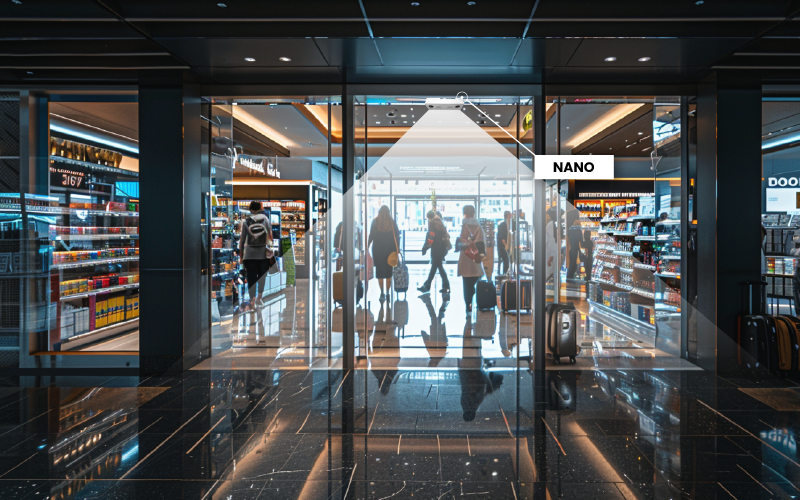
For the sensors themselves, Nano AI is the default indoor choice at store entrances and category thresholds. Nano Prime 3D stereo suits the high-ceilinged, wide, brightly backlit openings typical of a main departures-hall unit, and it is the one to use where a single device has to cover a broad walk-through lane. Nano Outdoor covers the exposed approaches at land-border and ferry-terminal duty-free, where the shopfront faces weather. VCare handles live occupancy where a terminal operator caps how many people may be inside a unit, and BoostBI is the cloud platform where all of it becomes dashboards, scheduled reports and threshold alerts. The general mechanics are covered on the people counting hub, and the terminal-wide view – security lanes, immigration halls, gates – sits on the airport people counting page.
How duty-free and travel retail operators use the data
- Roster against the flight schedule, not the clock. Hourly entry curves overlaid on departures show where the real peaks sit. Shifts get built around banks of flights, and the fragrance and spirits bays get their advisers when the passengers who buy them are in the hall.
- Fix the queue before boarding fixes it for you. Alerts on queue length and wait time let a supervisor open a lane while the passenger is still willing to wait, which is the difference between a completed basket and an abandoned one.
- Price and defend brand space. Measured pass-by, entries and dwell at a promotional podium give a concession operator a defensible basis for what a brand activation costs, and give the brand evidence of the exposure it bought.
- Re-lay the store around the through-route. Zone traffic shows which bays the walk-through lane starves. Moving confectionery to the exit run or pulling fragrance testers onto the main flow is a layout decision that can be tested and measured rather than argued.
- Judge promotions on traffic, not just till receipts. If a promotion lifted sales but entries were flat, the offer worked on people who were already inside; if entries rose and conversion fell, the message pulled browsers the range could not close.
- Benchmark the estate. Capture rate and conversion compared across terminals and airports expose the units that underperform their passenger flow, which is usually a layout or staffing problem rather than a market one.
- Report to the airport authority. Concession agreements increasingly ask for footfall evidence. Consistent, anonymous counts make the renewal conversation a data conversation.
Want to see it against your own terminal layout? Book a demo and we will walk through capture rate, zone dwell and queue alerts for a duty-free floorplate.
Duty-free people counting FAQ
What is capture rate in a duty-free store and how do I measure it?
Capture rate is the share of passing passengers who actually enter the shop: store entries divided by the people who walked past the frontage in the same period. It needs two counts, not one, so V-Count places a sensor line across the concourse in front of the unit as well as on every entrance.
BoostBI then reports capture by hour, by day and by flight bank. Without the pass-by line you only have raw entries, which tell you how busy the terminal was rather than how well the store pulled travellers in.
How does a duty-free people counter work in a walk-through store where everyone has to pass through?
In a walk-through layout almost every passenger is technically an entry, so capture rate stops being informative and penetration depth takes over. V-Count counts the through-lane separately from the merchandising bays, so you can see how many travellers stepped off the route into liquor, fragrance or confectionery rather than simply walking the corridor.
Zone dwell then shows whether they stopped or drifted. That distinction is what tells a category manager whether the store is genuinely trading or just being walked through on the way to the gate.
Can duty-free visitor analytics tell me which nationalities are shopping?
Not from the sensors. V-Count devices count people anonymously and do not identify anyone or infer nationality. What works in practice is joining hourly counts to the flight schedule: if the 07:00 bank is dominated by two long-haul routes, you know which passenger mix was in the hall when the store traded well or badly.
If you want an explicit audience read, V-Count offers an optional age and gender module, and nothing beyond that. Everything else about the traveller profile comes from your own flight and sales data, not from the counter.
How do I match staffing to the flight schedule?
Overlay the hourly entry curve from your duty-free people counting system on the departures schedule, and the peaks stop being a surprise. Most terminals produce three or four distinct banks a day, each with its own conversion pattern, so a flat roster overstaffs the quiet middle and understaffs the early wave.
BoostBI exports the hourly curve in the format workforce planning tools expect, and threshold alerts cover the days when a delay bunches two banks together and the plan needs to change in the moment.
Do the sensors record video or identify travellers?
No. V-Count sensors process images on the device and output counts, not footage. No video leaves the sensor, no faces are stored, and nobody is identified or tracked between visits, which is what makes the approach workable in an airside environment where privacy expectations and airport security rules are both strict.
The output is anonymous aggregate numbers – entries, zone traffic, dwell, occupancy – which is all a concession needs for capture rate, conversion and staffing, and which keeps the deployment straightforward to clear with the airport authority.
How do I prove to a brand that its promotional space was worth the fee?
Measure the space, not the store. A zone around the branded podium or gondola end gives pass-by, entries into the zone and dwell for the run of the activation, and a comparable period before it.
That turns a concession fee negotiation into a conversation about measured exposure rather than estimated impressions. Pairing zone traffic with till data for the promoted SKUs shows whether attention converted, which is also the evidence a brand needs internally to renew the space for another season.
Can I compare the same retailer duty-free stores across several airports?
Yes, and it is one of the main reasons operators instrument the estate. Because every unit uses the same sensor logic and the same metric definitions, capture rate, conversion, zone dwell and queue wait are directly comparable between terminals and countries.
BoostBI groups locations so a regional manager sees the whole portfolio in one view and can spot the unit converting below its passenger flow. That is normally a layout, range or staffing problem, and the benchmark is what makes it visible.
How do I stop till queues from costing me sales before boarding?
Treat queue length as an operational trigger rather than an end-of-month report. A zone over the checkout area counts how many people are waiting, and an alert fires when the queue passes the threshold you set, so a supervisor opens a second till while the passenger is still willing to wait.
Because duty-free shoppers abandon baskets the moment the queue looks longer than the walk to the gate, the payback is immediate. See V-Count queue management for how the thresholds and alerts are configured.