V-Count vs RetailNext:Choose the Right Fit for Your Stores
Choose V-Count Nano AI and BoostBI for entrance measurement, conversion analysis and weekly store-manager guidance. Evaluate RetailNext when your brief also calls for integrated video and asset protection. Compare the installed configuration, data connections and complete price before deciding.
See V-Count in a Live Demo →V-Count Editorial · Reviewed 19 September 2026
A V-Count-authored comparison using linked primary vendor sources.
Two Platforms, Different Buying Priorities
Both vendors supply their own hardware and analytics. Start with the decisions your store teams need to make and the functions your quote must include.
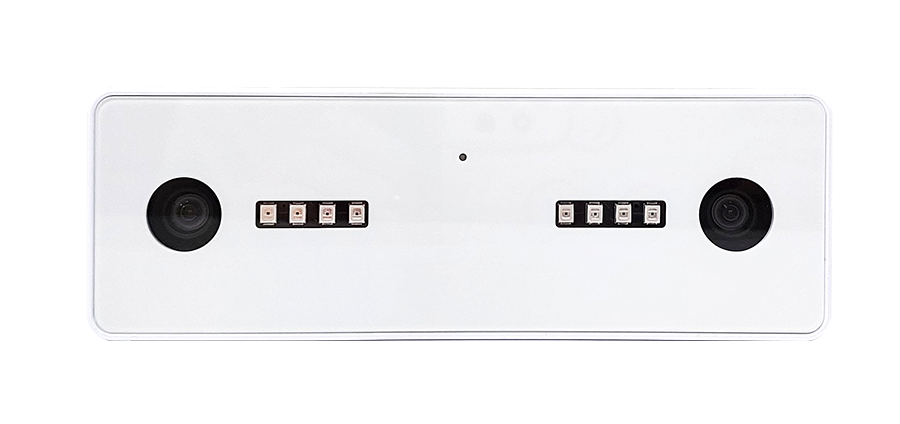
*Nano AI specifications refer to people counting. Validate coverage, lighting and traffic at the intended mounting position; optional demographics and staff-exclusion functions can have different operating requirements. Source ↗ · Source ↗.
What RetailNext Is, and Why It Is Compared With V-Count
A neutral summary of the vendor, using publicly available information only. Where a detail is not published, this page says so instead of estimating it.
RetailNext is a retail analytics company headquartered in the United States. Its published business is in-store analytics for retailers: sensors installed at store entrances and inside the shop floor, combined with a hosted cloud platform that reports shopper traffic, in-store movement and store performance metrics such as conversion.
Retailers buy it through a sales process rather than a self-service sign-up, and commercial terms are published on request rather than on a public price list. This page does not quote RetailNext prices, accuracy figures or customer names, because those are not published in a form that can be verified independently.
V-Count competes in the same category with a different emphasis. The hardware line is Nano AI for AI-based entrance counting, Nano Prime for 3D stereo counting and Nano Outdoor for exterior and covered-entrance counts, reported through the BoostBI analytics platform, with VCare for live occupancy. If you are still deciding which technology you need before you shortlist vendors, start with people counting and retail store analytics.
RetailNext platform and login
Both vendors deliver reporting through a browser-based platform that store managers and head-office analysts sign in to. The RetailNext platform and login are for existing RetailNext customers and are reached from the vendor’s own website; V-Count has no access to it and cannot reset credentials for it.
The V-Count equivalent is BoostBI, where the same roles see traffic, conversion, dwell and heatmap reporting, with user permissions set per store or per region.
RetailNext vs V-Count at a Glance
The dimensions buyers ask about first. V-Count entries name the actual products you would be quoted. RetailNext entries state only what the vendor publishes; everything else is marked not published, which means ask them, not that it is missing.
| Dimension | V-Count | RetailNext |
|---|---|---|
| Sensor types offered | Nano AI (AI entrance counting), Nano Prime (3D stereo), Nano Outdoor (exterior and covered entrances) | Sensor hardware sold with the platform; the current model line-up is listed on the vendor’s own site |
| Cloud analytics platform | BoostBI — traffic, conversion, dwell, heatmaps, store and regional views | Hosted cloud analytics platform with in-store reporting |
| Queue measurement module | Yes — queue and wait-time analytics on the same sensors | Not published; confirm module availability with the vendor |
| Occupancy / live capacity | VCare real-time occupancy with in-store display options | Not published; confirm with the vendor |
| Demographics (gender and age) | Optional anonymous gender and age recognition module | Not published; confirm with the vendor |
| Deployment model | Sensors on site with on-device processing; analytics in the BoostBI cloud | Sensors on site with a hosted cloud platform |
| Ideal store size | One entrance upwards — a single store and a several-hundred-store chain use the same hardware and platform | Published positioning is multi-store and enterprise retail; ask about minimums for a single site |
| Pricing model | Hardware purchase plus a per-sensor BoostBI subscription; structure explained on V-Count pricing | Not published — available on request from the vendor’s sales team |
| Data ownership and privacy | On-device processing, non-identifiable analytics outputs, your data exportable by REST API and scheduled reports | Privacy documentation is published on the vendor site; confirm retention and ownership terms in the contract |
Retail Next vs NXT: they are not the same thing
These two names are regularly confused in search results and in procurement documents, so it is worth separating them before you compare anything. RetailNext, written as one word, is the retail analytics company described above. “NXT” is a short brand and model suffix used by a number of different companies inside and outside retail technology; it is not an abbreviation of RetailNext and it does not describe a single product category.
If a datasheet, quotation or RFP line refers to “NXT”, check the legal company name on the document before you place it in a comparison, because the specifications behind the two names are unrelated. V-Count writes its own product names out in full — Nano AI, Nano Prime, Nano Outdoor, BoostBI and VCare — so a quotation is unambiguous.
For a like-for-like look at another frequently compared vendor, see V-Count vs ShopperTrak.
Compare the Configuration You Will Actually Use
A published feature is not automatically enabled in every package. Ask both suppliers to confirm the quoted model, software functions and acceptance test.
| Buyer requirement | V-Count: Nano AI + BoostBI | RetailNext: Aurora + platform |
|---|---|---|
| Hardware | Nano AI: dedicated 3D people counting with onboard processing. Source ↗ | Aurora: stereo analytics, edge processing and video capabilities. Source ↗ |
| Counting accuracy | Up to 99%; validate your entrance and counting rules. Source ↗ | Published range of 95–99%, with installation audits. Source ↗ |
| Mounting and coverage | 2.2–7 m for Nano AI people counting. Confirm width, lens coverage and optional-feature limits. Source ↗ | Confirm height, lens and coverage for the quoted Aurora model; the reviewed brief does not give a maximum. Source ↗ |
| Counting in darkness | 0 lux using built-in infrared LEDs. Source ↗ | Minimum lux is not specified in the reviewed brief; ask for the proposed low-light configuration. Source ↗ |
| Staff exclusion | Three methods; select the compatible method and BoostBI sublicence. Source ↗ | Staff exclusion is available; the Aurora brief describes UWB. Source ↗ |
| Gender and age | Gender and age estimation in the same Nano AI sensor, with the appropriate configuration and licence. Source ↗ | Gender demographics documented; age estimation not confirmed in the reviewed sources. Source ↗ |
| Manager guidance | AI Sales Coach: weekly store-specific guidance in BoostBI. Source ↗ | Pulse AI conversational analytics and staffing predictions are documented. Source ↗ |
| Privacy and data flow | On-device processing with non-identifiable analytics outputs. Review integration data, retention and access. Source ↗ | Configurable privacy controls and video functionality. Review the configuration and retention. Source ↗ |
| Commercial model | Hardware purchase + BoostBI per-sensor subscription, including selected sublicences. Source ↗ | Subscription includes Aurora hardware; site-specific services can add cost. Source ↗ |
| Integrations | Native Shopify and Nebim; other working integrations and scoped REST API connections. Source ↗ | POS integrations and API access documented; confirm specific systems. Source ↗ |
Unspecified means the reviewed source does not establish the detail, not that a vendor lacks the capability. Counting accuracy is separate from demographic or staff-exclusion accuracy.
Turn Better Visitor Data Into Store Decisions
V-Count brings entrance measurement and an actionable reporting workflow together. These are three benefits to demonstrate with your own retail team.
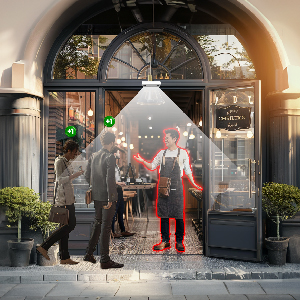
Keep Staff Movements Out of Customer Counts
Where staff repeatedly cross the entrance, V-Count’s three exclusion methods give you options for protecting the visitor denominator. Choose the method that fits your team and validate it separately from total crossing counts.

Measure Entrances With Changing Light
Nano AI’s built-in infrared LEDs support people counting at 0 lux. Include your darkest trading conditions in the test and confirm coverage at the proposed height, especially where a high ceiling or wide doorway affects placement.
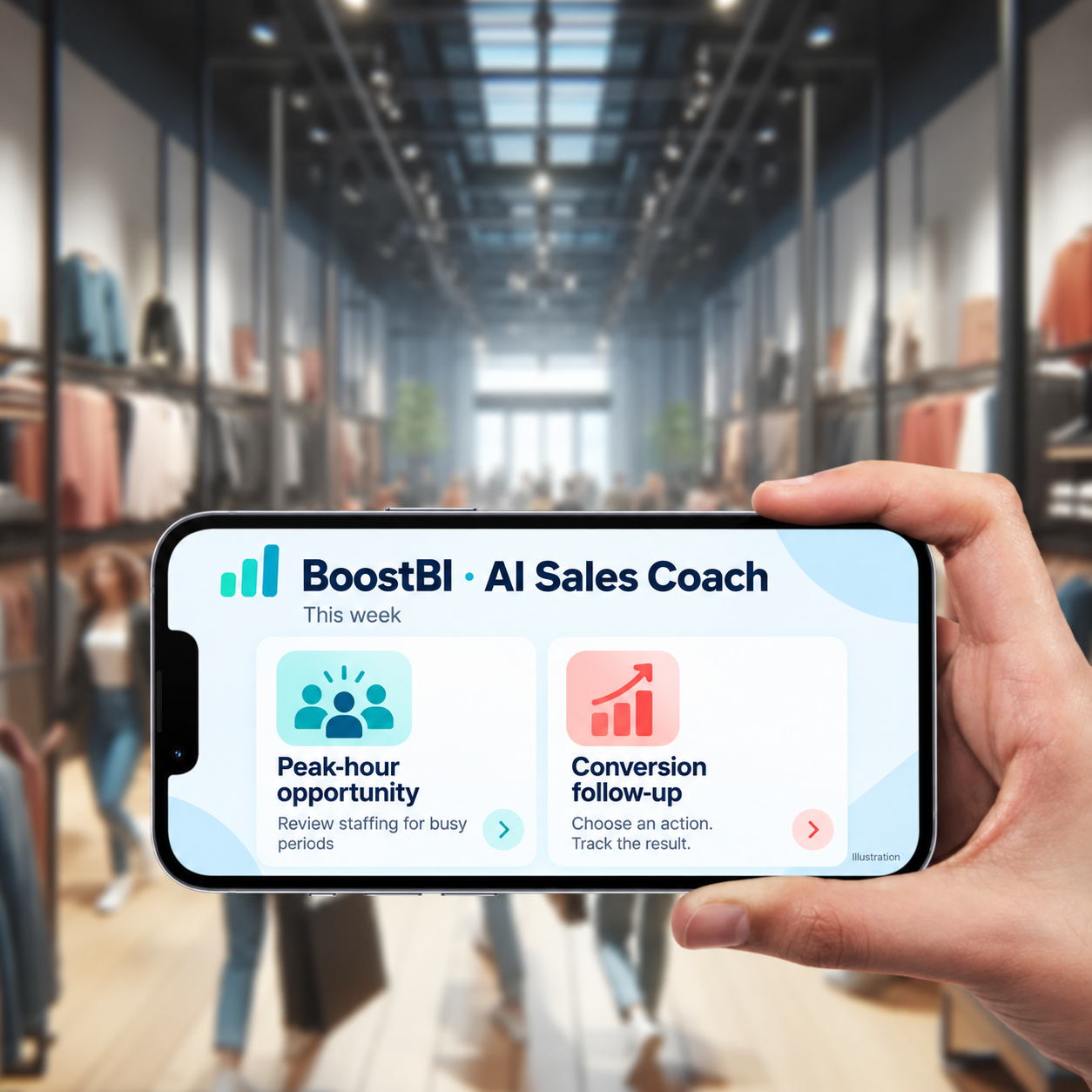
Give Managers a Weekly Next Step
BoostBI’s AI Sales Coach uses available store data to provide weekly guidance. Managers can choose a staffing or conversion action, review the result and keep improving the operating routine.
Connect Footfall With the Systems You Already Use
For conversion reporting, V-Count supplies the visitor measurement and connects it with compatible sales data in BoostBI. Native Shopify and Nebim connectors are available; VendPOS, Nayax, ImagineX and QuickBooks are working integrations. Manual sales import and scoped REST API connections provide further routes. Review BoostBI integration options.
RetailNext also documents POS integration and API access. Confirm the supported system and fields rather than treating “has an API” as proof that a particular loyalty, inventory or ERP workflow is ready. Footfall is anonymous visit data; matching it to named loyalty customers would be a separate project with its own data requirements.
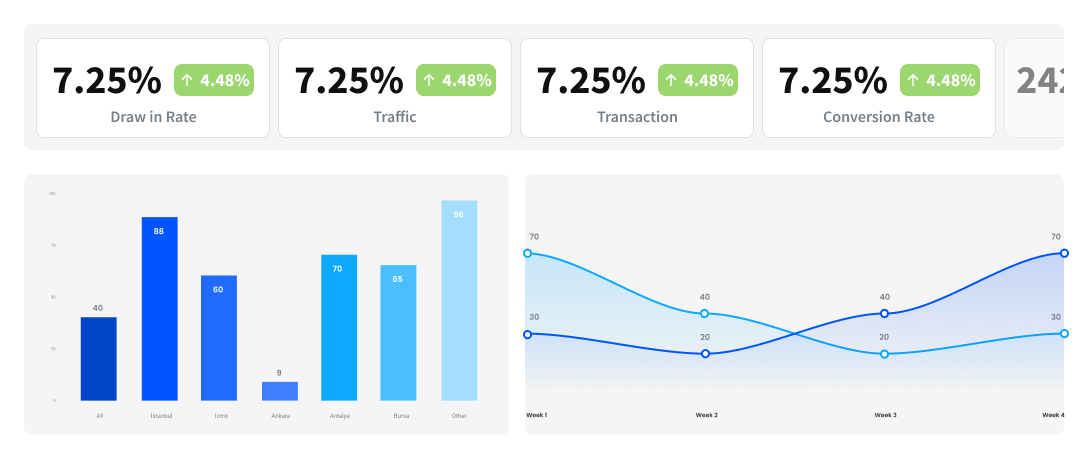
Agree the reporting rules before comparing results
Purchase conversion = eligible purchase transactions ÷ eligible store visits × 100. Match store IDs, time zones and complete reporting periods. Define returns, cancellations, repeat entries, staff exclusion and group counting consistently. Visit counts do not automatically represent unique shoppers.
BoostBI typically refreshes every 10 minutes; enabled real-time configurations can refresh as frequently as every minute. POS arrival time is separate. Confirm data-gap handling, historical imports, export formats and who supports each connection before the rollout.
Compare the Same Entrances Over the Same Term
V-Count’s public ranges are $299–$799 per sensor, one-time, and $9–$49 per sensor per month for BoostBI. The quoted BoostBI rate includes the selected sublicences; API access, staff exclusion, demographics, queues and heatmaps are not all enabled at every price point. Check current V-Count pricing and request a configuration-specific quote.
RetailNext’s current estimator calculates a subscription from store locations, entrances, industry, region and existing technology. Aurora hardware is included. Its pricing page identifies installation, custom mounting, cabling and custom integrations as possible additional costs. Use the RetailNext pricing source for current inclusions.
Comparable project cost = hardware not included in the subscription + installation and site work + subscription over the agreed term + integration and support charges + applicable delivery and taxes.
Ask for these assumptions in writing
- Coverage: stores, entrances, width, mounting height, sensor quantity and any separate zone or queue coverage.
- Power and network: Nano AI’s 5V supply and external PoE option, mounting accessories, cabling and site readiness.
- Reporting: enabled analytics, API rights, POS connector, historical data, exports and refresh frequency.
- Commercial terms: currency, billing period, minimum term, renewal, hardware ownership, warranty and any installation or integration charges.
- Support: remote and onsite responsibilities, response targets, regional coverage and handover training.
Use the people-counting provider buyer guide for a broader shortlist and a consistent requirements checklist. V-Count can turn that checklist into a Nano AI and BoostBI proposal for your stores.
Prove the Fit at a Representative Entrance
- Agree the objective. Choose traffic reporting, staffing, conversion or another defined decision. Select the V-Count hardware and BoostBI functions needed to support it.
- Check the site. Record height, width, lighting, obstacles, power and connectivity. Confirm mounting and coverage before installation.
- Validate the counts. Compare entry and exit events against the same independently observed reference, including peak traffic, groups and staff crossings. Record missed and extra counts separately.
- Reconcile the reports. Test POS mappings, time periods and exclusions. Agree acceptable data completeness and who fixes missing information.
- Plan the handover. Confirm historical-data export rights, the existing contract, support contacts and manager training before expanding to more stores.
A pilot determines your installed performance. Neither a product headline nor a customer story establishes a guaranteed conversion uplift for a new retailer.
RetailNext Alternatives
Retailers who compare RetailNext usually shortlist these people counting and retail analytics vendors:
V-Count: Nano AI 3D sensors with up to 99% accuracy for entrance counting, BoostBI analytics with a weekly AI Sales Coach, and published pricing of US$299–799 per sensor plus US$9–49 per sensor per month.
ShopperTrak: Sensormatic’s retail traffic analytics, with Orbit sensors and traffic benchmarks.
Xovis: a Swiss maker of 3D people counting sensors.
FootfallCam: people counting hardware and software, founded in the UK in 2002, with offices in the UK and Malaysia.
Compare V-Count with each: V-Count vs ShopperTrak, V-Count vs Xovis and V-Count vs FootfallCam.
V-Count vs RetailNext: Buyer Questions
Which shopper analytics solution fits a mid-sized retailer?
Which RetailNext-style analytics features should a small retailer prioritise?
How do V-Count and RetailNext integrate with POS, loyalty and inventory systems?
How do ShopperTrak, RetailNext and V-Count compare for retail analytics?
How should I compare V-Count and RetailNext pricing?
Can I move from RetailNext to V-Count?
What features does RetailNext offer for retail analytics?
RetailNext publishes an in-store analytics platform covering shopper traffic counting, in-store movement and store performance reporting, delivered through a cloud dashboard with sensors at entrances and inside the store. Which specific modules are enabled in a given quote is not published as a fixed list, so ask for the enabled feature set in writing before comparing.
V-Count’s equivalent set is concrete: Nano AI or Nano Prime at the entrance, Nano Outdoor for exterior counts, BoostBI for traffic, conversion, dwell and heatmap reporting, VCare for live occupancy, and an optional anonymous gender and age module. See retail store analytics.
What is RetailNext and what does it do?
RetailNext is a United States-based retail analytics company. It sells in-store sensors together with a cloud analytics platform so retailers can count visitors entering a store, see how traffic moves through it, and report metrics such as footfall and conversion for a single store or a whole chain.
It is bought through a sales process rather than self-service, and pricing is published on request. V-Count addresses the same need with Nano AI sensors and BoostBI, adding queue measurement and VCare live occupancy on the same devices.
Start with people counting for the underlying technology.
What are the key differences between Retail Next and NXT when it comes to in-store analytics?
They are not two versions of one product, and the names are frequently confused. RetailNext, written as one word, is the retail analytics company described on this page. “NXT” is a short brand or model suffix used by several different companies inside and outside retail technology; it is not an abbreviation of RetailNext.
If a datasheet, quotation or RFP mentions “NXT”, check the legal company name on the document before placing it in a comparison, because the specifications behind the two names are unrelated. V-Count writes its products out in full — Nano AI, Nano Prime, Nano Outdoor, BoostBI, VCare — so quotations stay unambiguous.
Is RetailNext suitable for small businesses or large retailers?
RetailNext’s published positioning is enterprise and multi-store retail: chains with several locations, a head-office analytics function and an existing procurement process. Whether a single site or a small chain qualifies depends on minimum contract terms that are published on request, so ask directly rather than assuming either way.
V-Count is deliberately sold at both ends of that range. One entrance with a single Nano AI sensor and a BoostBI licence is a valid starting configuration, and the same hardware and platform scale to hundreds of stores without re-platforming later.
What are the pricing plans for RetailNext?
V-Count publishes fixed price ranges (US$299–US$799 per sensor, paid once, plus BoostBI at US$9–US$49 per sensor per month); RetailNext sells a subscription and gives an instant online estimate per store.
RetailNext’s pricing page asks for the number of stores, entrances per store, store type, region and current technology, then shows a cost per store per year and the number of sensors. The subscription includes Aurora sensors, desktop and mobile platform access, software licences and updates, an unlimited Aurora hardware warranty, annual audits and access to Benchmarks market data.
RetailNext lists costs that may be added: installation priced by site complexity, cabling and network work, shipping, taxes and import duties, special mounting hardware and custom integrations beyond standard POS connections.
Compare like for like over three years: V-Count hardware is a one-time purchase plus BoostBI per sensor per month, while RetailNext bundles its sensors into the subscription. See V-Count pricing.
How do Retail Next platforms integrate with POS, loyalty programs, and inventory systems?
V-Count BoostBI connects sales through native Shopify and Nebim connectors, working integrations for VendPOS, Nayax, ImagineX and QuickBooks, manual sales import or a scoped REST API, and exports traffic to the BI tool where loyalty and inventory data usually live.
RetailNext’s pricing page includes standard POS connections in its subscription and prices custom integrations beyond those separately. Ask RetailNext which POS, loyalty and inventory systems are covered as standard for your stores, which way the data flows and how often it refreshes.
Whichever platform you choose, join data on store ID and date, and agree how returns, staff and opening hours are treated before comparing stores.
Which features should I look for in a Retail Next–style analytics platform for a small business?
V-Count suggests six features for a small business: accurate entrance counting (Nano AI, up to 99%), staff exclusion (lanyard, shoulder tag or mobile app), conversion from connected sales, a mobile app for owners, published pricing and simple installation.
RetailNext-style platforms add in-store paths, video and asset-protection features that larger chains use. A small business usually gets most of the value from traffic, conversion and staffing reports, so check which features you would pay for but not use.
V-Count fits small stores with published pricing (US$299–US$799 per sensor, paid once, plus BoostBI at US$9–US$49 per sensor per month), Wi-Fi sensors on 5 V USB-C, and placement advice within 24 hours from a floor plan and photos taken by the store manager.
What are the best RetailNext alternatives?
V-Count is a RetailNext alternative built around its own people counting sensors: Nano AI counts entrances with up to 99% accuracy from US$299 per sensor (paid once), and BoostBI reports traffic, conversion and occupancy from US$9 per sensor per month, with an open REST API.
Other vendors often compared with RetailNext include ShopperTrak, Xovis and FootfallCam. Compare them on accuracy against a manual count at your own entrance, total cost per entrance and how the data reaches your POS and BI tools.
Primary Sources Behind This Comparison
Reviewed 19 September 2026 by V-Count Editorial. Pricing and product scope may change. Confirm the named model and selected functions in a current proposal.
- V-Count Nano AI product information
- BoostBI capabilities and integrations
- V-Count pricing
- People-counting provider buyer guide
- RetailNext Aurora sensor
- Aurora technical product brief
- RetailNext pricing and inclusions
- RetailNext Traffic Analytics
- RetailNext demographic feature summary
- RetailNext platform and AI comparison
- FootfallCam V9 integrations
- Sensormatic ShopperTrak Traffic Insights
See V-Count on Your Own Store Requirements
Bring your entrance dimensions, reporting goals and POS system. We’ll show you how Nano AI and BoostBI can support your next store decision.