People Counters for Spa Centers
A spa visitor counter does more than tally heads at the front door. It tells you how many guests are in the pool hall, the sauna corridor and the relaxation rooms at this moment, how long they linger in each, and whether the group sitting in reception is about to turn into a complaint.
V-Count sensors sit above the entrance, the changing-room corridors and the doorway of every quiet or wet zone, counting anonymously with no faces, no names and no images kept. That lets a spa hold each area inside its comfort and licence capacity, roster therapists and attendants against the real arrival curve, and clean by how much a room was used rather than by the clock.

Explore the gallery showcasing our diverse range of customers. We’re proud to work with these leading brands, providing visitor analytics solutions that drive their success.


















Why People Counting Matters for Spa Centers
Monitor Client Flow
Understand peak hours and client flow to optimize staff scheduling and reduce wait times.
Maximize Service Efficiency
Use dwell time data to identify areas where clients spend the most time, allowing you to enhance those spaces for a better customer experience.
Improve Customer Retention
Analyze repeat visit patterns to offer personalized promotions and loyalty programs that keep clients coming back.
Enhance Marketing Strategies
Tailor your marketing efforts based on real data about your clientele, including demographics and visit frequency.
Key Features of People Counters for Spa
Real-Time Visitor Counting
Track the number of clients entering and leaving your spa in real-time. Adjust staffing levels and resources based on actual foot traffic.
Dwell Time & Zone Analytics
Identify which areas of your spa clients are drawn to the most. Optimize the layout and service delivery in high-traffic zones for maximum impact.
BoostBI Dashboard
Gain access to an intuitive dashboard that compiles all your data into easy-to-read insights. Make informed decisions to improve the overall performance of your spa.
Sales Coach
Use the Sales Coach feature to receive actionable insights on how to upsell services, improve staff performance, and increase overall revenue.

Spa visitor counter: what a wellness centre should actually measure
A spa people counter earns its place when it answers the questions a till roll cannot: how many guests are in the pool hall right now, whether the sauna corridor has drifted over its comfort limit, how long people stay in the relaxation room, and how many are still waiting at reception for a locker key. Counting the front door alone gives you the day’s total.
Counting zone by zone tells you how the day felt to the guest — which is what drives the review, the rebooking and the membership renewal.
These are the measurements spas, day spas, thermal baths, hotel spas and wellness centres manage week to week:
- Live occupancy per zone against comfort and licence capacity. The pool hall, sauna, steam room, hammam, relaxation lounge, treatment corridor and gym each have a number above which the experience degrades, and usually a separate figure set by your licence, insurer or fire officer. A zone-level count gives you both, live, instead of a guess from the duty manager.
- Reception and changing-room queues. Wait time at check-in, at locker and robe issue, and at the treatment handover point — the three places a relaxing visit starts badly.
- Dwell per zone. How long a guest stays in the sauna suite versus the relaxation room versus the pool tells you whether your quiet space is big enough and whether a zone is being used the way it was designed.
- Entry mix: day pass, member and hotel guest. Counting at the entrance and at the internal doorways, and matching the curve against your booking system, shows how much of the peak is day-pass traffic that you can throttle and how much is resident hotel guests you cannot.
- Arrival curve by hour and weekday. Therapists, lifeguards and changing-room attendants are the largest controllable cost in the building, and they are rostered weeks ahead on a pattern most spas have never measured.
- Usage between cleaning cycles. Counts per changing room, per wet zone and per relaxation area since the last clean, so housekeeping is triggered by traffic rather than by a fixed rota.
- Capture rate for the café, retail shelf and treatment desk. Of the guests who entered today, what share walked into the café or stopped at the product display? That single ratio is the honest measure of whether your secondary spend areas are in the right place.
Spa queue management at reception, lockers and treatment handovers
Spa queue management is a different problem from a supermarket checkout. Nobody queues to pay; they queue to be let in, to be given a robe and locker, to be collected for a treatment, and sometimes to get into a sauna session that runs to a timetable.
Arrivals bunch hard against appointment slots on the hour and half hour, and a hotel spa adds a second bunching pattern around check-in and breakfast.
Counting at those three points turns the problem into something you can roster against. Sensors over the reception approach measure how many people are waiting rather than how many are being served, so you know when a second front-desk position needs opening — usually fifteen minutes before the queue becomes visible.
Counts at the changing-room corridors show whether lockers or robe issue is the real bottleneck. And a count at the treatment corridor shows how often guests are left sitting past their slot time, which is the failure guests actually write about.
Our queue management tooling turns those live counts into wait-time estimates and threshold alerts, so the duty manager is told to open a second desk instead of discovering it later in a report.
Where the sensors go in a spa, and which ones survive the environment
Spa buildings are awkward: glass, water, steam, low light, candlelight, high ceilings over the pool and heat that no electronics belong in. Placement matters more here than in almost any other venue.
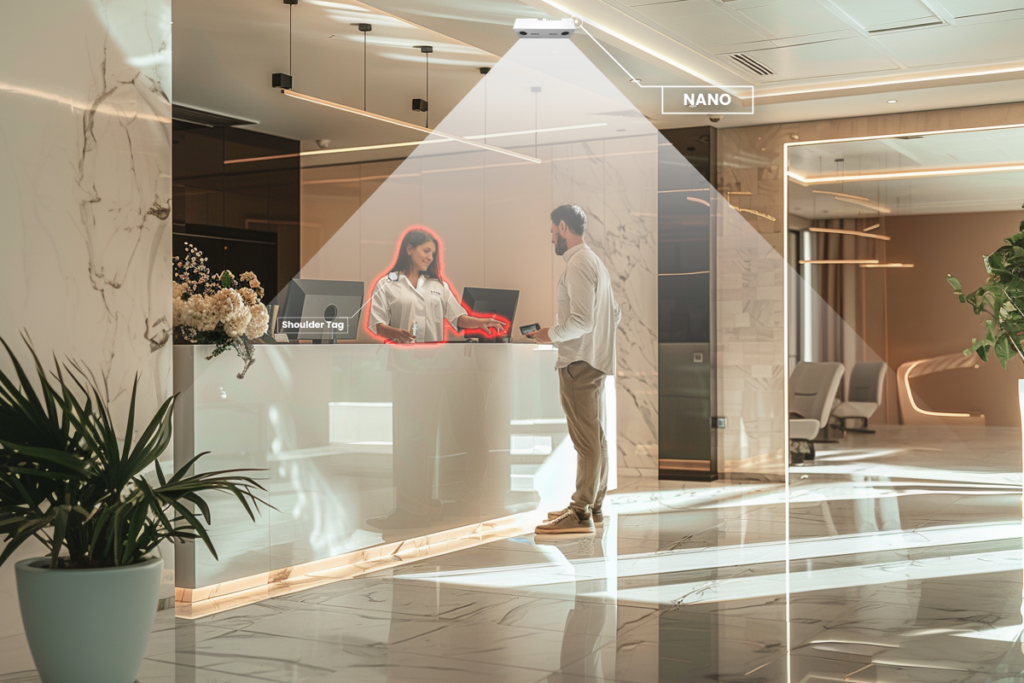
- Main entrance and reception. Nano AI overhead at the door gives the day’s in and out totals and the arrival curve that everything else is built on.
- Pool halls and double-height spaces. Where the ceiling is high, the light is dim or the floor is reflective, Nano Prime 3D stereo counting handles the geometry that a standard camera height cannot.
- Zone doorways. Sauna suite, steam room, hammam, relaxation lounge, gym and treatment corridor each get a sensor at the threshold, not inside the room. You get occupancy and dwell for the zone while the hardware stays in dry, temperate air.
- Wet and hot areas — be careful. Do not mount sensors inside saunas, steam rooms or directly over a pool edge. Count the doorway from the dry side instead. For genuinely outdoor areas — an outdoor pool deck, a thermal terrace, a garden relaxation area — Nano Outdoor is built for it, with an IP65 waterproof design and a stated temperature tolerance of −25 to 60 °C. That rating is for outdoor weather, not for sauna interiors, so a sauna cabin still gets a doorway count rather than an internal one.
- Live occupancy display. VCare shows the current number for a zone on a screen or on the reception dashboard, so guests and staff can both see whether the pool hall is full before anyone walks down there.
- Reporting. All of it lands in BoostBI, where zone occupancy, dwell, queue and capture rate sit on one dashboard with threshold alerts by email or on screen.
Counting guests anonymously — privacy belongs in a spa
Guests in a spa are in swimwear or a robe. Anything that looks like surveillance is a problem, and in many markets it is also a legal one. V-Count sensors process the scene on the device and output a number: a person crossed a line, a person is present in a zone.
No facial recognition, no identification, no image or video stored or sent to the cloud. Nobody is recognised between visits and nothing leaves the sensor that could identify a guest, which is what lets you put a counter over the changing-room corridor at all.
It is worth telling guests this plainly on the signage — “we count, we do not record” — because the question will be asked.
How operators turn wellness centre visitor analytics into decisions
The point of wellness centre visitor analytics is not the dashboard; it is the six or seven recurring decisions a spa manager makes with worse information today.
- Rostering therapists and attendants. Build the rota from the measured arrival curve for each weekday rather than from last year’s assumption. Most spas find their real peak is an hour off where they thought it was, and that one weekday is carrying a shift it does not need.
- Holding capacity without policing it. Set a comfort threshold per zone below the licence limit and let the alert fire first. Staff intervene by pacing entry to the sauna suite or opening a second relaxation area, long before anyone has to turn guests away at the door.
- Releasing day passes with confidence. If you know how many hotel guests and members are already inside on a given afternoon, you can sell day passes into the gap instead of capping them defensively and leaving revenue on the table.
- Cleaning by usage. Trigger a changing-room or wet-zone clean at a count threshold rather than every two hours. Busy afternoons get more attention, quiet mornings stop consuming labour for nothing.
- Proving what a refit or a new zone did. Compare dwell and zone entries before and after adding a salt room, moving the product display or reconfiguring the loungers. Footfall in, dwell per zone, capture rate out.
- Growing secondary spend. Capture rate for the café and retail shelf against total entries shows whether the problem is traffic or positioning — and whether a promotion changed either.
- Comparing sites. Groups with several spas can rank locations on visitors per opening hour, dwell and capture rate on the same basis, which makes a weak site obvious without an inspection visit.
Every one of those decisions runs off the same sensors. If you want to see the zone occupancy and queue views against your own floor plan, request a demo and we will walk through a spa layout with you.
Spa people counting FAQ
How many people should be in each spa zone at once?
There is no universal number — it is set by your licence, your insurer and by the point at which the experience stops being relaxing, and the second figure is usually lower than the first. The practical approach is to record the legal limit for each zone, then set a comfort threshold underneath it.
A zone-level count at the sauna suite, pool hall and relaxation lounge gives you the live figure against both lines, and BoostBI alerts staff when a zone passes the comfort threshold so they can pace entry before the legal limit is anywhere near.
Can I measure sauna and steam room use without putting hardware in the heat?
Yes, and you should. Sensors are mounted at the doorway on the dry, temperate side rather than inside the cabin. Counting entries and exits at the threshold gives you occupancy and dwell for the sauna or steam room just as accurately as an internal sensor would, without exposing electronics to heat and moisture they are not rated for.
Nano Outdoor’s IP65 rating and −25 to 60 °C tolerance cover outdoor pool decks and thermal terraces; a sauna interior is a different environment and still gets a doorway count.
How do I separate day-pass visitors, members and hotel guests?
The sensors count everyone who crosses a line; the separation comes from matching those counts against what your booking and access systems already know. Hotel-guest and member entries are usually recorded at check-in or by wristband, so subtracting them from the measured total at the spa entrance leaves the day-pass and walk-in flow.
Once you can see the three curves over a week, you know which part of your peak is fixed and which part you can move by adjusting when day passes are released.
Where exactly do queues form in a spa, and can counting fix them?
Three places: the reception approach, robe and locker issue in the changing rooms, and the treatment handover point. Counting people waiting at each — not people being served — gives an early warning roughly a quarter of an hour before a queue becomes visible from the desk.
Thresholds trigger an alert to open a second reception position or move an attendant to the changing rooms. Over weeks, the same data shows whether your appointment slot pattern itself is creating the bunching.
Will counting work in steam, dim light and candle-lit relaxation rooms?
Spa lighting is the reason sensor choice matters here. V-Count sensors do not rely on ambient light the way a simple camera count does, and Nano Prime’s 3D stereo counting is designed for high ceilings, reflective floors and low-light areas such as pool halls and relaxation lounges.
The one thing to avoid is mounting a sensor where steam or spray reaches it directly: position it at the doorway or at the dry edge of the zone and the environment stops being a factor.
Can visitor counts tell housekeeping when to clean?
That is one of the fastest payoffs. Instead of cleaning changing rooms and wet zones on a fixed rota, set a threshold on the number of guests through each area since the last clean and let the system raise the task when the count is reached.
Busy Saturday afternoons get more frequent attention, quiet weekday mornings stop consuming labour for rooms nobody used, and you have a record of usage per zone if a hygiene question is ever raised.
How do I measure whether spa guests are reaching the café and retail shelf?
Put a counter at the café entrance and at the retail area, then divide those counts by total spa entries for the same period. That capture rate is the number to manage.
If it is low while footfall is healthy, the problem is position or visibility rather than traffic, and moving the display or changing the exit route will show up in the ratio within a week. Compare the rate before and after any change rather than looking at sales alone.
Can guests see how busy the spa is before they walk down?
Yes. VCare takes the live zone count and displays it on a screen at reception, in the changing-room corridor or on an internal app, showing the pool hall or sauna suite as free, filling or full.
Guests self-select quieter zones and staff stop being asked how busy it is. The same live figure drives the threshold alerts behind the scenes, so one set of sensors serves both the guest-facing display and the operational side.