People Counter Rental
for Events, Pop-Ups and Pilots
A people counter for rent gives you the same sensors and the same BoostBI analytics as a fixed deployment – for three days at a trade show, six weeks in a pop-up or one season on a high street.
Not every counting project deserves a permanent installation. If you need visitor numbers for three days at a trade show, six weeks in a pop-up or one season on a high street, a people counter for rent gives you the same sensors and the same BoostBI analytics as a fixed deployment, but only for the length of the project.
This page covers who uses V-Count people counter rental services, what a short-term deployment includes, how a rental runs from site plan to post-event report, and how it is priced – quoted per event rather than published, because the number of sensors, the number of days and the reporting you need all move the figure.
If the technology itself is new to you, start with what a people counter is and the people counting hub, then come back here for the short-term commercial side.
Who rents people counters, and why
Renting makes sense whenever the counting need has an end date. The venue is temporary, the budget is a project budget rather than a capital line, or you are trying to prove something before you commit. In practice we see the same handful of situations.


- Exhibitors and stand holders. A stand at a trade show exists for three or four days. Counting the people who cross the stand line is the only honest way to separate footfall from the conversations your team remembers, and it turns the stand into a measurable line item rather than a feeling. Our events, exhibitions and trade shows page goes into what to measure at stand and hall level.
- Event organisers and venue operations teams. Gate throughput per hour, hall occupancy against the safety limit and the shape of the arrival curve all matter while the doors are open, and again in the report that goes to exhibitors and sponsors afterwards.
- Pop-up shops and brand activations. A unit taken for six weeks still needs a conversion rate. Counting entries next to transactions is the difference between reporting a successful activation and proving one.
- Festivals and outdoor public events. Open-air entrances, temporary gates and weather mean the sensors have to survive the site as well as count on it.
- Pilots and proof of concept. Multi-site organisations often want real curves from two or three of their own buildings before signing off a rollout. A short-term deployment produces that evidence instead of a vendor projection.
- Seasonal peaks. A garden centre in spring, a ski resort base area in winter, a retail site over the holiday period – sites that only have a traffic or capacity problem for part of the year can add counting on the entrances that matter for that window.
- Councils, BIDs and urban studies. Pedestrian counts on a street, a square or a park are usually commissioned as a study with a start and an end, not as permanent infrastructure.
What a people counter rental includes
A rental is scoped the same way as a permanent deployment: sensors sized to the entrances, an analytics workspace open for the period, and a way to get the data out at the end. The elements below are what a typical V-Count short-term package covers.
Sensors matched to the site
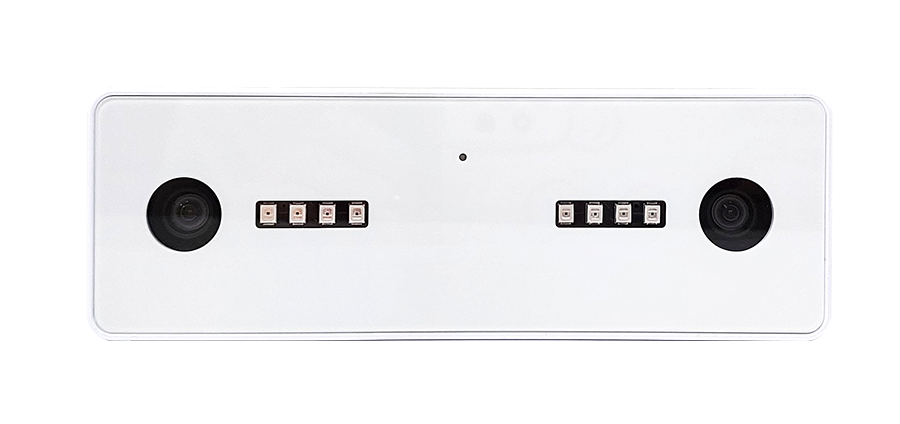
The sensor choice is driven by the entrance, not by the fact that it is a rental. Nano AI is the usual indoor unit for stands, pop-ups and standard doorways; it is plug-and-play, hangs at the entrance on the clips supplied with it, connects over Wi-Fi and is configured in a few minutes, which is exactly what you want on a build-up day when nobody has time for cabling.
Nano Prime, our 3D stereo sensor, suits wide or high-traffic entrances where separation between closely spaced visitors matters. Nano Outdoor is the unit for weather-exposed gates, open-air entrances and street-level counting. Where the deliverable is a live capacity number rather than a daily total, VCare provides the real-time occupancy layer on top of the same sensors.
BoostBI access for the hire period
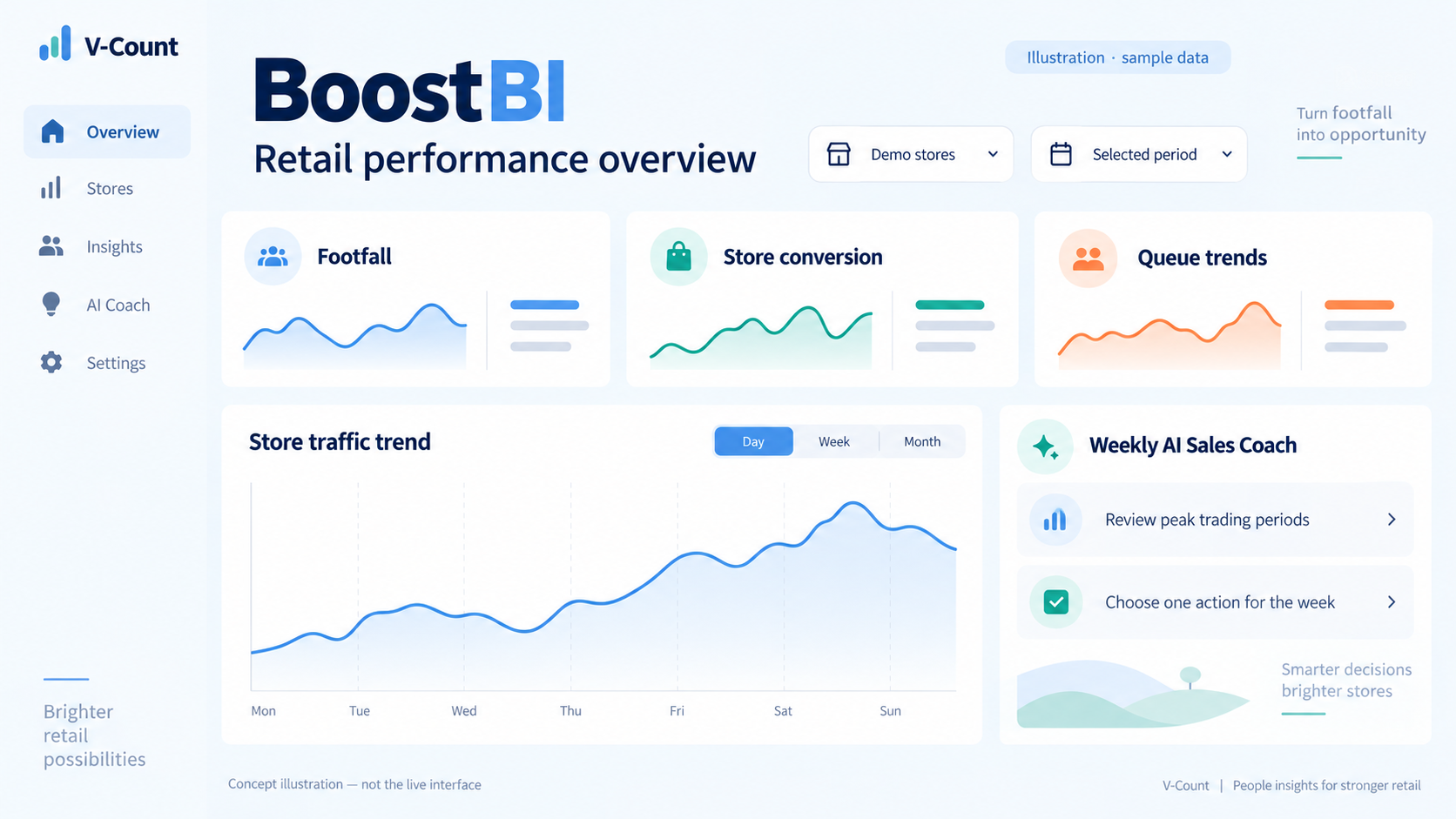
Rented sensors report into BoostBI, the same cloud analytics platform permanent customers use. Your workspace is open for the event window with the dashboards, comparisons and exports you would have on a fixed contract, so a rental is not a cut-down product with a simpler screen.
Setup guidance
You get placement guidance before the equipment arrives – which door needs a sensor, at what height, and how the coverage should be aimed – plus support while you install. Indoor Nano AI units are designed for self-installation; more complex sites, outdoor gates and mounted positions are planned with our team or a local partner.
Live dashboards during the event
Counts are readable the same day, not after the show. That is the point of renting rather than tallying manually: you can move a steward, open a second registration lane or push an announcement while the day is still running.
A post-event report and your data
When the event closes the hardware goes back, but the numbers stay with you. The data is exported from BoostBI so the report survives the return of the sensors, which is what makes a rental defensible internally when next year is being planned.
People counter rental vs purchase
Renting is not automatically the cheaper option; it is the right option for a defined set of circumstances. The table below is the comparison we actually walk customers through.
| Consideration | Rental / hire | Purchase |
|---|---|---|
| Best for | One-off events, pop-ups, festivals, pilots, seasonal peaks, fixed-length studies | Permanent stores, malls, venues and any site you will measure year after year |
| Budget line | Project or event cost for the period used | Capital purchase plus ongoing platform subscription |
| Commitment | Ends when the event ends; no long-term tie | Long-term, with the value compounding as history builds |
| Data history | Covers the rental window; exported at the end | Year-on-year comparison, seasonality and trend analysis |
| Maintenance | Handled by us; nothing to service or store between events | Your asset, supported under your agreement |
| Hardware version | Current generation each time you rent | The units you bought, until you refresh them |
| Risk | Low-risk way to test whether counting changes decisions | Committed, and usually cheaper per day once usage is continuous |
| Typical tipping point | A few events a year, or a single study | Several shows a year, or a permanent venue – ownership usually costs less across a season |
The short version: if you exhibit two or three times a year, rent. If you run many shows a year or manage a permanent site, buying the sensors normally works out cheaper across a season, and you keep the historical data. We will model both against your calendar rather than push one.
Planning an event, a pop-up or a pilot?
Send us the venue, the entrances you need covered and the dates, and we will scope the sensor count and quote the hire for you.
How a rental deployment runs
A short-term deployment has to work first time, because there is no second week to fix it in. The sequence below is how we run one.
1Site plan
We start from a floor plan, a stand layout or a site map. Which entrances count as entrances, where visitors can enter unofficially, where power sits, whether the doorway is indoor or weather-exposed, and how wide each opening is. This determines the sensor count and the models – it is also the stage where over-ordering or under-covering gets caught.
2Sensor placement
Each unit is assigned a position and a mounting method: clips at a stand entrance, a mounted position over a hall door, a pole or structure mount for an outdoor gate. Coverage is planned so that the counting line sits across the full width of the opening rather than part of it.
3Calibration day
On build-up day the sensors go up, connect and are checked against the real doorway: direction rules confirmed as in and out, counting lines aligned, thresholds set, and a walk test run so you can see your own passes appear in BoostBI before the public arrives.
4Live counting
Once the doors open the dashboards are live. Gate throughput by hour, cumulative attendance, occupancy against the limit if VCare is part of the package, and comparisons between entrances or between days of the show.
5Report and return
After the close we produce the post-event view – totals, peaks, arrival and departure curves, per-entrance splits – and export the data set. The sensors are returned or collected.
Pedestrian traffic counters for hire for councils, BIDs and urban studies
Street-level counting is a different job from counting a doorway. A high street, a market square, a park path or a transport approach has no frame to mount on, no indoor power and no shelter, and the study usually has a defined duration: before and after a public realm scheme, a seasonal market, a night-time economy review, or a BID reporting period.
This is where pedestrian traffic counters for hire earn their place – you get the count you need to make the case without adopting permanent street furniture.

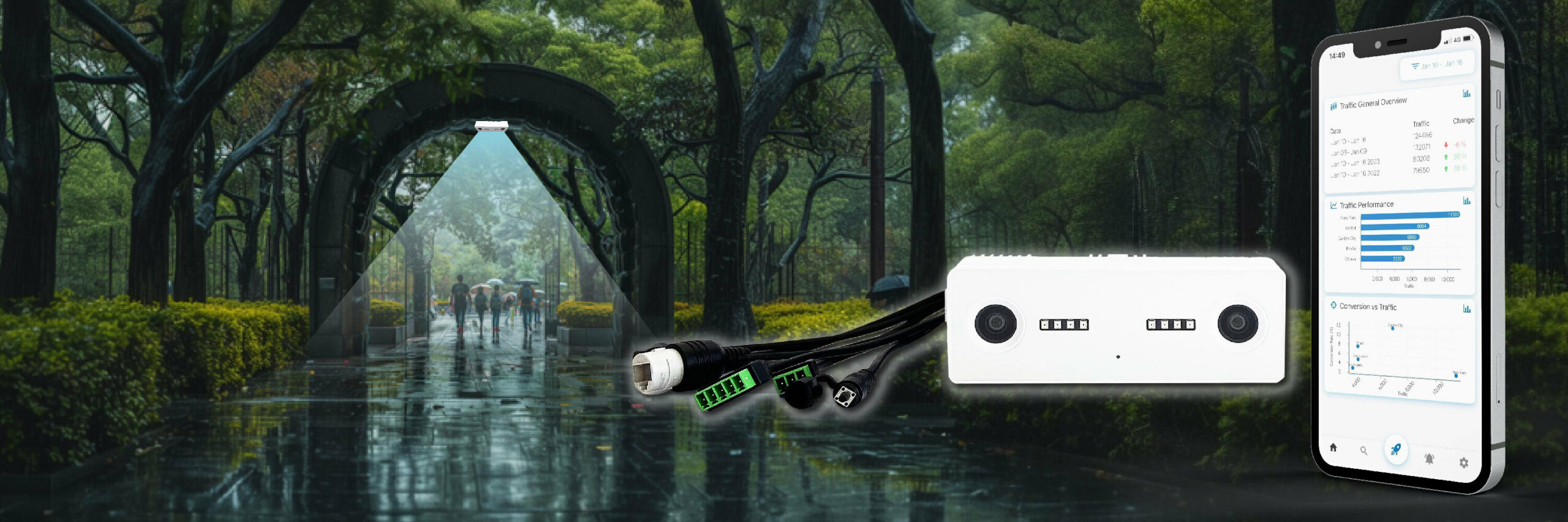
For these deployments we use Nano Outdoor, which is built for weather-exposed positions and varying light rather than an indoor doorway. Indoor sensor specifications should not be applied to an outdoor location, so the model, the mounting and the aiming are validated for the actual site before anything is quoted.
Outputs that matter for this audience are typically hourly pedestrian volumes by direction, day-of-week and time-of-day profiles, and a clean before-and-after comparison between two counting periods on the same line.
Occupancy monitoring system hire for capacity-managed venues
Some short-term deployments are not about marketing numbers at all – they are about how many people are inside right now. A temporary venue with a capacity condition, a festival arena, an exhibition hall with a safety limit, or a seasonal attraction that only has a crowding problem for a few weeks all need a live figure and an alert before the limit is reached, not a report the following morning.
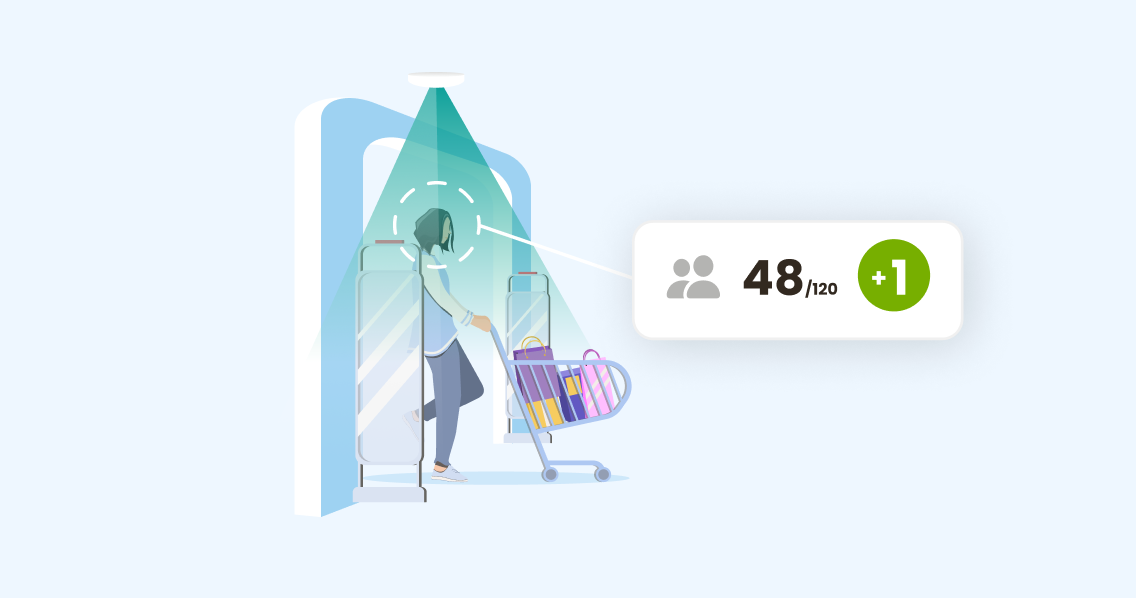
An occupancy monitoring system hire from V-Count is scoped like a permanent one: sensors sized to the number of entrances, mounting suited to the site including Nano Outdoor units where the gates are open-air, zones and capacity thresholds configured, the VCare live occupancy view and BoostBI open for the duration, alert routing to your nominated staff, and removal at the end of the period. The current figure can also be published to entrance screens or an existing signage player so stewards and visitors see the same number.
Event analytics rental: what the numbers actually tell you
An event analytics rental is worth more than a turnstile total, because event measurement is not store measurement. A shopping centre counts the same doors every day for years; an exhibition builds its venue on Monday, fills it on Tuesday and takes it down on Thursday.
That short, spiky life cycle is why the counting has to go up quickly, be calibrated on the spot and be readable the same day. The numbers organisers and exhibitors act on are gate throughput per hour, live hall occupancy against the safety limit, the arrival and departure curve across each show day, how attendance splits between entrances, and – at stand level – how many of the people walking the aisle actually stepped in.
How people counter rental is priced
V-Count does not publish a rental price list, and any page that quotes one for your event without seeing it is guessing. Rental is quoted per event, because three things move the figure and they are different for every job.
- Sensors. How many units, and which models. A single stand entrance is not the same job as eight hall gates, and an outdoor gate needing Nano Outdoor is not priced like an indoor doorway.
- Days. The length of the period the hardware and the BoostBI workspace are live, including build-up and break-down, not just show days.
- Reporting. Whether you need live dashboards only, live occupancy and alerting through VCare, or a prepared post-event report and data export on top.
Who installs also matters: a self-installed Nano AI package is scoped differently from a site where our team or a local partner mounts the units. Tell us the venue, the dates, the number of entrances and what the report has to show, and you get a scoped quote rather than a range. The same approach applies to permanent systems – our pricing page explains how a purchase quote is built.
Book a demo and we will scope the rental against your event calendar, and show you the point at which owning the sensors becomes cheaper than hiring them each time.
Rent a people counter for your next event
Whether you need one sensor on a stand, pedestrian traffic counters for hire across a study area, or an occupancy monitoring system hire for a capacity-managed venue, the process is the same: tell us the site, the dates and what the report has to prove. Request a demo and we will scope it, or read more about people counting for events, exhibitions and trade shows first.
People counter rental FAQ
How much does it cost to rent a people counter?
There is no published rental rate, because the cost depends on the shape of the job. A quote is built from the number of sensors, the models those entrances need, the number of days the equipment and the BoostBI workspace are live, and the reporting you want at the end.
A single self-installed sensor on one stand for a three-day show and a multi-gate hall deployment with live occupancy alerting are different jobs with different figures. Send us the venue, the dates and the entrance count and you will get a scoped price rather than an estimate.
What is the minimum rental period?
Rental periods are set per event rather than fixed to a standard term. In practice the period covers build-up, the show or activation itself and break-down, because sensors have to be up and calibrated before the doors open.
Short exhibitions, multi-week pop-ups and season-long deployments are all handled the same way – we scope the window you need. Confirm the exact dates with our team when you request the quote, as availability for a specific week is part of the answer.
V-Count rents sensors for events and sets the period around your build-up, show and breakdown dates.
How long does installation take?
Indoor Nano AI units are designed for self-installation and go up in minutes. You hang the sensor at the entrance using the clips supplied, configure the Wi-Fi settings and plug it into power – that is the whole process, which is why it works on a build-up day.
Outdoor gates, wide hall entrances and mounted positions take longer because the position has to be planned and fixed properly, and those sites are set up with our team or a certified local partner rather than self-installed.
Do I need to run cables or provide a network?
Nano AI connects over Wi-Fi, so no data cabling is needed at a typical stand or pop-up; what you do need is a power source at the sensor position and a usable wireless connection at the venue. Exhibition halls often sell venue Wi-Fi separately from stand power, so check both when you book your stand services.
For outdoor and larger deployments, connectivity is planned as part of the site plan before the equipment ships.
Can I rent outdoor people counters?
Yes. Weather-exposed entrances, festival gates, street-level counting lines and open-air venue perimeters use Nano Outdoor, which is intended for outdoor conditions and varying light rather than an indoor doorway. Indoor sensor specifications should not be applied to an exposed site, so the model, mounting, coverage and direction rules are validated for the actual location before the rental is quoted.
Councils, BIDs and consultants running fixed-period pedestrian studies use the same units.
Do I keep the data after the rental ends?
Yes. The hardware goes back, the numbers stay with you. Your BoostBI workspace is live for the rental window, and the data set is exported at the end so the counts, curves and per-entrance splits survive the return of the sensors.
That export is what makes the rental defensible internally – it is the evidence you use when next year is planned, or when you compare this venue against the next one.
Can I rent first and buy later?
That is one of the most common reasons to rent. A short-term deployment is a low-risk way to see whether counting actually changes your decisions before you commit to hardware, and multi-site organisations often pilot on two or three representative locations before signing off a rollout.
If it proves out, the permanent system is scoped from your own data instead of a projection; if it does not, you are not holding equipment you never use. V-Count offers sensor rental for events, so you can test counting before you buy.
Is renting cheaper than buying?
For occasional use, yes – you pay for the event duration instead of making an upfront purchase, and there is nothing to maintain, store or refresh between events. But if you run several shows a year, or you manage a permanent venue, owning the sensors usually costs less across a season than renting each time, and you gain year-on-year history that a series of separate rentals cannot give you.
We will work through which way round it falls for your calendar before you decide. V-Count quotes rental per event, so you can compare it with buying for your own schedule.