Healthcare
Hospitals, clinics and pharmacies live or die on flow. V-Count counts people — anonymously, never identifying anyone — at main and campus entrances, ward doors, outpatient waiting rooms, pharmacy and reception counters, cafeterias, lobbies and restroom corridors.
That gives you healthcare visitor monitoring per ward and entrance for visiting-hours policy and infection-control capacity limits, and healthcare queue management built on real waiting room occupancy rather than tickets issued. Staff movement is excluded, so department footfall reflects patients and visitors only.
Everything lands in BoostBI as anonymised counts — entries, exits, occupancy, dwell — that your privacy team can review line by line, because no patient is ever recognised, named or followed.
Explore the gallery showcasing our diverse range of customers. We’re proud to work with these leading brands, providing visitor analytics solutions that drive their success.


















Benefits of Visitor Analytics for the Healthcare Industry

People counting solutions bring substantial benefits to hospitals, significantly elevating both operational efficiency and patient satisfaction. By delivering real-time foot traffic data, these innovative systems empower hospitals to make informed and strategic decisions related to cleaning, staffing, and resource allocation. The efficient distribution of crucial resources, including medical equipment and beds, is streamlined, guaranteeing their availability precisely where and when they are most needed.
Moreover, the optimization of hospital operations not only enhances overall efficiency but also leads to a notable reduction in energy costs, making this solution not just advantageous but also cost-effective for hospitals. This holistic approach contributes to the improved functionality and sustainability of healthcare facilities.
Access to detailed visitor traffic trends not only optimizes hospital operations but also significantly boosts patient satisfaction and revisits.

Hospitals can optimize patient experiences by implementing efficient queue management solutions, effectively minimizing wait times in critical areas such as registration, billing, and pharmacy services. This not only streamlines administrative processes but also contributes significantly to overall patient satisfaction, ensuring a smoother and more positive healthcare journey.

The ability to comply with government regulations and swiftly respond to emergencies through real-time occupancy data enhances overall safety measures within the hospital environment. This comprehensive approach ensures a safer, more efficient, and patient-centric healthcare facility.
Healthcare people counting: what to measure
A hospital is several venues under one roof, and each one has its own rhythm. The main entrance peaks first thing in the morning, outpatient clinics peak by appointment block, the pharmacy peaks a little later as those clinics empty, and the cafeteria peaks twice a day.
Counting the building as one number hides all of it. Healthcare people counting works when every space with its own queue, its own capacity limit or its own cleaning rota is measured on its own line.
These are the figures that actually change a decision in a hospital, clinic or pharmacy:
- Waiting room occupancy — how many people are in each waiting area right now, against the number of seats and the room’s safe capacity.
- Wait time and queue length — how many people are standing at reception, triage, imaging and the pharmacy counter, and how long that line persists.
- Visitors per ward and per entrance — the number that visiting-hours policy and infection-control limits are enforced against.
- Footfall per department — traffic into radiology, phlebotomy, physiotherapy and outpatient suites, used for space planning and opening hours.
- Lobby and cafeteria occupancy — the shared spaces where crowding builds up without any one department owning it.
- Restroom visits since the last clean — a usage count instead of a fixed timetable.
- Visitors and patients separated from staff — so a department’s numbers are not inflated by nurses and porters walking through.
Healthcare queue management: waiting rooms, outpatient clinics and the pharmacy
Healthcare queue management starts with an honest measurement of the queue. A ticket system tells you how many numbers were issued; it does not tell you how many people are actually standing in the room, how many walked out before being seen, or how many companions came with each patient.
Counting sensors over the waiting area and the service points give you both halves: the number of people present and how long the group in front of the desk takes to clear.
In outpatient departments, the useful pattern is the gap between arrival and appointment. Patients often arrive well before their slot, so the waiting room fills in a wave that has nothing to do with clinic throughput.
Once you can see that wave in the data, you can move appointment blocks, stagger check-in windows, or open a second reception desk for the twenty minutes when it matters rather than staffing it all day.
Pharmacy queues behave differently again. A hospital pharmacy inherits its demand from the clinics that just finished, so the peak arrives on a delay you can measure and then plan around.
The same applies to phlebotomy first thing in the morning and to discharge paperwork in the afternoon. For the operational side of this — alerts, thresholds, counter-opening rules and service-point measurement — see our queue management solution and the guide to choosing a queue management system.
Healthcare visitor monitoring by ward and entrance
Healthcare visitor monitoring is about knowing who is in the building outside the patient record: relatives, companions, contractors and outpatients. Sensors on ward doors and on each public entrance give a live count per area, which is what a visiting-hours policy needs to be enforceable rather than aspirational.
If a ward allows two visitors per bed between set hours, the count at the ward door is the only thing that tells you whether the policy is holding.
The same counts support infection-control capacity limits. During an outbreak or a seasonal surge, limits are usually set per ward or per waiting area and then policed by whoever happens to be at the desk.
A live occupancy figure with a threshold replaces that with something repeatable: staff see the number, the number is logged, and the log shows afterwards how long the area spent over its limit. VCare displays that live occupancy on a screen at the door, so visitors see the status before they walk in.
Anonymous counting: no patient is ever identified
V-Count sensors count people. They do not identify anyone. No patient, visitor or member of staff is recognised, named, matched to a record or tracked between visits. The sensor processes what it sees on the device and passes on counts — entries, exits, occupancy, dwell — not images of people. Nothing leaves the sensor that could be used to work out who a person was.
That matters in healthcare because the moment a system can identify a patient, it becomes part of your clinical data estate. Anonymous counts stay outside it. The data is anonymised at source, which makes it straightforward to fit into HIPAA and GDPR programmes as non-personal operational data, and your privacy team can review exactly what the sensor emits.
V-Count does not claim any healthcare certification on your behalf — the point is simply that there is no personal data to certify.
Where the sensors go in a hospital or clinic
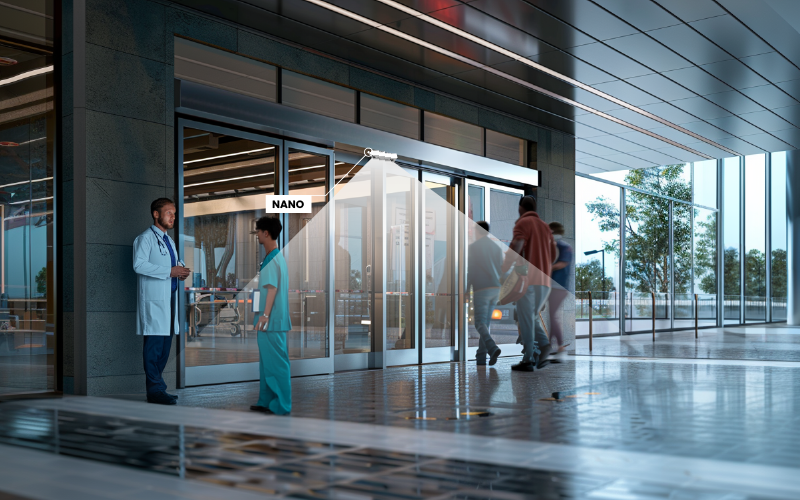
A hospital people counter is normally mounted at the main entrance, at each secondary and staff entrance, at the ward doors, over outpatient waiting rooms, at the pharmacy and cafeteria, and at restroom corridors. Each of those is a separate counting line in people counting terms, and each answers a different operational question.
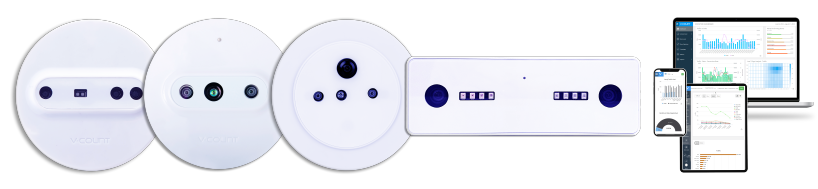
Nano AI is the usual choice for indoor doorways, waiting rooms and department entries: an AI camera sensor with enough on-device intelligence to separate people from trolleys, wheelchairs and equipment being pushed through. Where the space is a tall atrium entrance, a glazed lobby with strong daylight, or a corridor that is dim at night, Nano Prime 3D stereo handles the height and the changing light. Nano Outdoor covers campus gates, car park approaches and ambulance-bay entrances that sit outside the building envelope.
A small clinic visitor counter is typically a single Nano AI over the front door plus one more over the waiting area — the same platform, fewer lines.
All of them report into BoostBI, V-Count’s cloud analytics platform, where each ward, clinic and site becomes a comparable location with its own thresholds and alerts. Staff exclusion is configured there: staff-only doors and back-of-house routes are set up as separate lines so clinical movement never lands in a patient or visitor figure.
How hospitals and clinics use the data
- Staffing to the real curve. Reception, triage and pharmacy cover is set against the hours people actually arrive, not against a rota written years ago.
- Waiting-room capacity. When a waiting area regularly sits above its seated capacity, that is a case for more seats, an overflow room, or a change to appointment spacing — with a number attached.
- Visiting-hours policy. Ward counts show whether limits are being kept, and where the policy needs a different limit rather than more signage.
- Infection-control limits. Occupancy thresholds per ward and waiting area, with a record of time spent over the limit.
- Cleaning triggered by use. Restrooms and high-traffic corridors are cleaned after a set number of visits instead of on a clock, which moves effort to where it is needed and away from where it is not.
- Space planning per department. Footfall per department over months is the evidence base for relocating a clinic, extending opening hours, or converting a room.
- Estate-wide comparison. A trust or group can compare sites on the same definitions — visitors per entrance, waiting room occupancy, time over limit — instead of on locally invented counts.
If you want to see any of this against your own floor plans, book a demo and we will walk through the sensor placement for a single department first.
Healthcare people counting FAQ
Can a hospital people counter tell patients and visitors apart from staff?
Yes, by geography rather than by recognising anyone. Staff entrances, back-of-house corridors and staff-only doors are set up as their own counting lines, and those lines are excluded from public footfall figures.
In mixed doorways the sensor is positioned and zoned so the staff route crosses a different line from the patient route. No one is identified in order to do this — the system never knows who a person is, only which line they crossed and in which direction.
The result is department and waiting-room numbers that reflect patients and visitors rather than clinical traffic.
How do you measure waiting room occupancy and wait time without a ticket system?
A sensor over the waiting-room entrance counts people in and out, so the live occupancy is simply the difference. Because entries and exits are timestamped, the system can also show how long the room takes to clear after a clinic block ends, which is a practical proxy for wait time.
A second sensor over the reception or triage desk shows the queue in front of the service point itself. None of this needs patients to take a ticket, scan anything or be identified, and it captures companions who never appear in a ticketing system at all.
Is people counting in a hospital HIPAA or GDPR compliant?
V-Count sensors produce anonymised counts, not personal data. Nobody is identified, no faces are stored or matched, and no individual is followed between visits or between sites. Processing happens on the sensor and only numbers leave it.
Because there is no personal or health information in the output, the data normally sits outside the scope that HIPAA and GDPR govern, which is what makes it straightforward for a privacy team to sign off. We do not claim a healthcare certification on your behalf — we give your privacy team the technical detail of exactly what the sensor emits so they can assess it.
Can we enforce a visitor limit per ward during an outbreak?
Yes. Each ward door becomes its own occupancy area with its own limit, which you can change per ward and per time of day as policy changes. VCare shows the live count and status on a screen at the entrance so visitors can see it before they enter, and BoostBI can alert the nurse station when an area goes over its threshold.
Afterwards you have a record of how long each ward spent above its limit, which is far more useful for an infection-control review than an estimate written up from memory.
Which sensor suits a main hospital entrance with a high atrium ceiling?
Nano Prime, our 3D stereo sensor, is built for tall mounting heights and for lobbies where daylight through glazing changes through the day and the lighting drops at night. Standard indoor doorways, department entries and waiting rooms are normally covered by Nano AI.
Entrances that sit outside the building line — campus gates, car park approaches, ambulance bays — use Nano Outdoor. In practice most hospitals run a mix, and all three feed the same BoostBI dashboards, so the choice per doorway does not fragment the reporting.
Can it measure the outpatient clinic and pharmacy queues across several sites?
Yes. Each clinic waiting area and pharmacy counter is configured as a location with the same definitions everywhere, so queue length and occupancy are comparable between sites rather than locally invented.
That is what lets a group see that one hospital’s pharmacy peak lands forty minutes after its clinics close while another’s lands immediately, and staff each accordingly. Our queue management pages cover the alerting and service-point side of this in more detail.
Can occupancy data trigger restroom cleaning?
Yes, and it is one of the quickest wins in a hospital. A sensor at the restroom corridor counts visits, and BoostBI raises a task once the count since the last clean passes the threshold you set.
Quiet restrooms stop being cleaned on a timetable they do not need, and the busy ones near outpatients and the main entrance get attention when they actually need it. The same trigger logic works for high-traffic lobbies and cafeteria seating areas.
Do we need a sensor in every department to get useful data?
No. Most hospitals start with the main entrance plus the two or three areas where the pain is worst — typically the largest outpatient waiting room, the pharmacy and one ward door.
That is enough to prove out the numbers and the staff exclusion setup. Departments are added afterwards as the space-planning questions come up, and because every sensor reports into the same platform, later additions extend the same dashboards rather than starting a new reporting exercise.