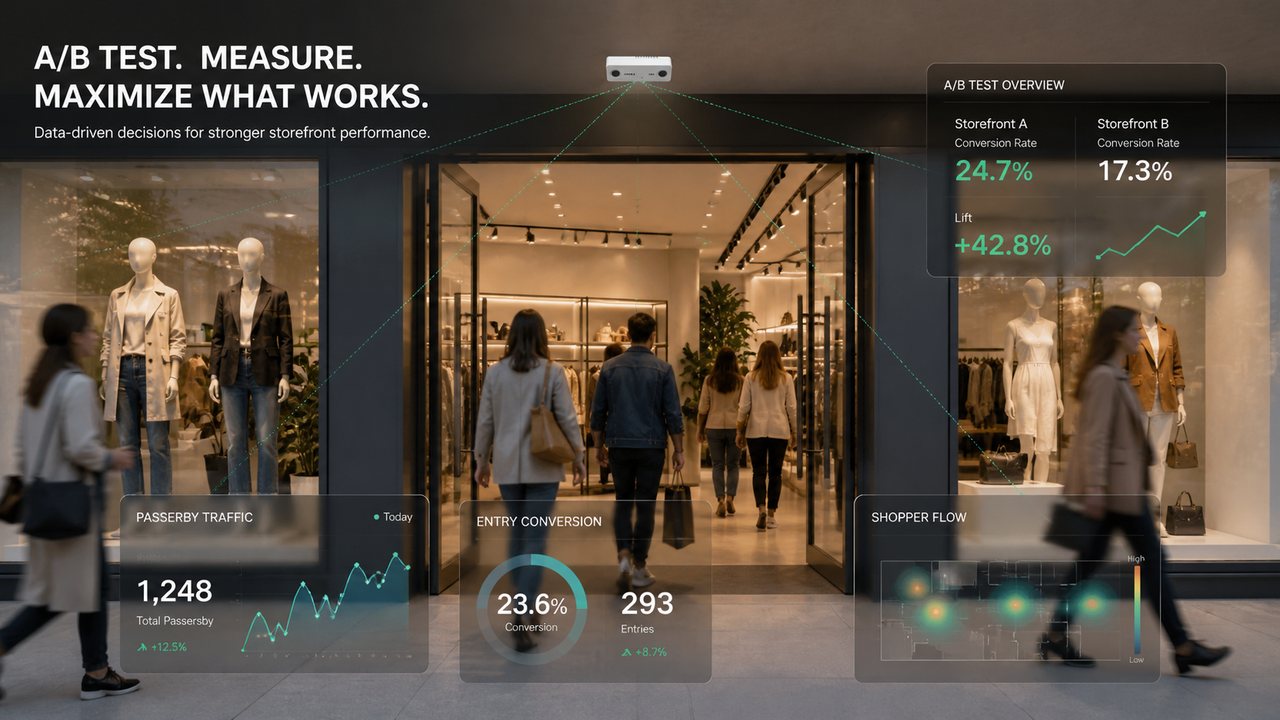
#1 People Counting Sensor in the World
Nano AI People Counting Sensor
Nano AI is bringing you two decades of experience in people counting. Nano AI is used by 600+ industry leading brands in 130+ countries around the world. New to the category? Start with our guide to what a people counter is and how the types compare.
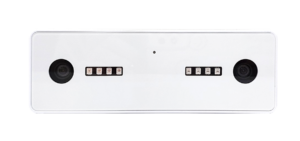
Nano AI people counter sensor: Wi-Fi, smart AI and intelligent counting

Up to99% Accurate People Counting
Our 3D stereo vision technology, combined with our over decade experience of AI tracking algorithms, enables Nano AI to achieve up to 99% accuracy in people counting.
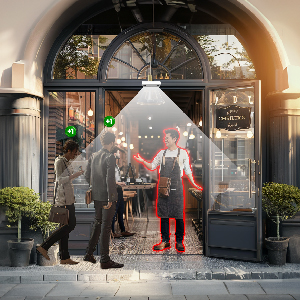
90% Staff (Employee) Exclusion Accuracy
People Counting with Nano AI enables you to exclude the staff to help you get the most accurate traffic data in your store. With Nano’s optional Staff Exclusion Solution, you will know the exact number of customers in your store and receive the purest conversion data while measuring customer to staff ratio.
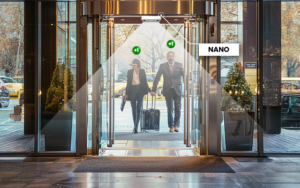
95% Gender Recognition
V-Count offers the world’s highest accuracy in gender recognition technology with AI on CHIP. This technology operates without recording, transferring, or uploading images to servers, providing a 100% GDPR-compliant solution.

80% Age Recognition
V-Count provides the world’s most accurate age recognition technology with AI on CHIP, ensuring precision without capturing, storing, or transferring any images—making it fully GDPR-compliant.
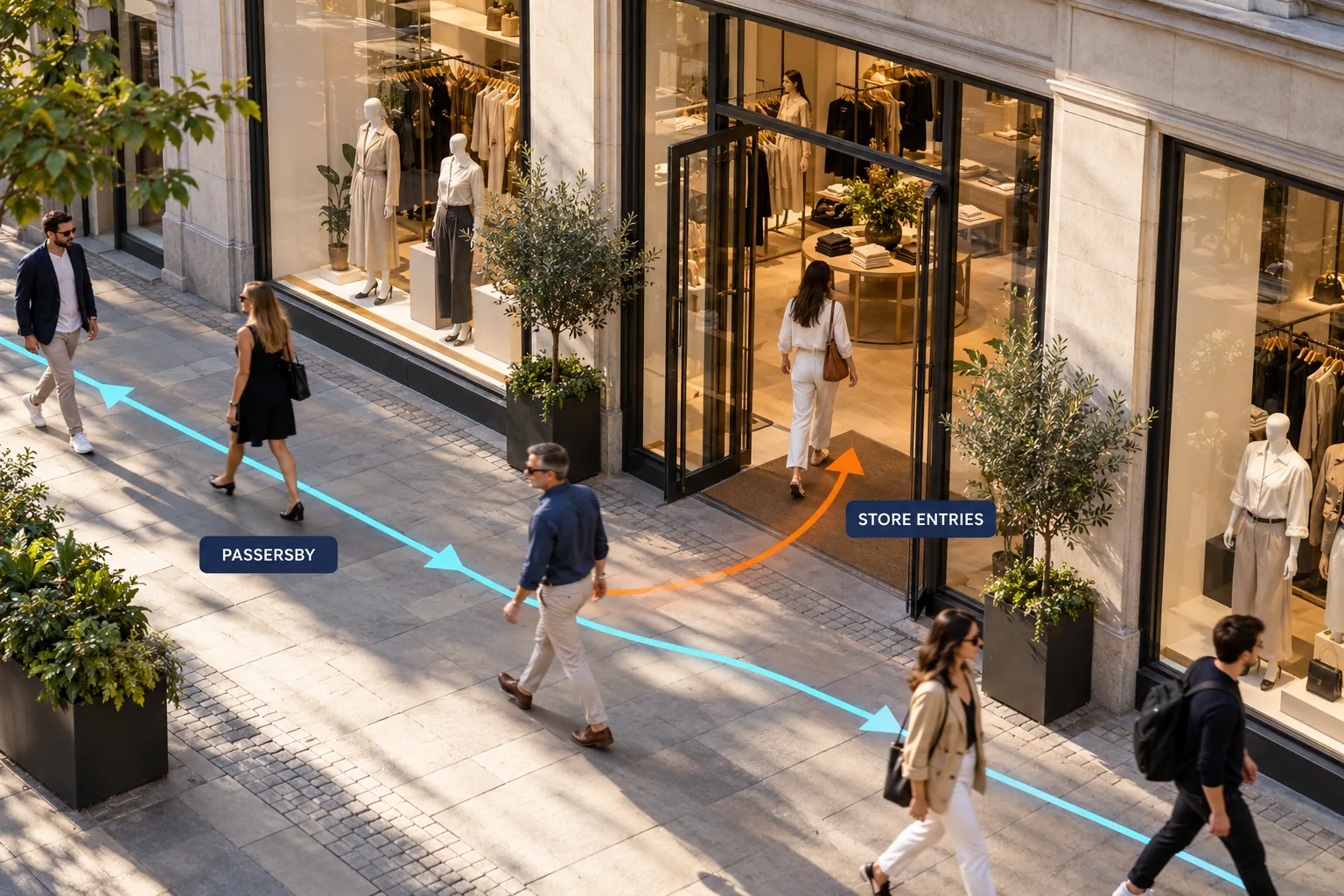
Street Traffic Measurement
Nano AI not only provides top-tier people counting, but it also offers advanced street traffic measurement, along with staff exclusion and gender recognition, making it the only device capable of doing all three. This feature allows businesses to accurately track how many people pass through their stores street, all without recording or transferring images, ensuring 100% GDPR compliance.

Effective Queue Management
Nano AI’s Queue Measurement & Management solution can monitor self service desk or cashier queues. Using data derived from BoostBI, you can effectively manage long queues by opening additional cash registers or enhancing your team capacity through optimized staff allocation. This approach not only enhances customer satisfaction by reducing instances of cart abandonment, but also ensures that no sales opportunities are missed.
Plug & Play
Nano AI is a Plug & Play people counter sensor. It’s quick and simple to set up. Just plug in, connect and configure remotely. Install under 5 minutes. We have installation services all around the globe but most of our customers do self-install cause it’s pretty easy. Don’t worry about calibration, we’ll take care of it remotely if necessary.
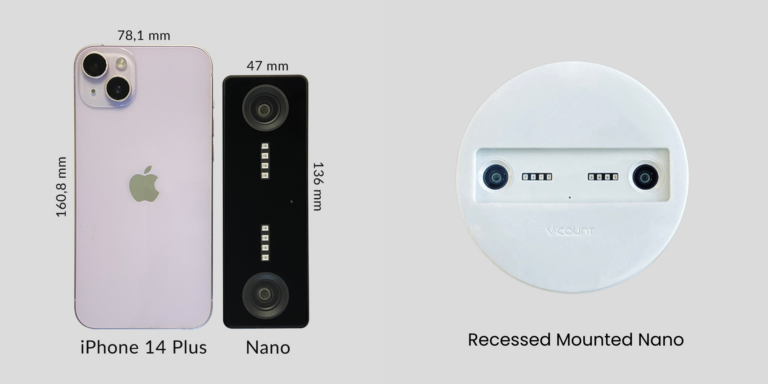
Tiny and Discreet
With its recessed mounting option, Nano AI is fully invisible in the ceiling. It is also one of the tiniest people counting sensors in the global market.

Night Vision That Works in Total Darkness
Powered by active Infrared lighting and ultra low sensitivity sensors enables Nano AI to be able to count in total darkness. Nano AI is the only solution that can deliver this in the global market.

Incredibly Strong Wi-Fi Connectivity
Nano AI with its built-in powerful antenna, provides robust Wi-Fi connectivity up to 40 meters, first time in the industry, allowing cost effective access to real-time people counting data anytime, anywhere.

Battery-Free
Unlike other people counters that require a battery, Nano AI offers a battery-free solution. Thus, it prevents problems such as replacing the battery after it runs out and data interruption .Instead of manually obtaining the data like in battery solutions, our solution automatically sends the data.

Excellent Durability
Nano AI is designed to work for a decade withstanding temperatures between 0°-45°C. It is water-leakage proof and features a splash-proof casing to protect against ceiling leakages.

Eco Friendly USB-C Charging
Nano AI includes a USB-C port for easy, eco friendly charging. It operates at 5V, improving sustainability for a greener planet. Nano AI is the only USB-C powered, true sustainable people counting sensor on the global market. External PoE Adapter Option: In addition to USB-C, Nano AI can also be used with the PoE splitter option.
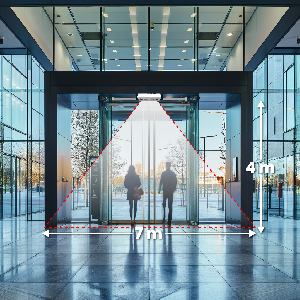
Ultra Wide Field of View
Nano AI provides an ultra wide coverage with a very high effective counting range and field of view, thus decreasing the number of counters needed and decreasing costs and improving the eco-footprint.
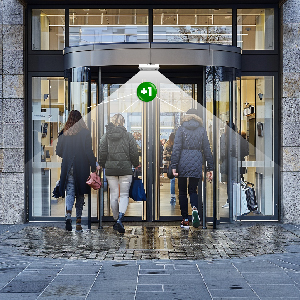
Group Counting
Families, friends, or couples, people often visit stores in groups. Counting them as separate individuals can negatively impact your conversion rates and KPIs. Nano AI people counting sensors can recognize the crowds moving together and count them as one customer.

Real-Time Occupancy
Monitor your business’s venue capacity and occupancy in real-time with V-Count’s mobile BoostBI app (IOS / Android). This solution enables you to precisely track the current number of people in your space instantly. Nano AI sensor provides accurate data on your venue’s occupancy status, allowing you to manage daily operations more effectively, lower energy costs and make strategic decisions based on real-time information.

GDPR Compliance
100% Privacy
Nano AI is designed to be fully compliant with GDPR. Our technology, which processes 3D depth data to ensure complete anonymity by never capturing personal details. With our patented AI on CHIP technology, data is processed on-device, transmitting only non-identifiable insights.
BoostBI – Dashboard & Mobile App
Easy Access Your Data. Anywhere, Anytime.
If you travel frequently and are unable to remain at your computer, but still need to monitor your stores’ status, BoostBI offers a solution. It frees you from your desk, allowing you to track foot traffic, monitor performance, and utilize advanced analytics, all from your mobile device. IOS and Android available.
Real-Time Footfall Data At Your Fingertips
- Accurate Insights: Depend on precise, real-time footfall data to understand customer behaviors.
- User-Friendly Interface: Engage with an app that’s as intuitive as it is powerful.
- Remote Management: Stay updated on multiple locations without being confined to one spot.
Key Benefits
- Comprehensive Dashboards: Monitor key metrics at a glance.
- Accurate People Counting: Get highly precise data for better decision making.
- Flexible Management: Manage your retail business from any location, at any time.
- Streamlined Operations: Use actionable insights to streamline operations and enhance efficiency.
- Two-Way API Integration: Push and pull data through a fully bidirectional REST API, connecting V-Count with your POS, ERP, and BI tools in both directions.

API Integrations
Boost your productivity with our Rest API integrations across your existing apps. Easily connect point-of-sale (POS) systems, shopify or PowerBI and more integrations to streamline your workflow. Build powerful connections between our products and your apps now to optimize workflows and increase efficiency.
Nano AI specifications
Nano AI is V-Count’s AI camera people counter sensor: a ceiling-mounted unit that watches a doorway or a zone, recognises human shapes in the frame and turns them into counts. What follows is a plain-language spec sheet for buyers who compare people counting sensors on detection method, mounting, lighting and privacy rather than on marketing copy.
If the category is new to you, read our explainer on what a people counter is first, then come back here for the ai-based people counting technology detail.
Detection method: AI camera with on-device edge processing
Nano AI pairs an optical sensor with a neural network that runs on the device itself. Frames are analysed on the edge, inside the unit, and only anonymous count events leave it; no video stream is shipped to a server to be processed.
That edge design is what makes it a real-time people counting sensor rather than a recorder, because a count is produced as the person crosses the line instead of after a batch upload. And because the model is trained to recognise people rather than heat blobs or raw motion, it can separate a shopping group from a lone visitor, and a staff member from a customer.
What the sensor counts
- Entries and exits with direction across a counting line at the door or between internal zones.
- Live occupancy, entries minus exits updated continuously, which is what drives capacity and dwell reporting.
- Staff exclusion, so employees are removed from visitor totals and conversion rate is not diluted by your own team walking in and out.
- Group counting, so a family or a couple arriving together is counted as the right number of individuals and can also be reported as one group.
- Anonymous demographics, gender and age bracket, derived on the device and never linked to an identity.
- Street traffic outside the window, so passers-by and entrants can be compared and capture rate calculated from one device.
Mounting and ceiling considerations
Nano AI mounts on the ceiling directly above the entrance and looks straight down, so its view is never blocked by displays, signage or a queue of people. The housing is small and discreet enough to disappear into a ceiling tile.
An ultra-wide field of view means one unit normally covers a standard double-door entrance; very wide, angled or multi-lane entrances are handled by placing units side by side. Suspended ceilings, plasterboard and concrete soffits all work.
What actually matters is an unobstructed line of sight across the full width of the opening and a stable mounting point.
Lighting and night operation
The sensor works in bright daylight, in ordinary shop lighting and in total darkness. Night vision is built in, so a night people counter deployment such as a 24-hour transport hub, an unlit corridor or an out-of-hours building entrance needs no extra lighting installed.
Strong backlight through a glass shopfront, the classic failure mode of a simple footfall camera, is resolved by the AI model rather than by a fixed brightness threshold. That is why an intelligent people counter holds its accuracy steady through sunrise, sunset and seasonal changes in daylight.
Privacy: no faces stored, fully anonymised
No faces are stored, no images are retained and no individual can be identified. Video is processed in memory on the device and discarded immediately; what reaches the database is an anonymous count event with a timestamp.
The device is therefore GDPR-compliant by design rather than by policy, which is the practical reason a smart ai people counter clears legal review in cases where a CCTV-based counting workaround would not. Nothing on the unit can be replayed, exported as footage or matched to a person.
Connectivity and BoostBI integration
Nano AI connects over Wi-Fi, making it a wifi people counter in the useful sense: the device is networked wirelessly, rather than guessing at counts by sniffing visitors’ phone signals, which is a different and far less reliable technique. Counts flow into BoostBI, V-Count’s cloud analytics platform, where footfall, occupancy, conversion and dwell appear in dashboards and the mobile app.
Open APIs push the same figures into POS, BI or workforce-management systems. Installation is plug and play, the unit is battery-free, and it charges over USB-C.
Nano AI vs other people counting sensors
Not all counter devices work the same way, and the detection method decides what you can and cannot measure. The table below compares the five technologies buyers usually shortlist when specifying a traffic counter sensor for a store, a venue or a public building.
V-Count builds two of them: Nano AI for ai people counting indoors, and Nano Prime as the 3D stereo alternative. For entrances exposed to weather there is Nano Outdoor. A broader overview of the category lives on our people counting hub.
| Technology | How it works | Strengths | Limitations | Best for |
|---|---|---|---|---|
| AI camera (Nano AI) | An optical sensor feeds a neural network running on the device, which recognises people and tracks their direction across a line. | Direction, occupancy, staff exclusion, group counting and anonymous demographics from one unit; works in darkness; counts street traffic as well as entrants. | Needs a ceiling mounting point and a clear downward view; indoor unit, so weather-exposed doors need the outdoor model. | Retail stores, malls, showrooms, museums, libraries and any entrance where conversion and demographics matter. |
| 3D stereo (Nano Prime) | Two lenses build a depth map of the scene, so people are identified by height and volume rather than by image recognition. | Very robust against shadows, reflections and floor patterns; excellent at separating adults from children and trolleys. | No demographic data; depth accuracy depends on mounting height; a physically larger device than an AI camera. | High-traffic entrances, airports and transport hubs where raw entry accuracy outranks demographics. |
| Thermal | Detects the heat signature of a body passing beneath the sensor and counts the blob as it crosses. | Completely image-free, so it is easy to approve on privacy grounds; unaffected by lighting conditions. | Struggles when people walk close together or wear heavy coats; no direction nuance, no demographics, and hot surfaces or HVAC output can confuse it. | Privacy-sensitive sites with simple counting needs, such as clinic corridors. |
| Infrared break-beam | A beam is fired across the doorway; the count increments each time something interrupts it. | Cheapest option to buy and to install; needs almost no configuration. | Counts interruptions, not people, so groups register as one and pushchairs or trolleys register as extra; direction is unreliable and occupancy drifts badly over a day. | Very low-traffic single doors where an approximate number is enough. |
| Wi-Fi / BLE probe counting | Listens for Wi-Fi or Bluetooth probe requests broadcast by phones and estimates how many devices are nearby. | No line of sight needed; can estimate presence across a whole floor rather than one doorway. | Counts phones, not people; misses anyone with Wi-Fi off and double-counts anyone with two devices; MAC randomisation on modern phones has undermined it, and it cannot produce a trustworthy entry count. | Rough zone-level dwell estimates only, never a door count. |
In short: if you need a defensible entry number plus conversion, occupancy and demographics from one device, an AI camera sensor is the right class of product. If you only need to know roughly how many bodies passed a point, a simpler counter will do.
Our foot traffic counter page walks through the buying decision in more detail, or book a demo and we will size the deployment for your entrances.
Planning a Nano AI Installation: What to Check and Measure
Nano AI counts crossings at defined indoor entrance lines. Good results depend on a good setup. This guide covers the site survey, the key specifications to plan around, how to validate the count, and how to use the data once it is live.
Key facts to plan around
- Accuracy: up to 99% for counting crossings at defined indoor entrance lines. Validate it at your own entrance.
- Mounting range: 2.2–7 m.
- Low light: built-in IR LEDs support counting at 0 lux.
- Power: 5 V USB-C, with an optional external PoE splitter.
- Network: Wi-Fi.
- Optional analytics: gender-and-age analytics with the compatible configuration and selected licence. Staff exclusion is also available.
Step 1: the site survey
Every installation starts with a site survey. There is no universal installation time, because each entrance is different. The survey checks five things:
- Height: confirm the mounting point sits within the 2.2–7 m range.
- Field of view: make sure the full width of the entrance is covered.
- Obstructions: look for signs, lights, doors or displays that block the view.
- Power: find a USB-C power source, or plan for the PoE splitter.
- Network access: check Wi-Fi signal at the mounting point.
Step 2: define the counting line
The counting line is where a crossing is recorded. Place it where every visitor must pass. Avoid spots where people stop and turn, such as right next to a display or a mat. Decide which direction counts as "in". Write the rule down, so it stays the same across stores.
If a site has more than one entrance, cover every entrance that visitors use. A store total built from some doors only will be too low.
Step 3: validate the count
Validation compares the sensor count with a reference count taken at the same time. Plan it carefully:
- Choose periods that include busy and quiet traffic.
- Include groups, families, prams and trolleys if they are common at your site.
- Test in real lighting, including evening and bright daylight at the door.
- Agree acceptance criteria before you compare results.
- Test optional analytics, such as demographics, separately from the entrance count.
Step 4: set up staff exclusion
Staff crossings can inflate visits and lower your conversion rate. Staff exclusion offers three methods: lanyard, shoulder tag or mobile app. Pick one and keep the rule consistent. Test staff movement on its own during the pilot.
What to measure once it is live
- Visits by hour and day: the basis for staffing and opening-hour reviews.
- Conversion rate = eligible purchase transactions ÷ eligible store visits × 100. Use the same store and period, and define how you treat staff, repeat entries, returns and cancellations.
- Revenue per visitor = net sales ÷ eligible visits.
- Sales per labour hour = net sales ÷ paid labour hours.
- Visits per labour hour: a workload measure. It does not describe individual performance.
BoostBI typically refreshes reports every 10 minutes. Enabled real-time configurations can refresh as often as every minute. Sales data arrives on its own schedule, depending on the integration.
How to read your first month of data
The first weeks show whether the setup is sound. Look for these signs:
- Entries and exits roughly balance by closing time. A large, steady gap can point to a coverage issue at one door.
- The daily pattern looks plausible. Traffic should rise and fall with opening hours and known busy periods.
- No unexplained zero hours. Gaps in trading hours can mean a power or network break.
- Staff exclusion works. Counts before opening and after closing should be low if staff are excluded.
Once the data looks stable, start trend work. Compare full weeks, and compare the same weekdays with each other.
Connecting Nano AI data to sales
Conversion needs both visits and transactions. BoostBI has native Shopify and Nebim connectors. It has working integrations for VendPOS, Nayax, ImagineX and QuickBooks. Manual sales import and a scoped REST API are also available, and V-Count provides the API documentation.
Before you rely on the numbers, confirm what counts as a transaction. Agree how to treat returns, cancellations and staff purchases. Use the same rules in every store.
Rolling out to more stores
- Finish and document the pilot at one or two representative sites.
- Turn the pilot rules into a standard: line placement, direction, exclusions and naming.
- Survey each new site. Entrances differ, even within one chain.
- Validate each new site before it joins chain reports.
- Keep a change log for every site.
A consistent standard makes store comparisons fair. Without it, differences between stores may come from setup, not from trading.
Using the data day to day
- Store managers can check hourly visits against rota plans and spot hours that are under- or over-staffed.
- Area managers can compare conversion across similar stores, using the same definitions.
- Head office can review trends after campaigns, while logging weather, promotions and opening hours.
The AI Sales Coach in BoostBI gives targeted weekly suggestions from each store's data. Managers review them, act, and compare the KPI later. It is AI-generated guidance, not a guaranteed uplift.
Occupancy: what counting can and cannot do
Live occupancy needs coverage of all relevant entrances and exits. It also needs an agreed baseline and regular checks for drift or missing data. Counting supports occupancy reporting. It does not replace venue safety procedures, and it does not set a safe capacity.
After a refit or layout change
New doors, signs or lights can change what the sensor sees. After any change near the entrance, check the view and repeat a short reference count. Record the date in your change log, so trend reports stay fair.
Common mistakes
- Mounting outside the 2.2–7 m range.
- Leaving a side door or staff door uncovered when visitors use it.
- Placing the line where people stop, turn or queue.
- Assuming demographic results are validated because the entrance count passed.
- Changing the counting line without noting the date.
- Using revenue ÷ visits and calling it conversion. That number is revenue per visitor.
- Comparing a store with staff exclusion to one without it.
Everything you need to know about growing traffic, sales and efficiency with V-Count.
Which brands or suppliers offer sensor and cloud system solutions for physical stores and commerce?
Which vendors offer reliable footfall cameras and sensors for busy hours?
What are the best sensors for foot traffic analysis?
What are the best sensors for people counting?
Which companies offer reliable people counting sensors for retail or public spaces?
What are the best sensors for counting people in retail stores and how accurate are they compared to other methods?
What are common use cases and benefits of installing a people counting sensor?
The common uses are conversion rate, staffing, marketing measurement and capacity management. A people counting sensor at the door gives you visitors per hour; combined with transactions that produces conversion rate, the single most useful metric in retail.
The same feed exposes peak hours so shifts match demand, proves whether a campaign actually brought people through the door, compares branches on equal terms, and keeps live occupancy inside safe limits. Add sensors inside the space and you also learn which areas visitors ignore.
In every case the benefit is the same: an opinion is replaced by a measured number.
Where is a Nano AI sensor typically installed, and what does it deliver?
Can Nano AI count in the dark?
Built-in IR LEDs support counting at 0 lux. Still validate coverage and lighting at your entrance.
Does Nano AI need a network cable?
Nano AI uses Wi-Fi and 5 V USB-C power. An external PoE splitter is optional.
Can one sensor count and estimate demographics?
Yes, with the compatible configuration and the selected licence. Validate demographic performance separately. See gender and age recognition.
Is Nano AI suitable for outdoor doors?
Nano AI is for indoor entrance lines. For weather-exposed counting, look at Nano Outdoor. Indoor Nano AI specifications do not apply outdoors.
Where does the data go?
Compatible sensors process measurements on the device and send analytics outputs to BoostBI. Review data flows, access, retention and connected systems with your team.
What should I prepare before the survey?
Have a floor plan with all entrances marked. Note ceiling heights, power points and Wi-Fi coverage near each door. List any doors used only by staff or deliveries. This makes the survey faster and the plan more accurate.
How is Nano AI priced?
Pricing is per sensor. Some sublicences are included in the quoted BoostBI package. Others, such as staff exclusion and demographics, are separately selectable. See pricing or request a demo.