How Museums and Libraries Are Using Visitor Analytics to Secure Funding and Transform Experiences
From Oslo’s Nasjonalmuseet to Denmark’s Aros, the world’s leading cultural institutions are turning to AI-powered people counting to prove impact, optimize spaces, and unlock new revenue.

In an era where every public institution must justify its existence with data, cultural institutions face an uncomfortable truth: passion for art, literature, and heritage is no longer enough to secure funding. Grant committees, government agencies, and private donors want numbers. They want trends. They want proof of community impact.
For decades, museums and libraries relied on manual click-counters at doorways or, worse, rough estimates. A librarian tallying heads at the circulation desk. A security guard with a hand counter. These methods were slow, inaccurate, and provided zero insight into how visitors moved through spaces, which exhibits drew the most attention, or when peak visitation occurred.
Today, AI-powered visitor analytics has changed everything. Institutions like Nasjonalmuseet, Aros Museum, Munch Museum, Arte Museum, and the Latvian National Museum are deploying sophisticated people counting sensors that deliver 99% accuracy, real-time dashboards, and granular movement analytics—all while maintaining complete GDPR compliance with zero facial recognition.
The Visitor Analytics Market Is Booming—And Cultural Institutions Are Driving Adoption
The global people counting market is projected to reach $1.4–1.66 billion by 2026, with video-based and AI-powered technology driving the highest compound annual growth rates. This surge reflects a broader shift across public institutions: understanding visitor behavior is no longer a luxury; it is the foundation of strategic planning, accountability, and funding success.
Consider the forces converging on cultural institutions today. Government budgets continue to tighten, forcing museums and libraries to compete fiercely for every grant, endowment, and city allocation. Post-pandemic, many institutions are still recalibrating their operations around fundamentally changed visitor patterns. And the technology itself has matured dramatically—modern sensors achieve 98%+ accuracy (with leading solutions like V-Count hitting 99%), while maintaining 100% privacy compliance through anonymous counting that never records or identifies individuals.
Industry Benchmark: Over 70% of retail executives now consider foot traffic data essential to their business operations—the same principle is rapidly transforming how cultural institutions plan, operate, and report. Visitor data is becoming the universal language of institutional accountability.
Five Ways Museums and Libraries Use Visitor Data to Win
1. Securing Grants and Government Funding
When a museum applies for a major grant or a public library submits its annual budget justification, visitor numbers tell the most compelling story. But not just raw headcounts—funders want to see peak attendance periods, seasonal trends, visitor reach across diverse demographics, growth trajectories, and impact metrics that prove community engagement.
Museums like Nasjonalmuseet in Norway and Aros Museum in Denmark have used V-Count analytics to strengthen funding applications by providing auditable, real-time visitor data that eliminates guesswork and proves sustained audience engagement. When a grant committee sees verified footfall data showing 23% year-over-year growth in a specific demographic, that’s a funding story that writes itself.

2. Optimizing Exhibit Design and Visitor Flow
Here is where visitor analytics becomes truly transformative. Rather than relying on curator intuition or occasional visitor surveys, institutions gain a continuous, objective view of how people actually move through their spaces. Zone analytics reveal which exhibits capture attention and which get bypassed. Dwell-time measurements show where visitors linger versus where they hurry through. Directional flow analysis uncovers bottlenecks that frustrate the visitor experience.
This data directly informs strategic decisions about exhibit rotation, interactive installation placement, wayfinding improvements, and collection reorganization—ultimately creating visitor journeys that feel intuitive rather than confusing.

3. Smart Staffing and Resource Allocation
Understanding visitor patterns by hour, day, and season allows institutions to align staffing with actual demand. Museums can schedule tour guides during genuine peak periods rather than assumed ones. Libraries can ensure adequate help-desk coverage when foot traffic is highest. Security presence can be matched to real occupancy data. And maintenance and cleaning can be scheduled during verified low-traffic windows.
This precision eliminates the costly guesswork that plagues most institutions. A mid-sized museum spending $2M annually on staff can typically reduce labor costs by 10–15% simply by aligning schedules with verified traffic patterns—freeing budget for programming, acquisitions, and visitor experience improvements.

4. Event Planning and Programming Decisions
When a museum plans a blockbuster exhibition or a library schedules author talks and programming, historical visitor data becomes an invaluable forecasting tool. Institutions can predict attendance with confidence, manage capacity proactively, plan resources precisely, and evaluate ROI after events conclude.
Munch Museum and Arte Museum have both leveraged this forecasting capability to maximize the success of time-limited exhibits and special events—using historical patterns to set realistic targets and then measuring actual performance against those benchmarks.

5. Demonstrating Community Impact for Strategic Planning
Beyond funding, visitor analytics shapes institutional strategy. Demographic analysis reveals which community segments are being reached—and which are being missed. A public library might discover that its weekday afternoon programming overwhelmingly serves retirees while families cluster on Saturday mornings, prompting targeted outreach. A museum might find that international visitors concentrate in specific galleries, informing multilingual signage decisions.
This depth of understanding transforms institutions from passive spaces into actively managed community assets.

The Technology Behind Modern Museum and Library Analytics
Compact, Privacy-Respecting Sensors Built for Cultural Spaces
Cultural institutions have unique requirements. Sensors must be visually unobtrusive so they don’t detract from artwork or architectural ambiance. They must be 100% privacy-compliant—no facial recognition, no individual tracking, no stored images. Installation must be simple and non-destructive. And accuracy must be high enough to withstand audit scrutiny from funding bodies.
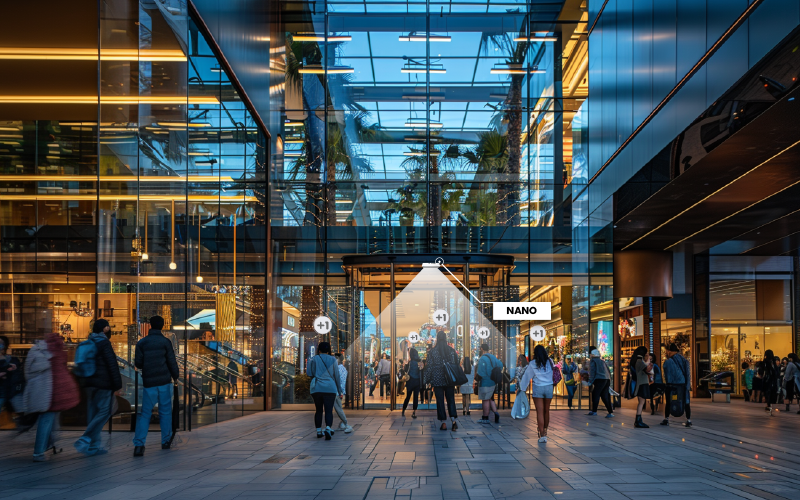
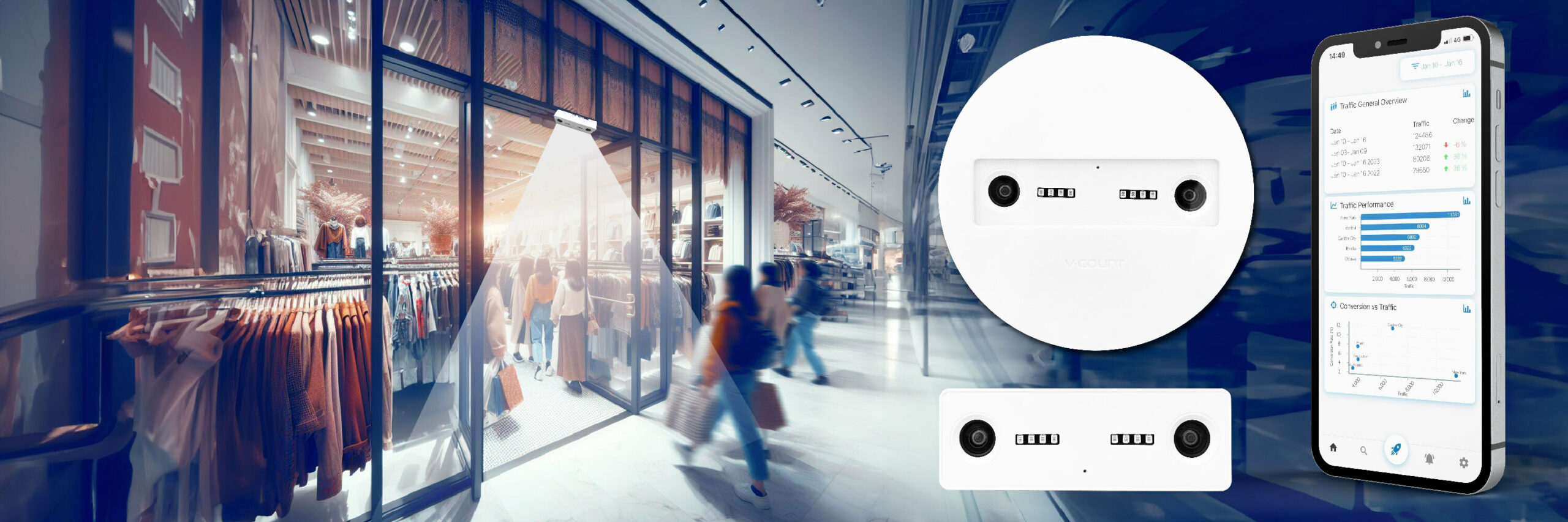
V-Count’s Nano sensor was designed with precisely these constraints in mind. Using 3D active stereo vision with AI-on-chip processing, the Nano delivers 99% counting accuracy from a device small enough to mount above any doorway. It connects via USB-C power and Wi-Fi, sets up in under five minutes, and operates in complete darkness (0 Lux)—ideal for dimly lit gallery environments.

Actionable Dashboards That Speak to Every Stakeholder
Raw data is worthless without clear visualization. BoostBI, V-Count’s cloud-based analytics platform, transforms sensor data into intuitive dashboards that serve every stakeholder: the museum director reviewing quarterly trends for a board presentation, the facility manager optimizing HVAC schedules based on occupancy, the marketing team evaluating campaign impact, and the grant writer compiling impact metrics.
Key capabilities include real-time occupancy tracking with capacity alerts, historical trending with year-over-year comparisons, heatmap visualization showing visitor distribution across zones, demographic breakdown by age range and group composition, and exportable reports formatted for funding applications.
Zone Analytics and Heatmapping: Understanding Movement at a Granular Level
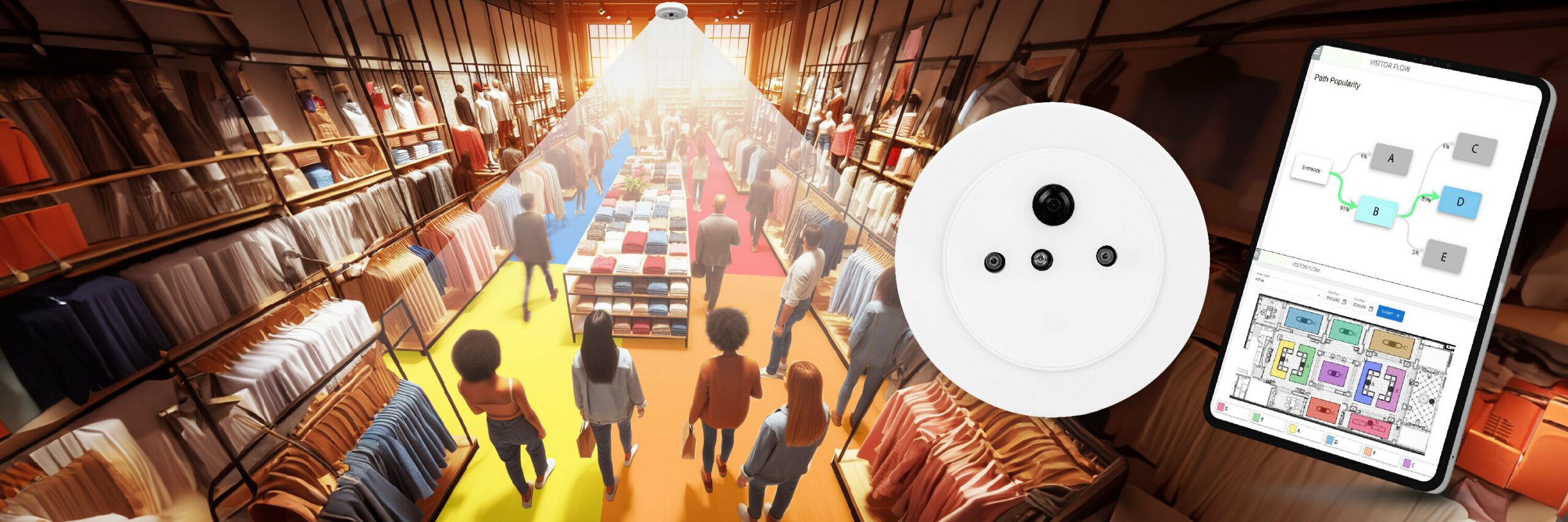
This is where visitor analytics moves from useful to indispensable. Zone analytics and heatmapping reveal patterns that are completely invisible to manual observation. Which gallery wing receives the most sustained attention? Where do visitors pause to read interpretive panels versus walk past? Which exhibit placement generates the highest dwell time? Where do visitor paths converge into uncomfortable bottlenecks?
For Ultima Prime, V-Count’s dedicated zone analytics sensor, a single device covers up to 120 square meters from 4.5 meters height, meaning fewer sensors are needed to map an entire wing. The heatmap data is color-coded for immediate interpretation—red zones of high engagement, blue zones of low traffic—enabling curators and facility managers to make evidence-based decisions about exhibit placement, wayfinding, and space utilization.
Cultural Institutions Leading the Analytics Revolution
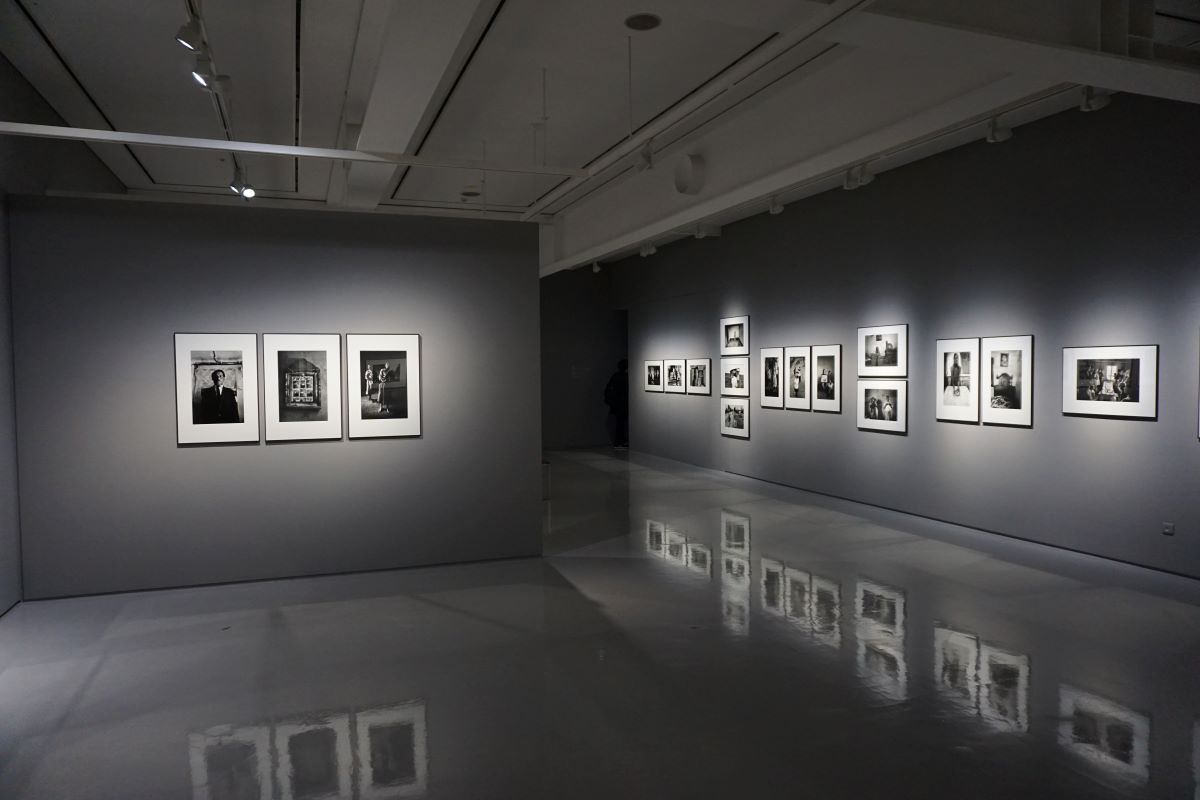
Across Europe and beyond, leading museums have already transformed their operations through V-Count’s visitor analytics platform. Here’s how five institutions are putting data to work:
Nasjonalmuseet, Oslo
Norway’s largest art museum uses V-Count analytics to optimize visitor flow through its world-class collections, plan staffing for permanent and temporary exhibitions, and provide verified attendance data for government reporting.
Aros Museum, Aarhus
Leverages real-time occupancy data to manage capacity during popular exhibitions while ensuring visitor comfort—critical for its iconic Rainbow Panorama installation that can only accommodate limited visitors simultaneously.
Munch Museum, Oslo
Deployed visitor analytics to understand how audiences interact with Edvard Munch’s iconic works, informing both exhibit design and conservation decisions based on actual crowd density data near sensitive artworks.
Arte Museum
Uses demographic analysis to demonstrate community engagement across age groups and visitor segments, providing the granular impact metrics that local government and cultural funding bodies increasingly require.
Latvian National Museum
Implemented cross-location visitor tracking to understand patterns across multiple museum facilities, optimizing programming resources and identifying which locations drive the highest per-visitor engagement.
Privacy and Compliance: The Non-Negotiable Foundation
Cultural institutions are entrusted with public spaces. Visitors expect—and deserve—the assurance that their presence is not being surveilled. This makes privacy compliance not just a regulatory requirement but a fundamental trust issue.
V-Count’s entire technology stack is engineered around privacy as a first principle. The AI-on-chip architecture processes visual data on the sensor itself—no images are transmitted, stored, or accessible to anyone. The system outputs only anonymous, aggregated metrics: how many people entered, which zones they occupied, how long they stayed. There is zero facial recognition, zero individual tracking, and zero personal identifiable information at any point in the data pipeline.
This means institutions can deploy analytics with complete confidence: full GDPR compliance, full alignment with museum ethics standards, and full transparency to visitors who may ask about the technology.
The Future of Cultural Institution Analytics: What’s Coming in 2026 and Beyond
As AI technology accelerates, several emerging capabilities are reshaping what’s possible for museums and libraries. Predictive analytics is moving beyond historical reporting into genuine forecasting—enabling institutions to predict visitor demand for upcoming exhibitions before they launch, model optimal staffing scenarios, and anticipate capacity challenges during holiday periods.
CRM integration is connecting anonymous foot traffic data with membership and ticketing systems, creating a comprehensive understanding of the visitor lifecycle from first visit through long-term patron engagement. And sustainability metrics are gaining traction as cultural institutions recognize that occupancy-based HVAC and lighting optimization can reduce energy costs by 20–30% while demonstrating environmental responsibility to funders who increasingly evaluate ESG criteria.
Why Cultural Institutions Cannot Afford to Wait
In an increasingly competitive funding environment, the gap between data-driven and data-blind institutions will only widen. Museums and libraries that invest in visitor analytics today gain compounding advantages: stronger funding applications backed by verified impact data, evidence-based programming decisions that replace expensive guesswork, operational efficiencies that free budget for mission-critical activities, enhanced visitor experiences that drive satisfaction and repeat visits, and competitive differentiation that positions institutions as innovative, forward-thinking organizations worthy of support.
The institutions profiled in this article didn’t adopt analytics because it was trendy. They adopted it because they recognized that in a world of finite resources and infinite accountability demands, understanding your visitors isn’t optional—it’s existential.
Transform Your Museum or Library with Visitor Analytics
Join Nasjonalmuseet, Aros, Munch Museum, and hundreds of cultural institutions across 120+ countries already using V-Count to secure funding, optimize operations, and deliver exceptional visitor experiences.