
March 11, 2026 • Updated March 12, 2026
People Counting
Retail Analytics
⏱ 10 min read
Retail people counting has evolved from manual clickers at the door to AI-powered sensors that track foot traffic, measure conversion rates, and generate heatmaps — all while maintaining complete customer privacy. This guide covers everything retailers need to know in 2026.
- What Is People Counting in Retail?
- How Does a People Counting Sensor Work?
- People Counting Technologies Compared
- Why Foot Traffic Data Matters for Retail
- 5 Ways Foot Traffic Analytics Increase Conversion
- How to Calculate & Improve Your Retail Conversion Rate
- Why CCTV-Based People Counting Violates GDPR
- People Counting & GDPR: Privacy by Design
- ROI of People Counting & Why Vendor Support Matters
- How to Choose the Right People Counting System
- Frequently Asked Questions

What Is People Counting in Retail?
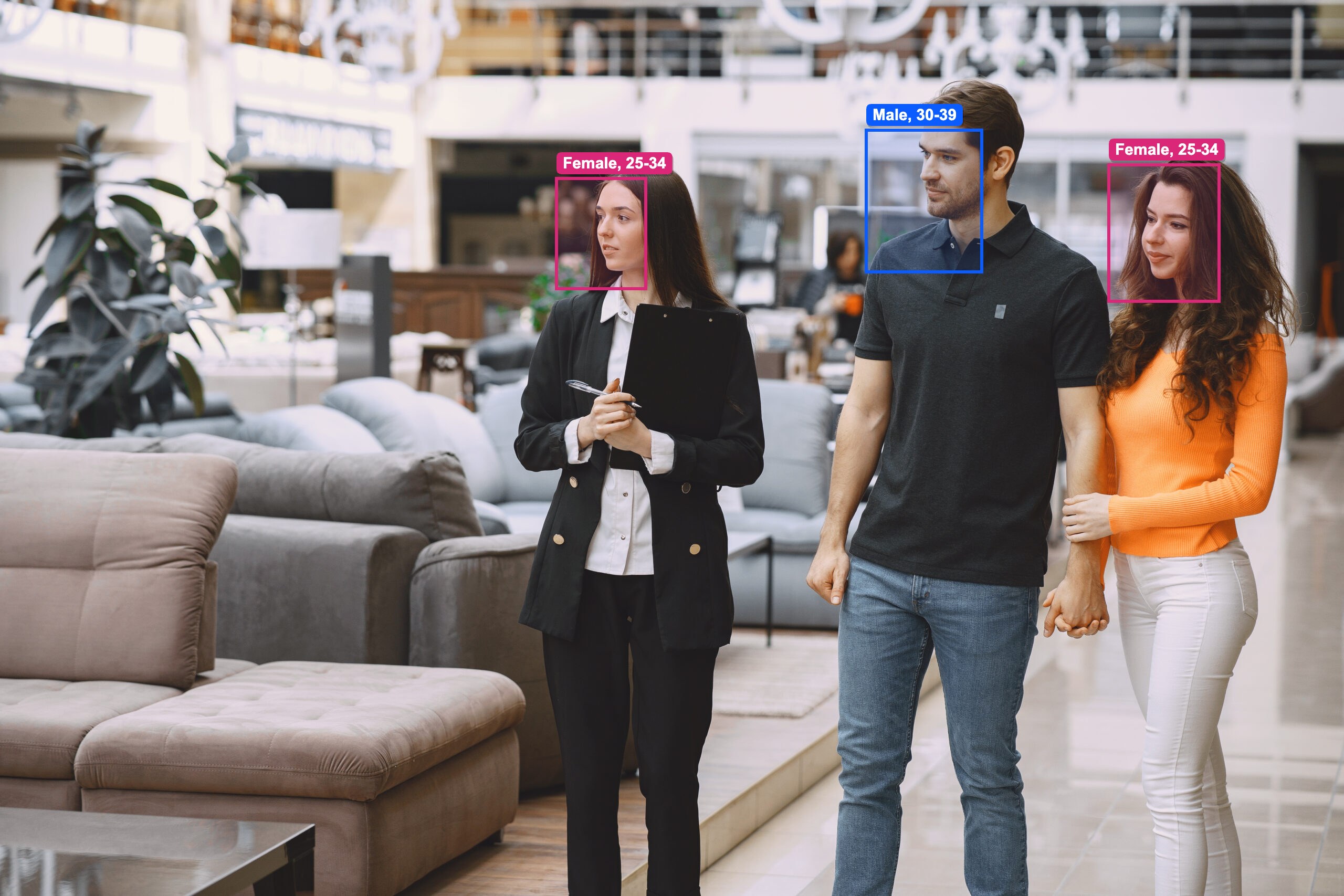
People counting (also called footfall counting or visitor counting) is the use of sensor technology to track the number of people entering, exiting, and moving within a retail store. At its simplest, a people counter tells you how many customers visited your store today. At its most advanced, it measures foot traffic patterns throughout the day, real-time store occupancy levels, dwell time in specific zones, customer-to-staff ratios, demographic trends such as age and gender distribution, queue lengths and wait times, and storefront capture rates from passing pedestrian traffic.
The global people counting system market is projected to reach $2.1 billion by 2029, driven by the retail sector’s growing need for data-driven decision making. Over 70% of retail executives now consider customer traffic data essential for operational decisions — up from just 35% five years ago.
How Does a People Counting Sensor Work?
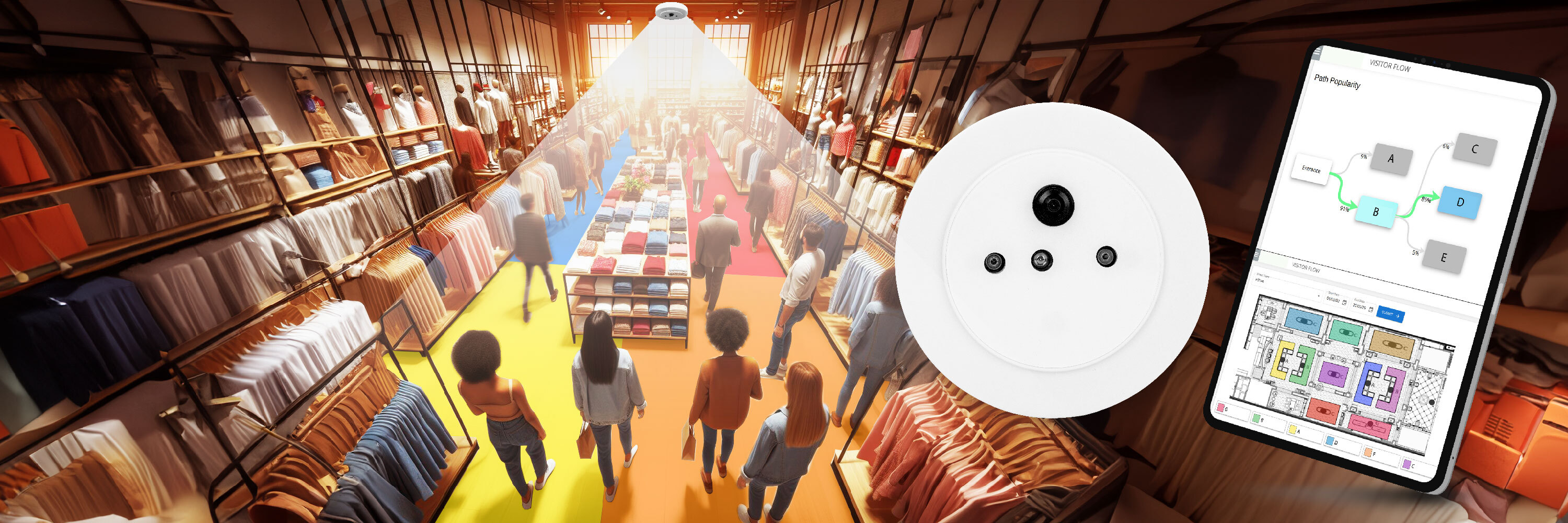
Modern AI-powered people counting sensors are compact devices mounted on the ceiling above store entrances or inside specific zones. Here is the step-by-step process of how they work.
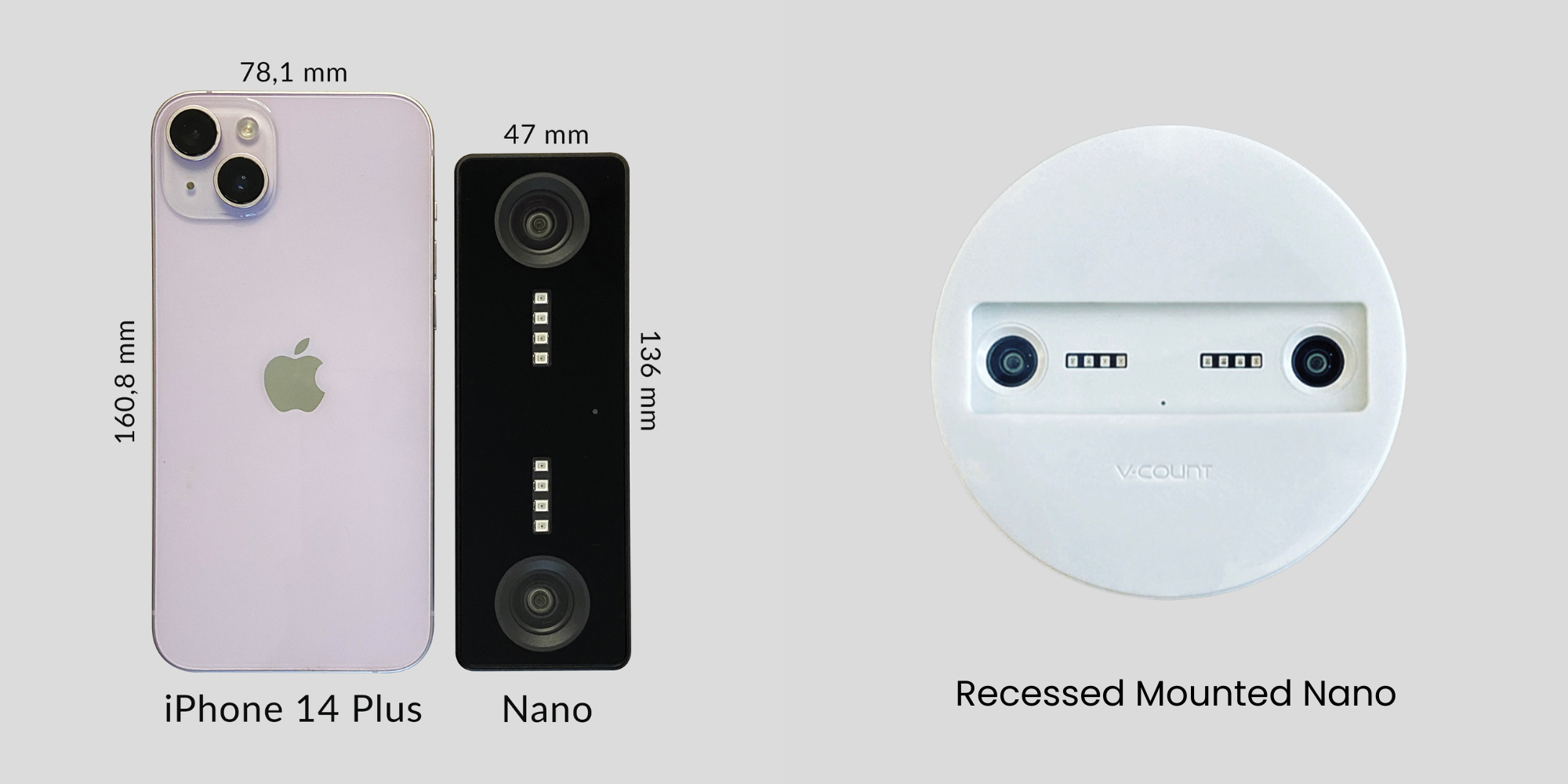
The sensor uses 3D active stereo vision — two camera lenses that create a depth map of the area below, similar to how human eyes perceive depth. When a person walks underneath, the sensor’s onboard AI chip detects the human shape using deep learning algorithms trained on millions of examples. The system then assigns a unique track to each individual, following their path to determine direction (entering vs. exiting) and counting them as they cross a virtual line. All processing happens directly on the sensor chip — this is called AI-on-chip or edge processing. No video footage is recorded, stored, or sent to the cloud. Only anonymized numerical data (count, direction, timestamp) is transmitted to the analytics platform.
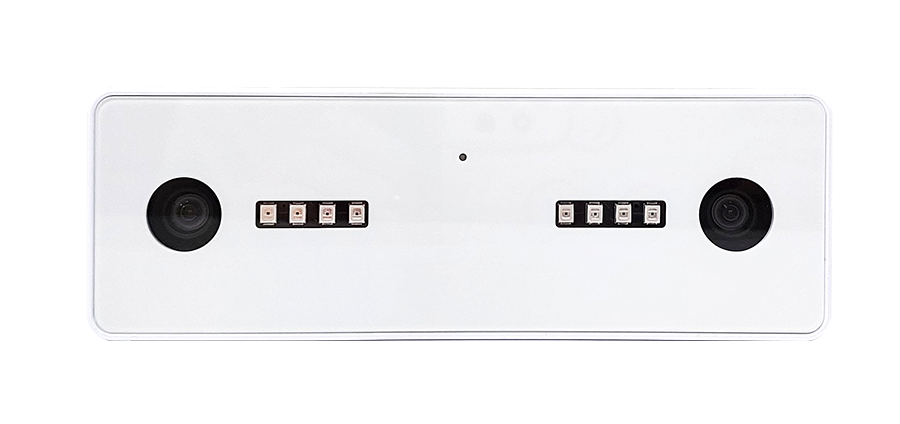
V-Count Nano AI: 99%+ Accuracy in a Compact Package
V-Count’s Nano AI sensor processes everything on-device using AI-on-chip architecture, achieving 99%+ counting accuracy even in complete darkness, heavy crowds, or wide entrances. It installs in under 5 minutes with a single USB-C cable and connects via Wi-Fi to the BoostBI analytics platform.
People Counting Technologies Compared
Not all people counters are created equal. The technology behind the sensor determines accuracy, the types of data you can collect, and whether the system respects customer privacy. Here is how the main technologies stack up.
⚠ Why CCTV-Based People Counting Is a GDPR Risk
Some vendors offer people counting as a software layer running on top of existing CCTV security cameras and on-premise servers. While this may seem appealing, it carries serious legal and operational risks that every retailer must understand.
GDPR and privacy violations: CCTV-based people counting systems record and process identifiable video footage of customers. Under GDPR, this constitutes processing of personal data — and in most retail scenarios, it fails the proportionality test because the same insights can be achieved without recording any identifiable images. Companies found in violation face fines of up to 4% of annual global revenue (or €20 million, whichever is greater). Similar penalties exist under CCPA, Brazil’s LGPD, and other data protection frameworks worldwide. For a retailer generating $50 million in annual revenue, a single GDPR enforcement action could result in a $2 million+ fine — far exceeding any savings from choosing a cheaper CCTV-based solution.
The privacy-first alternative: Purpose-built AI people counting sensors like the V-Count Nano AI use 3D depth sensing and AI-on-chip processing. They never record identifiable images — only anonymous silhouettes and numerical data. This makes them privacy-by-design and GDPR compliant from day one, eliminating regulatory risk entirely.
Why Foot Traffic Data Matters for Retail
E-commerce has always had an advantage: every click, scroll, and abandoned cart is tracked automatically. Physical retail operated in the dark for decades. Foot traffic analytics close that gap by giving brick-and-mortar stores the same depth of customer intelligence that online retailers take for granted.
Physical retail is far from dead. Shopping mall traffic grew around 1.8% year-over-year in 2025, with visit durations rising by 3.3%. Shoppers are coming back — but their expectations are higher. They want curated experiences, shorter wait times, and stores that anticipate their needs. Delivering on those expectations starts with understanding who walks through the door and what happens next.
Without people counting data, retailers are forced to make staffing decisions based on guesswork, measure marketing campaign success by sales alone (missing the traffic that came but did not convert), benchmark stores against each other using revenue only (ignoring that one store gets three times the foot traffic), and accept that layout and merchandising decisions are driven by intuition rather than evidence.

5 Ways Foot Traffic Analytics Increase Retail Conversion Rates
Optimize Staff Scheduling to Match Foot Traffic Peaks
The most immediate ROI from people counting comes from aligning staff schedules with actual visitor patterns. Most retailers build schedules based on historical sales data and manager intuition. Traffic data introduces a leading indicator: if footfall surges between 11 AM and 1 PM but the roster is optimized for a 2 PM sales peak, the store is systematically understaffed during its highest-opportunity window. The fix is simple once the data makes it visible, and the payoff is often measurable within weeks.
Measure Storefront Conversion Rate (Capture Rate)
Not every person who walks past a store walks in. The ratio of passersby to entrants — storefront conversion rate — is a metric most retailers have never tracked. Outdoor-rated sensors like V-Count’s Nano Outdoor count pedestrian traffic outside the store, providing the denominator that turns entry counts into a true capture rate. A store might discover its window display captures 12% of passing traffic while a competitor captures 20%, triggering a visual merchandising overhaul that lifts entries by thousands per week.
Use Zone Heatmaps to Eliminate Dead Spots
Aggregate traffic numbers tell you how many people entered, but zone-level heatmap analytics reveal what happened afterward. Which aisles do shoppers skip entirely? Where do they cluster but fail to purchase? Is the promotional endcap at the back of the store actually drawing traffic, or is it invisible? Heatmap data from overhead sensors like V-Count’s Nano Prime provides the spatial intelligence retailers need to optimize layout, product placement, and promotional positioning. Retailers who deploy zone analytics across their networks regularly see conversion rates increase by several percentage points.

Reduce Queue Abandonment with Real-Time Alerts
Long checkout lines are one of the most preventable causes of lost sales. Real-time queue monitoring lets store managers open additional registers before lines grow unmanageable, and the analytics layer identifies which hours, days, and seasons require preemptive staffing. Retailers report reducing average queue wait times by 30% within the first quarter of deployment, with corresponding improvements in customer satisfaction and retail conversion rates.
Connect Online Marketing Spend to In-Store Visits
The holy grail of omnichannel retail has been attributing digital ad spend to in-store foot traffic. Foot traffic analytics close this loop. By comparing traffic surges against the timing of email campaigns, social media promotions, or local paid search activity, marketing teams can finally see which digital investments drive physical visits — and which just generate clicks. This attribution capability turns foot traffic data from an operational metric into a strategic marketing asset.
How to Calculate & Improve Your Retail Conversion Rate
Your retail conversion rate is the percentage of store visitors who make a purchase. The formula is straightforward: divide the number of transactions by the total number of visitors, then multiply by 100.
Conversion Rate = (Number of Transactions ÷ Total Foot Traffic) × 100
Example: If your store sees 1,000 visitors on a Saturday and makes 220 sales, your conversion rate is 22%.
The average retail conversion rate falls between 20% and 40%, with top-performing stores pushing above 40%. Without people counting technology, most retailers cannot calculate this metric accurately because they lack reliable foot traffic data — they only know how many transactions occurred, not how many potential customers walked out without buying.
Even small improvements compound dramatically. For a store averaging 1,000 daily visitors and a $45 average transaction value, increasing the conversion rate from 22% to 25% adds $13,500 in monthly revenue — or $162,000 per year from a single location. Multiply that across a chain and the impact becomes transformational.
People Counting & GDPR: Privacy by Design
The conversation around in-store analytics inevitably raises privacy questions. The most forward-thinking people counting providers have made privacy a foundational design principle rather than an afterthought.
All data processed on-device — no video streams leave the sensor.
System counts shapes, not faces. No identifiable images recorded.
Meets the strictest global data protection regulations by design.
Retailers can confidently communicate data practices to customers and regulators.
Solutions like V-Count’s Nano AI sensor process everything on-device, meaning no identifiable images are ever recorded, stored, or transmitted. The system counts anonymous silhouettes and aggregates movement data — no faces, no personal identifiers. In a regulatory environment where data protection laws are tightening globally, this privacy-by-design approach turns a potential liability into a competitive advantage.
ROI of People Counting & Why Vendor Support Matters
Investing in a people counting system pays for itself remarkably fast. Most retailers report full return on investment within 3 to 6 months, driven by optimized staff scheduling, increased conversion rates, and smarter marketing spend. The key is choosing a system backed by ongoing support, cloud analytics, and regular updates — not just a one-time hardware purchase.
When evaluating solutions, look at the total package: sensor accuracy, analytics platform capabilities (like BoostBI), installation simplicity (modern sensors like the Nano AI install in under 5 minutes), and the vendor’s long-term support commitment. Contact V-Count for a custom quote tailored to your store count and requirements.
Why Subscription-Based Vendors Are the Safer Choice
An important pattern in the people counting market: almost all reliable, established vendors charge an ongoing subscription for their analytics platform and support services. This is not a hidden cost — it is a sign of a healthy vendor relationship. The subscription funds continuous software updates, cloud infrastructure, firmware improvements, technical support, and warranty service for your sensors.
Vendors who sell hardware-only with no subscription may appear cheaper upfront, but they consistently underdeliver on after-sales support. Industry forums and buyer reviews are filled with complaints from retailers who chose a low-cost, no-subscription people counter only to find that firmware updates stopped after six months, the analytics dashboard was never improved, support tickets went unanswered for weeks, and when a sensor failed or accuracy degraded, there was no one to call. In a system where data accuracy is the entire value proposition, a sensor without ongoing support quickly becomes an expensive ceiling decoration.
How to Choose the Right People Counting System
Selecting a people counting solution comes down to five factors that should guide every retail buyer’s decision.
Accuracy matters more than you think. A sensor at 95% accuracy sounds impressive, but for a chain of 200 stores with 5,000 daily visitors each, that 5% error means 50,000 miscounted visitors per day — enough to distort every conversion metric you rely on. Look for independently verified 99%+ accuracy.
Analytics depth determines value. A basic headcount is a starting point. The real ROI comes from heatmaps, dwell time, demographic insights, queue monitoring, and storefront analytics. Ensure the system offers a path to these features as your needs grow.
Privacy compliance is non-negotiable. In 2026, GDPR, CCPA, and similar regulations mean your people counter must be privacy-by-design. AI-on-chip processing that never stores images is the gold standard.
Integration capabilities save time. The best systems connect to your existing POS, staffing software, and business intelligence tools. Look for open APIs and pre-built integrations with platforms you already use.
Total value of ownership matters. Look beyond the initial purchase — factor in installation simplicity, analytics platform depth, support quality, and scalability. A system that seems affordable upfront but lacks cloud analytics and ongoing support may end up costing far more in missed insights and downtime over three years.