March 15, 2026
Shopping Malls
Foot Traffic Analytics
⏱ 12 min read
Managing a shopping mall without foot traffic analytics is like running an airline without knowing how many passengers board each flight. This guide shows mall operators and shopping center managers how to measure, analyze, and act on visitor flow data — from choosing the right mall visitor counting system to optimizing tenant performance, occupancy, and marketing ROI.

- Why Shopping Malls Need Foot Traffic Analytics
- 7 Key Metrics Every Mall Manager Should Track
- How Mall People Counting Systems Work
- Entrance Counting vs. Zone Analytics: What’s the Difference?
- Using Footfall Data to Measure Tenant Performance
- Real-Time Mall Occupancy Monitoring & Capacity Management
- Shopping Mall Heat Maps: Visualizing Customer Flow
- How to Increase Foot Traffic in Your Shopping Mall
- Measuring Marketing Campaign ROI with Visitor Data
- GDPR & Privacy Compliance for Mall Analytics
- How to Choose a Mall Visitor Counting System
- Next-Level Mall Management: Nano AI at Every Shop Door
- Frequently Asked Questions

Why Shopping Malls Need Foot Traffic Analytics
A shopping mall is one of the most complex commercial environments to manage. Dozens — sometimes hundreds — of tenants share common spaces, entrances, parking structures, and marketing budgets. Without accurate footfall data, mall managers are forced to make multi-million dollar leasing, staffing, and marketing decisions based on assumptions rather than evidence.

Shopping mall foot traffic analytics solve this problem by providing a continuous, accurate stream of visitor data across every entrance, floor, wing, and tenant zone. This data transforms how malls operate in several critical areas: lease negotiations are backed by real visitor exposure data, marketing spend can be measured against actual increases in footfall, peak-hour staffing for security and cleaning crews is driven by data rather than guesswork, and underperforming zones can be identified and revitalized before vacancy rates climb.
The stakes are significant. According to industry research, shopping centers that adopt comprehensive visitor analytics see measurable improvements in tenant retention, operational efficiency, and common-area revenue — because every strategic decision becomes grounded in real behavioral data rather than anecdote.
7 Key Metrics Every Mall Manager Should Track
Effective shopping center analytics go far beyond a single visitor count at the door. Here are the seven essential metrics that drive strategic decisions in mall management.
The aggregate count of visitors entering the mall across all entrances. This is the baseline metric for measuring overall mall performance, seasonal trends, and year-over-year growth. Sensors at every mall entrance ensure no visitor goes uncounted.
How visitors distribute across floors, wings, and corridors after entering. This reveals which zones generate the heaviest customer flow and which areas have dead spots that need attention — critical for tenant placement and wayfinding decisions.
The percentage of corridor traffic that actually enters a specific tenant store. A tenant on a busy corridor with a low capture rate may need better signage, window displays, or promotional support. This metric transforms lease renewal discussions from opinion into data.
The average time visitors spend in specific areas — food courts, atriums, seating zones, or event spaces. Longer dwell time in common areas correlates with higher overall spending. Short dwell times may indicate poor seating, lack of amenities, or layout issues.
Hourly and daily traffic patterns that reveal exactly when the mall is busiest. This data directly drives security scheduling, cleaning rotations, HVAC energy optimization, and event timing. Most malls discover that 60-70% of their weekly traffic concentrates in just 15-20 hours.
The live count of people currently inside the mall at any moment. Essential for fire safety compliance, emergency evacuation planning, and managing crowd density during sales events or holiday seasons. Occupancy monitoring has become a standard requirement for modern mall operations.
Anonymous age group and gender distribution data that helps malls understand their visitor profile. This information is invaluable for tenant mix optimization — ensuring the right balance of fashion, food, entertainment, and services for the actual demographic visiting the center. All demographic analysis is performed through anonymized AI inference, never facial recognition.
How Mall People Counting Systems Work
A shopping mall people counting system differs from a single-store setup because of the scale and complexity involved. A typical regional mall requires sensors at every public entrance (often 10-20+ doors), at corridor junctions to track visitor flow between wings and floors, at escalator and elevator landings to monitor vertical movement, and optionally at individual tenant store entrances to measure capture rates.
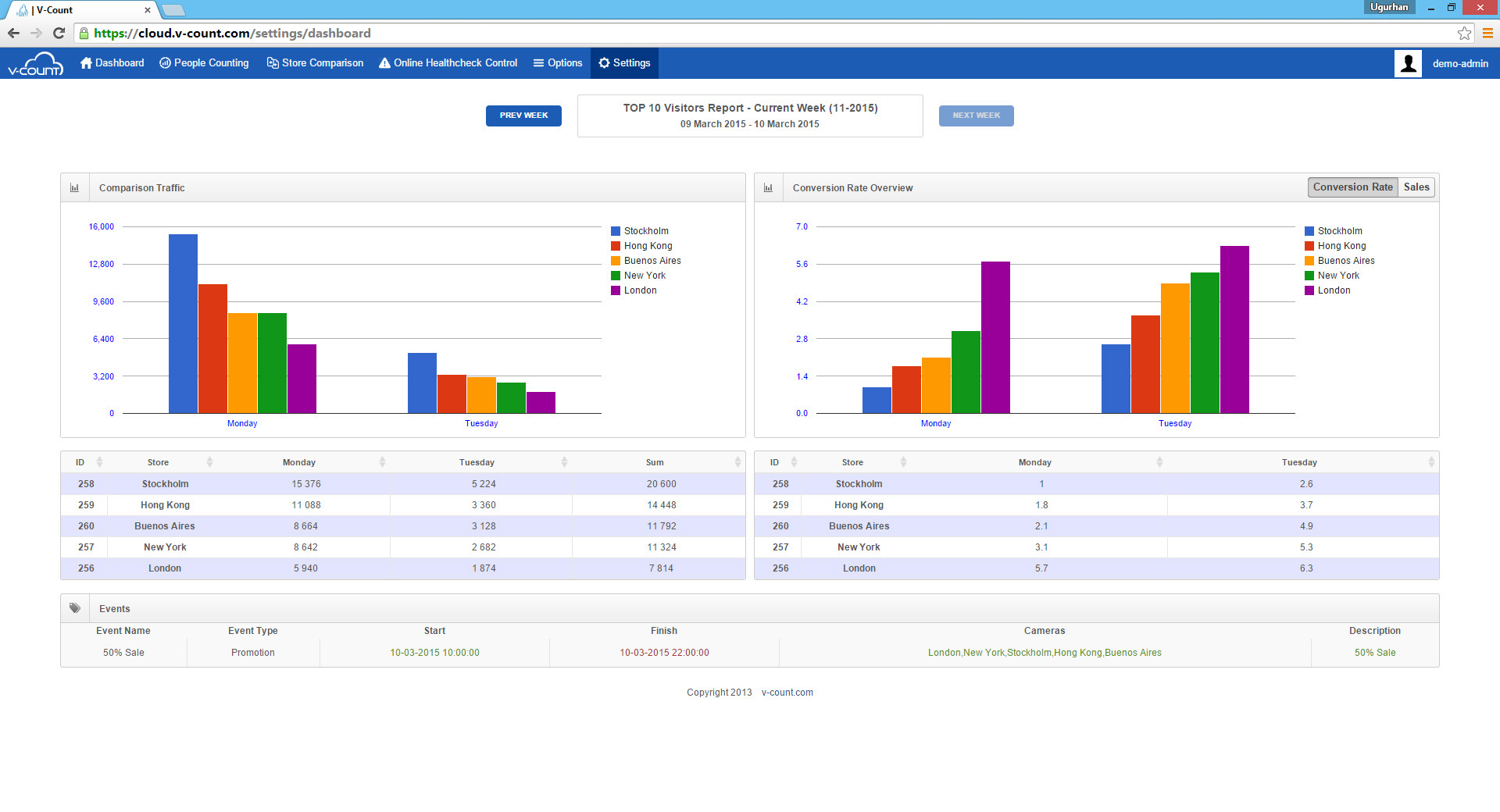
All of these sensors connect to a centralized analytics dashboard — such as V-Count’s BoostBI platform — where mall management can view total mall footfall in real time, compare performance across individual entrances, drill into floor-by-floor or zone-by-zone data, and generate automated daily, weekly, and monthly reports for stakeholders and tenants.
BoostBI: Purpose-Built for Multi-Location Analytics
V-Count’s BoostBI dashboard is designed to handle the complexity of shopping mall environments. Mall managers can compare footfall across hundreds of sensors from a single screen, set automated alerts for unusual traffic drops, and share read-only tenant reports without exposing proprietary mall-wide data. The platform integrates with POS systems, weather data, and marketing calendars for comprehensive performance analysis.
Entrance Counting vs. Zone Analytics: What’s the Difference?
Many mall managers start with entrance counting — placing sensors at the main doors to measure total footfall. This is a critical first step, but it only answers the question “how many people came in today?” It does not tell you where those visitors went once inside.
Zone analytics takes the next step by placing additional sensors at corridor junctions, floor transitions, and specific areas of interest. This reveals the internal distribution of foot traffic — which wings attract the most visitors, which floors suffer from low traffic, and how visitors flow between anchor tenants and smaller shops.
For malls serious about data-driven management, the ideal approach is a layered deployment: entrance sensors for total footfall plus zone sensors at strategic interior points. V-Count’s Nano AI sensor supports both configurations with 99%+ accuracy, and the Nano Prime handles wide corridors up to 10 meters with a single unit.
Using Footfall Data to Measure Tenant Performance
One of the most valuable applications of shopping mall foot traffic analytics is objectively measuring tenant performance. Traditionally, mall operators relied solely on tenant sales reports (often self-reported) and rent collection to gauge store health. Footfall data adds a crucial missing dimension.
With sensors at both corridor level and individual tenant entrances, mall management can calculate each store’s capture rate — the percentage of people passing by who actually walk in. A fashion retailer on the mall’s busiest corridor might see 10,000 people pass daily but only attract 800 inside. That 8% capture rate immediately raises actionable questions: Is the storefront attractive enough? Is the merchandise visible from the corridor? Would a promotional display outside the entrance help?
When combined with sales data, footfall numbers also reveal tenant conversion rate — the percentage of people who enter and actually buy something. A store with high foot traffic but low conversion may need better staff training or merchandising. A store with low traffic but high conversion may benefit from a more prominent location during lease renewal.
V-Count’s BoostBI platform allows mall managers to generate automated tenant performance reports that show each store’s footfall, capture rate, and peak hours — delivered on a weekly or monthly schedule. Tenants see only their own data, while management retains the full mall-wide picture. This transparency builds trust and provides a factual basis for lease negotiations, turnover rent calculations, and tenant mix decisions.
Real-Time Mall Occupancy Monitoring & Capacity Management
Real-time occupancy monitoring has evolved from a pandemic-era necessity into a standard requirement for responsible mall management. Knowing exactly how many people are inside your shopping center at any given moment serves multiple critical functions.
For safety and compliance, fire codes and building regulations specify maximum occupancy limits. Real-time counting at all entrances and exits gives mall operators a live, accurate number they can trust — far more reliable than manual estimates or sample counts. During peak shopping events like Black Friday, holiday seasons, or special sales, this data prevents overcrowding and enables proactive crowd management.
For operational efficiency, live occupancy data triggers smart building responses. When occupancy rises, HVAC systems can increase ventilation and cooling. Security teams can be repositioned to high-traffic areas. Cleaning schedules can be adjusted to focus on heavily used restrooms and food courts. When occupancy drops in the evening, energy systems can scale down — potentially reducing utility costs by 15-25% compared to fixed schedules.
Wide-Area Counting for Mall Entrances
Shopping mall entrances are typically much wider than individual store doors — often 6 to 12 meters across with multiple door banks. The V-Count Nano Prime sensor handles entrances up to 10 meters wide with a single unit, maintaining 99%+ accuracy even during peak rush periods when dozens of people pass simultaneously. For extra-wide entrances, multiple Nano Prime units can be linked to act as a single counting zone.

Shopping Mall Heat Maps: Visualizing Customer Flow
A shopping mall heat map is a visual representation of visitor density and movement patterns overlaid on the mall’s floor plan. Areas with high traffic appear in warm colors (red, orange) while low-traffic zones appear in cool colors (blue, green). This intuitive visualization turns complex foot traffic data into immediately actionable insight.
Heat maps answer questions that raw numbers alone cannot. They show exactly which corridors carry the most traffic, where bottlenecks form at peak times, which anchor tenants pull the most visitors through surrounding areas, and where “dead zones” exist that might benefit from new attractions, seating, or promotional displays.
For mall managers, heat map data is particularly powerful during tenant mix planning. When a lease expires on a prime location, heat map data proves exactly how many visitors flow past that spot daily — justifying premium rent. Conversely, when a tenant in a low-traffic zone requests a rent reduction, the heat map provides objective evidence to support or challenge the claim.

Common Heat Map Use Cases in Shopping Malls
Position high-margin tenants in the warmest zones to maximize their visibility. Place destination tenants (like gyms or cinemas) in cooler zones to draw traffic into otherwise underutilized areas.
Compare heat maps before, during, and after events to see exactly how seasonal activities, live performances, or promotional campaigns shift visitor flow throughout the mall.
Before investing in corridor redesigns or new escalator placement, use historical heat map data to predict how layout changes will affect visitor flow. Validate results after renovation with updated heat maps.
Price advertising space based on actual foot traffic exposure. A digital screen in a zone that sees 50,000 daily visitors commands a premium over one in a corridor with 5,000 — and heat maps prove the difference.
How to Increase Foot Traffic in Your Shopping Mall
Measuring foot traffic is only the first step. The real value comes from using that data to increase visitor numbers and improve the quality of each visit. Here are data-driven strategies that leading shopping centers use to grow footfall.
Optimize Your Tenant Mix Based on Visitor Demographics
If your demographic analytics show that 65% of your weekday visitors are women aged 25-44, but your tenant mix skews heavily toward electronics and sporting goods, there’s a mismatch. Use anonymous demographic data to ensure your mix of fashion, food, health, beauty, and entertainment aligns with who actually visits. V-Count’s demographic analysis feature provides this insight without collecting any personal data.
Schedule Events During Low-Traffic Periods
Most malls see predictable traffic dips — typically Tuesday and Wednesday afternoons, or the first two weeks after major holidays. Rather than accepting these dips, schedule events, pop-up markets, or promotional campaigns specifically during low-traffic windows. Track footfall before, during, and after each event to measure actual impact and refine your events calendar over time.
Improve Wayfinding and Internal Flow
If heat map data shows that upper floors or distant wings receive disproportionately low traffic, the issue may be poor wayfinding rather than lack of interest. Strategic signage upgrades, better escalator and elevator visibility, and attractive “pull” tenants (food courts, entertainment venues, anchor stores) placed in low-traffic zones can dramatically redistribute visitor flow and increase overall dwell time.
Leverage Seasonal Traffic Patterns
Year-over-year footfall data reveals seasonal patterns with precision: exactly when back-to-school traffic begins, how holiday traffic builds week by week, and when post-holiday slowdowns start. Armed with this data, mall marketing teams can launch campaigns days before the seasonal surge begins — capturing traffic that competitors miss — and plan staffing and inventory support well in advance.
Measuring Marketing Campaign ROI with Visitor Data
One of the biggest challenges for shopping center marketing teams is proving that their campaigns actually work. Digital advertising has click-through rates and conversion tracking. Physical malls have historically had nothing equivalent — until foot traffic analytics closed the gap.
With accurate visitor counting data, mall marketers can now run true before-and-after comparisons for every campaign. Did the social media promotion actually increase Saturday footfall? Did the influencer event bring new visitors or just shift traffic from other days? Did the new parking validation program increase visit frequency?
The methodology is straightforward. Establish a baseline footfall pattern for the same days and times over the previous 4-8 weeks. Launch the campaign. Compare actual traffic against the baseline during and after the campaign period. Account for external factors like weather, holidays, and construction by comparing against the same period in previous years.
A shopping center runs a weekend promotional event with live music and exclusive discounts. The 4-week baseline shows average Saturday footfall of 28,000 visitors. During the event weekend, footfall reaches 37,000 — a 32% lift. The following two Saturdays show 30,500 and 29,200, suggesting a residual “halo effect.” By comparing the total incremental visitors (approximately 10,700 across three weekends) against the event cost, the mall can calculate a precise cost-per-incremental-visitor and determine whether to repeat the format.
GDPR & Privacy Compliance for Mall Analytics
Shopping malls face heightened privacy scrutiny because of the volume and diversity of visitors they serve. Any foot traffic analytics system deployed in a mall must comply with data protection regulations including GDPR (Europe), CCPA (California), LGPD (Brazil), and similar frameworks worldwide.
The critical question is whether the system collects personal data. Under GDPR, personal data includes anything that can identify an individual — and that explicitly includes facial images, biometric data, and device identifiers like MAC addresses.
Some vendors offer people counting as a feature of existing CCTV camera systems. While this may seem cost-effective, it creates significant legal exposure. CCTV cameras capture identifiable facial images, which constitute biometric data under GDPR. Processing biometric data requires explicit consent from each individual — something that is practically impossible in a shopping mall environment with thousands of daily visitors. European data protection authorities have issued fines exceeding €2 million for unauthorized biometric processing in retail environments. Mall operators should ensure their visitor counting system uses dedicated, non-imaging sensors rather than repurposed CCTV infrastructure.
V-Count’s approach eliminates this risk entirely. The Nano AI and Nano Prime sensors use 3D depth sensing — they perceive human shapes as depth silhouettes, not identifiable images. No photographs or video are captured, stored, or transmitted. All processing happens on-device, and only anonymous numerical data (count, direction, timestamp) reaches the cloud platform. This privacy-by-design architecture means no consent is required under GDPR for basic people counting, since no personal data is processed.
Some people counting vendors market “one-time purchase, no subscription” models. While this sounds appealing, it often means no ongoing software updates to address new privacy regulations, no cloud analytics platform with automatic firmware updates, no customer support or accuracy recalibration as conditions change, and hardware that becomes obsolete without upgrade paths. For a shopping mall deploying dozens of sensors, the total cost of ownership with a subscription-based vendor that provides ongoing support, updates, and a maintained analytics platform is typically lower over a 3-5 year period — and the data quality is significantly higher.
Next-Level Mall Management: Nano AI at Every Shop Door
The modern shopping mall is undergoing a fundamental transformation. It’s no longer enough to count visitors at the entrance. Forward-thinking mall operators are deploying intelligent sensors throughout their properties to gain unprecedented visibility into every aspect of tenant performance and customer behavior. This shift represents the evolution of physical retail into a data-driven, AI-ready ecosystem — where every decision is informed by real-time analytics, and every square foot contributes to measurable business intelligence.
Why Next-Generation Malls Deploy Sensors at Every Shop Door
Modern malls have moved beyond basic entrance counting. The next generation of shopping centers recognize that true operational excellence requires a 360° digital view of how customers move through space and interact with every tenant. When mall management deploys per-shop analytics sensors at every individual shop entrance, they gain access to metrics that were previously invisible:
- Conversion Rate Tracking: Know exactly how many customers walk past each shop versus how many actually enter — measure the capture rate for every tenant in real time.
- Window Display Efficiency: When a tenant refreshes their window display, the data immediately shows the impact on foot traffic capture — prove what works and what doesn’t.
- Sales Efficiency Per Visitor: Combine foot traffic data with tenant POS systems to calculate revenue-per-visitor — identify which stores maximize sales from available traffic.
- Tenant Performance Benchmarking: Compare capture rates across similar store categories — recognize high performers and identify underperforming tenants that need support or lease renegotiation.
This is the inevitable evolution of physical retail. Just as e-commerce platforms track every click, scroll, and abandonment, modern shopping malls must track every visitor interaction with their physical environment. Without this data, mall operators are essentially flying blind — making lease decisions, tenant mix decisions, and marketing decisions based on intuition rather than evidence.
Properties equipped with per-shop analytics sensors become AI-ready malls — prepared for the next generation of artificial intelligence-driven decision making, predictive analytics, and automated optimization systems.

Without Nano AI at each door, you only see the top level. Full visibility requires sensors at every shop entrance.
Conversion Rate & Window Display Efficiency Tracking
The fundamental metric for any retail location is conversion rate tracking — the percentage of corridor traffic that converts into actual shop entries. When mall management lacks per-shop sensors, this metric remains invisible. A tenant might complain about low sales, but is the problem poor merchandising, weak marketing, or simply insufficient foot traffic? Without data, it’s impossible to answer.
With window display efficiency tracking enabled by per-shop sensors, the answer becomes clear. A tenant refreshes their window display on a Monday morning. By Tuesday, the data shows whether corridor traffic capture increased, decreased, or stayed flat. This provides immediate, quantifiable feedback on merchandising effectiveness. If a new display increases capture rate from 12% to 18%, that’s an 50% improvement in sales potential — and both the tenant and mall management know it works.
Combine foot traffic data with each tenant’s point-of-sale (POS) system, and you unlock sales per visitor metrics. Shop A might have 1,200 daily visitors and $8,000 in daily sales ($6.67 per visitor), while Shop B has 800 daily visitors but $7,200 in daily sales ($9.00 per visitor). These insights reveal which tenants are true efficiency leaders — capable of maximizing revenue from available traffic. This becomes critical data for lease negotiations, tenant placement decisions, and mall marketing strategies.
The Visibility Advantage: Without per-shop sensors, mall management operates with 5% visibility into tenant performance. With them, they achieve 100% visibility. Every decision — from tenant mix optimization to marketing budgets to lease renewals — shifts from intuition-based to data-driven.

Complete coverage across all tenant spaces enables unified performance monitoring and AI-driven insights
The AI-Ready Mall: Digital Twin of Physical Retail
When a shopping mall deploys sensors at every shop entrance, it becomes something unprecedented: a digital twin of physical retail. Every visitor movement is tracked anonymously, creating a comprehensive dataset that maps the physical reality of how customers navigate space, discover stores, and make purchasing decisions. This data feeds advanced AI models capable of insights that were previously impossible:
- Predictive Staffing: AI models forecast customer flow patterns by hour, day, and season — enabling optimal staff scheduling and labor cost reduction.
- Automated Marketing Triggers: Real-time data feeds into marketing automation systems. When a shop’s capture rate drops 20%, the system can trigger promotional messages, special offers, or floor staff deployment.
- Lease Optimization: AI analyzes which tenant mix maximizes total mall performance, which locations command premium rents, and when lease renegotiations are needed.
- LLM Query Intelligence: Large language models can query this data in natural language: “Which tenants have declining capture rates?” “What’s the ROI of the new food court signage?” “Which shop pairs drive the most cross-shopping?”
This is where the future of physical retail lives — in the intersection of real-world foot traffic data and artificial intelligence. Malls equipped with comprehensive per-shop analytics sensors become platforms for AI-driven optimization, capable of competing effectively in an era where every competitor is tracked, measured, and continuously improved.

Nano AI: Per-Shop Deployment Made Simple
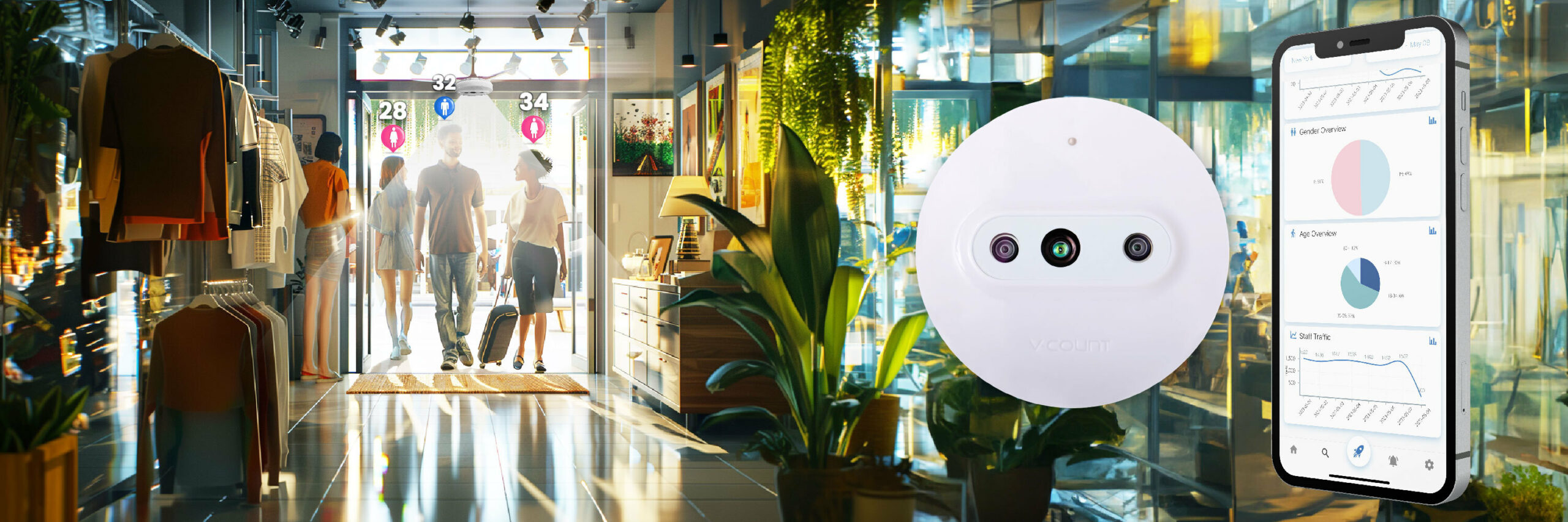
V-Count’s Nano AI is purpose-built for per-shop sensor deployment across modern shopping malls. Its compact wireless design eliminates the need for complex infrastructure — no cabling, no IT department involvement, no construction.
- USB-C Installation: Install in under 5 minutes per unit — any non-technical staff can deploy
- Wi-Fi Connectivity: Connects over existing mall Wi-Fi — no new infrastructure required
- Wireless & Accurate: No wires, no cabling, no network infrastructure — yet delivers sub-centimeter accuracy
- Rapid Deployment: At typical mall scale (80-150 shops), full deployment completes in 1-2 weeks

How to Choose a Mall Visitor Counting System
Selecting the right people counting system for a shopping mall requires evaluating several factors that differ from single-store deployments. Here is what mall operators should prioritize.

A 2% error at a single store entrance might mean miscounting 20 people per day. At a mall with 50,000 daily visitors across 15 entrances, the same error rate means 1,000 phantom visitors — enough to skew occupancy data and invalidate marketing ROI calculations. Demand 99%+ accuracy verified by independent testing.
Mall entrances are typically 6-12 meters wide with revolving doors, automatic sliders, and open atrium designs. Your sensor must cover these wide spans accurately without requiring one device per door. The V-Count Nano Prime covers up to 10m width in a single unit.
Mall management companies often operate multiple properties. The analytics platform should consolidate data from all locations into a single dashboard, support portfolio-level benchmarking, and allow drill-down into individual mall, floor, or zone performance.
Deploying 30-50 sensors across a shopping mall should not require months of construction or network infrastructure overhaul. Look for sensors that install in minutes with standard PoE or USB-C cabling and connect via existing Wi-Fi — minimizing disruption to mall operations and tenant business.
Your analytics platform should integrate with POS systems for conversion analysis, BMS (building management systems) for automated HVAC and lighting, marketing platforms for campaign tracking, and API access for custom reporting and data warehousing.
As discussed above, this is non-negotiable. Ensure the vendor’s sensors process only anonymized data on-device, store no images or video, and have been certified or independently audited for GDPR compliance. Ask for a Data Protection Impact Assessment (DPIA) template for your specific deployment.
Frequently Asked Questions
AI-powered 3D sensors are mounted above each mall entrance and at key interior points. These sensors use depth-sensing technology to detect and count every person passing beneath them, distinguishing between entering and exiting visitors. The data flows to a centralized analytics dashboard in real time, giving mall managers an accurate picture of total footfall, hourly patterns, and zone-by-zone distribution.
The number depends on the mall’s size and analytics goals. A basic entrance-counting setup typically requires one sensor per entrance (10-20 sensors for a mid-size mall). A comprehensive zone analytics deployment adds sensors at corridor junctions, escalator landings, and high-interest areas — typically 30-60 sensors for a full-service regional mall. V-Count’s team provides site surveys and sensor placement plans for each property.
Yes. Platforms like V-Count’s BoostBI support role-based access control. Mall management can give tenants view-only access to their own store’s traffic data without exposing mall-wide metrics or other tenants’ data. Many malls offer this as a value-added service that improves tenant engagement and retention.
Capture rates vary widely by category. Anchor department stores typically see 15-25% capture rates due to their destination appeal. Specialty retail stores on high-traffic corridors average 5-12%. Food court vendors and convenience stores can see capture rates above 30%. The most important thing is to track your own capture rate over time and measure the impact of changes to window displays, signage, and promotions.
It depends on the technology. Systems that use dedicated 3D depth sensors (like V-Count’s Nano AI and Nano Prime) process only anonymized depth data — no personal data is collected, so no individual consent is required. However, systems that use CCTV cameras, Wi-Fi tracking, or Bluetooth beacons may capture personal data (facial images, device identifiers) and would require consent or a valid legal basis under GDPR. Always consult with your data protection officer before deployment.
With modern wireless sensors like V-Count’s Nano AI (which installs in under 5 minutes per unit via USB-C and connects over Wi-Fi), a full mall deployment of 30-50 sensors can typically be completed within 1-2 weeks, including site survey, sensor placement planning, installation, calibration, and dashboard configuration. Minimal infrastructure work is needed since no dedicated cabling or network equipment is required.