Reviewed September 15, 2026
Buyer’s Guide
Vendor Comparison
Choosing footfall counting software starts with the decision you need to make: measuring visits to your stores, understanding in-store activity or comparing potential locations. This guide compares V-Count, FootfallCam, RetailNext, Xovis, Milesight and Placer.ai by data source, software package and buying considerations.
The short answer
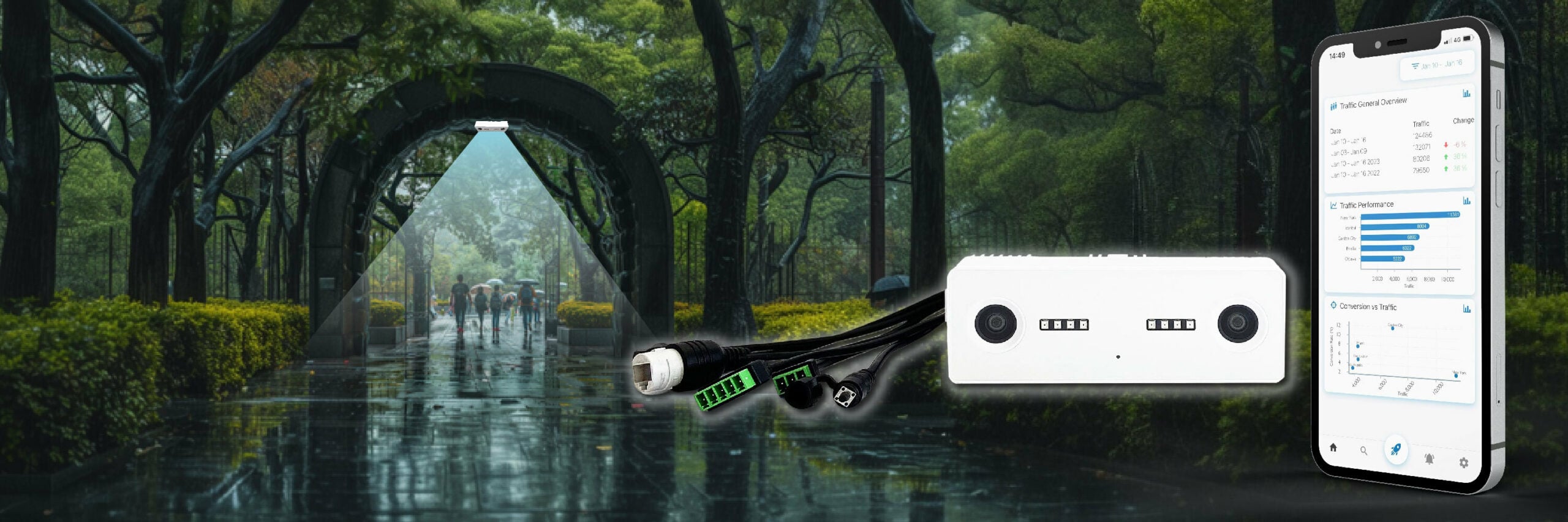
V-Count combines Nano AI people counting with BoostBI analytics and weekly AI Sales Coach guidance for store managers. Nano AI supports mounting from 2.2 to 7 m and counting in 0 lux darkness using built-in infrared LEDs. Hardware costs $299–$799 per sensor, one-time; BoostBI costs $9–$49 per sensor per month, including the selected sublicences.
Compare the required sensor performance, reports and operating workflow across the six providers below, then validate the proposed system at your own entrances.
On this page
- Footfall counting software compared: 6 vendors
- People counting features compared
- Nano AI pricing and BoostBI sublicences
- Three product categories buyers confuse
- 10 criteria that decide the shortlist
- Questions to ask before choosing a provider
- Head-to-head: V-Count vs each vendor
- Frequently asked questions
Footfall Counting Software Compared: 6 Vendors
Compare the data source, required reports and commercial package together. A feature appearing on a vendor website does not establish that it is included in every quote. The vendor links below support the package descriptions reviewed on 15 September 2026.
| Vendor | Primarily sells | Where the count comes from | Software and licensing | When to shortlist |
|---|---|---|---|---|
| V-Count | Nano AI people-counting sensors and the BoostBI analytics platform | Nano AI counting with simultaneous gender and age estimation; staff exclusion and other analytics depend on configuration and selected sublicences | Nano AI: $299–$799 per sensor, one-time. BoostBI: $9–$49 per sensor per month, including the selected sublicences for API access, staff exclusion, demographics, queues and heatmaps. See the pricing breakdown. | Retail and mall operators seeking counting up to 7 m, infrared counting in darkness, demographics and weekly store-manager coaching through BoostBI. |
| FootfallCam | People-counting hardware and V9 analytics | Installed people-counting sensors | V9 Lite covers basic metrics. The published package includes one year of Enterprise access; continued Enterprise access requires a subscription. Confirm current terms in the quote. Vendor source. | Buyers comparing basic counting with a broader analytics package |
| RetailNext | Aurora sensors and an in-store analytics platform | Installed sensors with analytics and business-system integrations | The published Traffic Analytics subscription includes Aurora hardware and platform access. Installation and other site-specific services may add costs. Vendor source. | Retailers evaluating a subscription package for sensors and in-store reporting |
| Xovis | 3D sensors and a partner ecosystem for analytics | 3D sensor measurements of counts, flow and zones; gender and apparent-age estimation are available through AI extensions on compatible sensors | Retail analytics can be delivered through analytics partners. Partner information. | Retailers and integrators needing sensor-based flow or zone measurement within a specified analytics solution |
| Milesight | People-counting sensors and IoT products | Technology varies by model; VS133/VS135 use AI ToF | Offers device-management/cloud options and integrations with analytics platforms. Vendor source. | Integrators selecting hardware for a defined reporting and data stack |
| Placer.ai | Location intelligence and aggregated location data | Aggregated data supplied by location-data providers | A location analytics product rather than an installed doorway counter. Confirm dataset coverage, permitted uses and plan terms. Vendor source. | Teams researching market trends, catchments or potential locations |
People Counting Features Compared
Compare maximum height, minimum light level, staff exclusion, combined gender and age recognition, and AI Sales Coach functionality. This comparison combines linked vendor specifications with V-Count’s competitive assessment, updated 15 September 2026.
| Feature | V-Count Nano AI + BoostBI | Footfall Pro2 (2025) | Retail Aurora + platform | Xovis PC2SE / PC2SE-L | Mile VS125 | Placer.ai Location intelligence |
|---|---|---|---|---|---|---|
| Max HeightMax height | 7 m2.2–7 m range | 6 m | 4 m | 6 mOther models go higher* | 6 mVS135 high-ceiling: 6.5 m | N/ANot applicable |
| Darkness Min LuxMin light (lux) | 0 luxBuilt-in IR LEDs | 0.05 luxExternal-IR night mode described | Not specifiedin reviewed brief | 2 lux | 0 luxIR illuminators on | N/ANot applicable |
| Staff ExclusionStaff exclusion | YesThree methods; selected BoostBI sublicence | LimitedDepends on behaviour, uniform and spatial cues | LimitedUWB-based staff exclusion | LimitedAI staff-exclusion extension; 2.5–3.5 m operating height | LimitedStaff identifiers; UWB kit on supported hardware | N/ANot applicable to doorway counting |
| Gender + Age Recognition in Same SensorGender + age same sensor | YesSimultaneous counting, gender and age; on-device processing | No | No | YesLicensed age and gender extensions on compatible sensors | NoGender and child/adult classification | N/ANot applicable: no counting sensor in this comparison |
| AI Sales CoachAI Sales Coach | YesWeekly coaching tailored to each store’s data in BoostBI | No | NoPulse AI: conversational analytics | No | No | No |
Model and feature details
V-Count
Nano AI + BoostBI
- Max Height: 7 m
2.2–7 m range - Darkness Min Lux: 0 lux
Built-in IR LEDs - Staff Exclusion: Yes
Three methods; selected BoostBI sublicence - Gender + Age Recognition in Same Sensor: Yes
Simultaneous counting, gender and age; on-device processing - AI Sales Coach: Yes
Weekly coaching tailored to each store’s data in BoostBI
FootfallCam
Pro2 (2025)
- Max Height: 6 m
- Darkness Min Lux: 0.05 lux
External-IR night mode described - Staff Exclusion: Limited
Depends on behaviour, uniform and spatial cues - Gender + Age Recognition in Same Sensor: No
- AI Sales Coach: No
RetailNext
Aurora + platform
- Max Height: 4 m
- Darkness Min Lux: Not specified in reviewed brief
- Staff Exclusion: Limited
UWB-based staff exclusion - Gender + Age Recognition in Same Sensor: No
- AI Sales Coach: No
Pulse AI: conversational analytics
Xovis
PC2SE / PC2SE-L
- Max Height: 6 m
Other models go higher* - Darkness Min Lux: 2 lux
- Staff Exclusion: Limited
AI staff-exclusion extension; 2.5–3.5 m operating height - Gender + Age Recognition in Same Sensor: Yes
Licensed age and gender extensions on compatible sensors - AI Sales Coach: No
Milesight
VS125
- Max Height: 6 m
VS135 high-ceiling: 6.5 m - Darkness Min Lux: 0 lux
IR illuminators on - Staff Exclusion: Limited
Staff identifiers; UWB kit on supported hardware - Gender + Age Recognition in Same Sensor: No
Gender and child/adult classification - AI Sales Coach: No
Placer.ai
Location intelligence
- Max Height: Not applicable
- Darkness Min Lux: Not applicable
- Staff Exclusion: Not applicable to doorway counting
- Gender + Age Recognition in Same Sensor: Not applicable: no counting sensor in this comparison
- AI Sales Coach: No
Green: Yes, 0 lux, or the highest maximum counting height among the named sensors. Red: Limited, No, unspecified, not applicable, a lower maximum height, or a nonzero minimum light level. Compare each entry with your installation requirements.
Compare the named model. The Xovis selection guide lists PC3SE for installations up to 14 m. The Milesight VS135 datasheet lists 6.5 m for its high-ceiling version. These are different products from the PC2SE and VS125 named in the column headings.
RetailNext’s 4 m maximum height and competitor “Limited” and “No” classifications reflect V-Count’s competitive assessment. “Limited” describes deployment or staff-identifier constraints. “AI Sales Coach” means weekly, store-specific AI coaching for managers; conversational analytics is a separate capability. Maximum height and minimum lux refer to counting; demographic and staff-exclusion limits can differ.
Nano AI Pricing and BoostBI Sublicences
V-Count has two core cost components: a one-time Nano AI sensor purchase and a recurring BoostBI subscription charged per sensor. BoostBI costs $9–$49 per sensor per month, depending on the selected sublicences. The selected features below are included in the quoted BoostBI subscription price.
| Component | Pricing or licensing basis |
|---|---|
| Nano AI sensor hardware | $299–$799 per sensor, one-time |
| BoostBI subscription | $9–$49 per sensor per month, including the selected sublicences |
| API access sublicence | Included in the BoostBI price |
| Staff exclusion sublicence | Included in the BoostBI price |
| Demographics sublicence | Included in the BoostBI price |
| Queue analytics sublicence | Included in the BoostBI price |
| Heatmaps sublicence | Included in the BoostBI price |
Ask the quote to identify the sublicences enabled for your deployment and the resulting monthly BoostBI rate. The selected sublicences are part of the $9–$49 price range, not extra licence charges on top of it. See V-Count pricing or request a quote for your sensor count and required capabilities.
Three Product Categories Buyers Confuse
Separate the measurement task from the way the solution is packaged. The categories below can overlap: a platform may combine entrance counting with zone analytics, and the available features depend on its configuration.
1. Measured counting at your own locations
Installed sensors measure entry and exit events at configured counting lines. With the right sensors, coverage and licences, a deployment can also measure zones and queues. These counts can support retail conversion measurement, staffing and tenant reporting. V-Count is one option; compare the required hardware and software scope across vendors.
2. Broader in-store analytics
Broader analytics can connect traffic with shopper activity, zones and business-system data. RetailNext is one example, and other vendors offer overlapping capabilities through different packages. Compare the actual deployment and included services rather than assuming one category is always more capable, expensive or difficult to install.
3. Market-level location intelligence
Location intelligence products use aggregated location data to help teams study markets, consumer patterns and potential sites. Placer.ai is an example. Evaluate coverage and methodology for that task; using this information to calculate a specific store’s conversion rate also requires an appropriate, aligned store-visit denominator.
10 Criteria That Decide the Shortlist
1. Counting accuracy under your actual conditions
V-Count reports up to 99% counting accuracy for Nano AI, including in difficult conditions. Review the Nano AI product information and ask for a test report relevant to your entrance. Compare vendors against the same manually verified entry and exit events, at the same height, lighting and peak traffic density.
Record overcounts and missed counts separately; aggregate totals can hide errors that cancel each other. Counting accuracy is a separate measure from age, gender or staff-exclusion accuracy.
2. Maximum supported mounting height
Nano AI supports a mounting range of 2.2–7 m. This matters when a high ceiling makes a lowered mounting pole impractical. Compare the exact model and lens variant: FootfallCam Pro2 and Xovis PC2SE list limits of 6 m, while specialist models support higher ceilings. The feature comparison above identifies the models being compared. Confirm entrance coverage and the permitted heights for every additional analytics function.
3. Low light and total darkness
Nano AI uses built-in infrared LEDs to count in 0 lux total darkness. Include the darkest operating period in your acceptance test, especially for cinemas, museums and venues with changing lighting. Ask whether the quoted counter has built-in illumination, requires an external infrared accessory or specifies a minimum ambient light level. A darkness capability statement alone does not establish a comparative accuracy result.
4. Staff exclusion that fits the store
V-Count offers three staff-exclusion methods. Ask which method fits your staff movements and store layout, how it is configured, and whether staff need to wear or carry anything. Test both staff movements that should be excluded and customers who should remain in the count. Keep staff exclusion, re-entry filtering and group counting as separate reporting rules. The selected staff-exclusion sublicence is included in the quoted BoostBI subscription price.
5. Counting, gender and age in the same sensor
Nano AI counts people and estimates gender and age using the same sensor. This provides demographic reporting without a separate demographics device. Its AI processing runs on the sensor; V-Count describes demographic analysis without recording or transferring images to servers.
See Nano AI’s demographic capabilities. Xovis also offers apparent-age estimation and gender statistics as licensed AI extensions on compatible counting sensors. Compare the supported age bands, demographic accuracy and operating limits; simple child/adult classification is a different measurement.
6. Weekly coaching for store managers
AI Sales Coach is a BoostBI module that delivers weekly, targeted coaching to store managers, curated by AI from their own store data. It gives managers a regular review of their store’s performance and guidance they can assess and act on. During the demo, ask to see one real weekly coaching output, the data behind it and how a manager would review the next week’s results.
Confirm AI Sales Coach access in the proposed package. Read the Sales Coach introduction for background.
7. Hardware, subscriptions and included features
Compare the same required functions over the same contract period. For V-Count, Nano AI is a one-time purchase and BoostBI is $9–$49 per sensor per month. Selected sublicences for API access, staff exclusion, demographics, queues and heatmaps are included in that BoostBI price. Ask the quote to identify each enabled function and any installation or integration services.
8. Integration with your existing systems
Check the API or connector, available data fields, time intervals, implementation work and support owner. V-Count API access is included as a BoostBI sublicence. Align traffic and POS reporting periods before calculating conversion.
9. Data handling across the complete deployment
Request a clear account of what the sensor processes, what leaves the device, where analytics are stored and who can access them. Check retention and any diagnostic or validation modes, as well as the settings of connected platforms. Use those technical details to assess the proposed deployment and your organisation’s requirements.
10. Installation, acceptance testing and support
Confirm who manufactures, installs, calibrates and supports each component. Agree the site survey, network prerequisites, acceptance test and escalation process for each country. Run a pilot at a representative difficult entrance before rolling out across the estate. Include a relevant customer reference and an itemised total-cost estimate in the evaluation.
Questions to Ask Before Choosing a Provider
- Under what test conditions was your accuracy figure measured, and can we validate the system at our busiest entrance?
- Who manufactures, installs and supports the system, and who owns each escalation?
- What are the hardware cost, subscription billing unit and included features for our requirements?
- How are staff, re-entry and group visits handled, and which licences do those functions require?
- Can we review the API documentation, required licence and integration scope before purchase?
- What data is processed or retained, and which technical and contractual documents describe the deployment?
- Can we review a relevant customer reference and an itemised total-cost estimate?
- Can the quoted model meet our mounting height and lowest light level with every required feature enabled?
- Can you show a real weekly coaching output and the store data that explains its recommendations?
Head-to-Head: V-Count vs Each Vendor
Explore the existing vendor comparison pages for technology and commercial context. For an accuracy decision, request measured results from a shared test protocol at your own site.
V-Count vs RetailNext →
V-Count vs Xovis →
V-Count vs Milesight →
V-Count vs Placer.ai →
V-Count vs ShopperTrak →
V-Count vs Ariadne Maps →
V-Count vs Vemcount →
V-Count vs Camlytics →
V-Count vs Viametrics →
V-Count vs FollowupCX →
Frequently Asked Questions
How does FootfallCam compare with other footfall counting solutions?
Compare the named FootfallCam model and its software package with the specific V-Count, RetailNext, Xovis or Milesight configuration being quoted. Check supported height, lighting, required analytics, staff exclusion, integration and total cost. The feature comparison shows model-level distinctions; the V-Count versus FootfallCam page provides further context. A shared on-site test is needed to compare counting performance.
How do I choose a reliable people counting sensor for a small business?
Start with the entrances you need to cover and the report you will use: daily visits, occupancy or conversion with POS data. Check mounting height, entrance width, lighting, staff exclusion and connectivity, then run a short acceptance test against observed crossings.
Compare total hardware, subscription and installation costs, and confirm who provides support. Select the functions you need rather than assuming the cheapest sensor delivers a complete reporting system. V-Count can help assess Nano AI entrance coverage and the BoostBI functions required for your store.
Compare V-Count against your shortlist
A 20-minute call: your entrances, your accuracy requirement, and a straight answer on where another vendor would suit you better.