Can libraries survive the age of downloads, ebooks, and easy online shopping? Yes, the ones embracing technology continue to be vital community institutions and evolve.
For a practical overview of sensors, KPIs and reporting, see our library and museum people counting solutions page.
People borrow fewer books as the years go by, but libraries are more popular than ever despite this fact. According to Words Rated’s study, in the US, physical books and other items accounted for less than 40 percent of libraries.
However, this doesn’t mean “libraries are dying,” as many would have you believe; they are just embracing digitalization. In fact, higher education professionals, students, publishers, and government researchers still regularly visit these institutions.
More importantly, libraries are evolving into community hotspots. They also provide people with free internet access and offer a range of digital resources, such as e-books and audiobooks. They also play a vital role in helping bridge the digital divide.
Yet, it’s quite challenging for libraries to maintain their traditional values and community-centric focus in this age. So, what can a manager do to ensure they stay relevant and their library survives?
Well, if you’re a decision-maker of a library, you can start exploring how you can use advancements in technology to your benefit.
For instance, Imagine having access to accurate, real-time insights about how members and other visitors are utilizing your library. Building historical visitor data would allow you to enhance operational efficiency, reduce unnecessary costs, improve foot traffic, and demonstrate your library’s value to stakeholders and funders.
You can also discover your visitors’ demographics, which zones in your library are more popular, and more. The possibilities that people counting technology brings to your fingertips are endless. A modern, reliable, and highly accurate people counting system can help turn your library into a dynamic and responsive institution that caters to the changing needs of your patrons.
Let’s dig deeper and uncover how people counting can transform your library for the better.

Show funders how many people you serve
Count visitors at every entrance and report daily, monthly and yearly attendance in a few clicks.
- Attendance reports
- Busiest hours
- Room occupancy
Staff Allocation and Resource Management

A modern visitor tracking system that’s powered by 3D Active Stereo Vision technology will get you up to 99% accurate footfall data, even under tough weather conditions or even when it’s completely dark. Hence, employing an accurate system will let you know how many people enter and exit your library at any given specific time period.
It can also provide you with live occupancy monitoring, enabling you to follow the government’s health guidelines and improve safety at your establishment.
Why does knowing the number of people visiting your library important for staff allocation and resource management? It’s quite obvious, isn’t it? Understanding peak library usage times and identifying busy periods allows you to optimize staff schedules, reduce wait times for visitors, and ensure that your library delivers great experiences for your patrons.
You can also properly and efficiently allocate resources when you build historical data and gain an in-depth understanding in regards to visitor traffic and engagement levels. Perhaps, one of your entrances is rarely ever used, but you’re using your valuable resources and labor force to maintain that entry point. The power of visitor data can easily reduce costs and improve the guest experience.
Accurate visitor data will also help you identify trends and patron preferences, giving you a chance to tailor library services to match the demands of your community and even organize community events that will drive more people and become members.
Space Planning and Visitor Flow
Most libraries have limited space; therefore, it is essential to optimize the use of available areas. Using visitor analytics tools can help you strategically organize the library layout. Arranging furniture, shelving, study areas, community meeting spots, and event locations through accurate visitor data will improve visitor flow and increase foot traffic. It will also help you maximize the library’s capacity and accommodate the needs of patrons.
Knowing and understanding visitor flow empowers your decision-making as well. If your people counting sensor is capable of in-depth visitor analytics, you can identify bottlenecks and congestion points at your library and come up with ways to eliminate such issues. Having this power in the palm of your hand can help you build a more intuitive and user-friendly environment for your patrons.
On top of that, combining zone analytics solutions with demographic-based solutions can help you promote the right event to the right audience and improve both engagement and attendance levels. You can use your library’s visitor data to get new funding or support from other helpful organizations.
Enhance Your Delivery System
Using zone analytics and discovering visitor flow patterns can help libraries optimize their service delivery and find the ideal places where self-checkout stations or additional staff members should be located.
Strategically placing team members or self-checkout kiosks will allow you to get ahead of overcrowding in certain areas of the library and improve your service quality. Improved response time and visitor experience will lead to higher satisfaction, and patrons are more likely to return to borrow other books (or other resources) in person.
Additionally, you can also launch an online reservation system for popular days and prime hours or when you have scarce resources. This, too, will eliminate congestion and increase satisfaction at your establishment.
What does it cost?
Sensors from US$299, paid once. BoostBI from US$9 per sensor per month.
Strategic Collection Placement

Gaining insights into the patrons’ behavior, preferences, and patterns can greatly assist the development of a library’s collection. Librarians can determine which sections of the establishment are more favored or which genres are more appealing among certain groups of patrons by closely tracking and analyzing visitor data.
Analyzing visitor flow across each section of your library can also reveal where to place which collection for the most visibility and engagement. After digging deep and segmenting your patrons into groups based on their demographics and preferences, this should be a walk in the park.
Just analyze the data you’ve collected so far, find out which group tends to frequent which specific zones, and curate collections to drive more engagement.
Of course, you can use this invaluable information to purchase books, digital content, and other items that suit your visitor base and enrich the library’s collection. This will drive more engagement and foot traffic as well.
Justify Funding
Most libraries are public, and they’re funded by the government, at least to some extent. In addition to traditional funding sources, public libraries can also utilize grants and private donations to secure valuable financial support. Some libraries (usually larger ones) even have dedicated staff to secure grants and private donations.
When it comes to securing additional funding or advocating for your library’s value, relying on concrete and precise metrics at your fingertips can greatly bolster your stand. Showcasing who visits your library and how many visitors you pull daily, weekly, monthly, and on special events, etc., can all help your funding efforts and show donators that your library is quite important in bringing the community together.
People counting and visitor analytics with extra features will also help you secure funding for improving your library’s technological infrastructure or getting new collections, as you can showcase patrons’ interest with proven numbers and data.
Simply put, to meet the diverse needs of your communities, you must secure funding and support from stakeholders. The best way to convince government organizations, foundations, or your community members is to provide them with concrete numbers.
Another great aspect of people counting is how it helps reduce your carbon footprint. Many foundations deeply care deeply about going green, and a library should play a key role in building sustainable and green spaces after all.
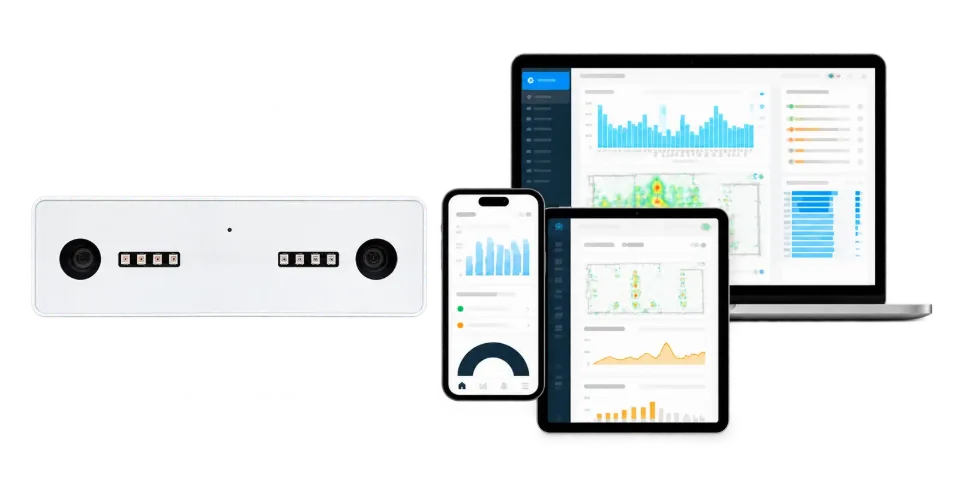
Count every visitor with up to 99% accuracy
Nano AI is a 3D people counting sensor. It counts entries and exits, can exclude staff and works in total darkness.
- Up to 99% accurate
- Staff exclusion
- Works at 0 lux
Choosing a People Counter for a Small Library
For a small library, start with reliable entrance counts, clear reporting definitions and a quote based on your building. Use these six checks to compare systems before buying.
- Entrances and coverage. List every public entrance, exit and shared access point, with doorway widths, mounting heights and photographs. Ask the supplier to confirm sensor quantities and coverage; one entrance does not automatically mean one sensor. Occupancy reporting requires all relevant entry and exit routes, plus an agreed starting count and reset rule.
- Visits versus unique patrons. Define a visit as an eligible inward crossing during the reporting period. One person entering twice creates two visits, not two unique patrons. Do not add entries and exits together and label the total visits. Anonymous entrance counting does not establish unique individuals across repeat visits. Agree how children, accompanying adults, groups, re-entry and staff are treated, especially for funding reports.
- Staff exclusion. Decide whether employees and volunteers should be excluded. Confirm the supported method, any accessories and package entitlement, then test repeated staff crossings alongside normal visitor traffic. Keep the exclusion rule consistent between reporting periods.
- Installation and acceptance. Confirm mounting permissions, doorway obstructions, power, connectivity and cable routes. Test side-by-side arrivals, children, wheelchair users and busy periods without narrowing accessible routes. Agree a manual-count comparison, acceptance criteria, commissioning responsibilities and support arrangements before installation.
- Reports and export. Request a sample hourly, daily and monthly report showing the branch, entrance, period, time zone, visit definition and exclusions. Verify the actual CSV, Excel, PDF or API output your team needs; do not assume every format is included. Confirm data retention, missing-data handling, user access and whether exported counts are raw or staff-excluded.
- Quote assumptions. Specify branches, access points, validated sensor quantities, opening hours, required reports and support. Ask for hardware or bundle terms, recurring software fees, selected features, accessories, installation, shipping, taxes, renewal and warranty conditions. Compare total cost over the same contract period.
When Nano AI and BoostBI fit
For indoor library entrances, Nano AI with BoostBI visitor analytics is a current V-Count option to assess once doorway coverage and mounting suitability are confirmed. Nano AI uses 5V USB-C power and Wi-Fi, with an optional external PoE splitter. Confirm the selected staff-exclusion configuration and validate it on site. BoostBI supports reporting and REST API access, with the required fields and entitlements agreed in your package.
If you also need reading-room heatmaps or zone analysis, assess Nano Prime against a floor plan and separate coverage requirements. Entrance counting alone does not provide a whole-library heatmap.
Ready for a scoped quote? Request a library entrance and budget assessment with entrance photographs, dimensions and a sample of the report you need.
Not sure where the sensors go?
Send a floor plan and a few photos taken by your store manager. We recommend sensor placement within 24 hours.
Library People Counting: Frequently Asked Questions
Which patron counter suits a small branch library?
For a small library that needs automated entrance counts and regular reporting, shortlist V-Count Nano AI with BoostBI. It gives your team a practical basis for reviewing busy hours, planning desk coverage and reporting visits, with staff exclusion available in the selected configuration.
Share your entrance dimensions and reporting template with V-Count so the proposed coverage and package fit your building and budget. Validate the installation against manual counts before acceptance.
Which library counter features matter most for annual returns?
Look for directional entry and exit counts, staff exclusion and clear hourly, daily and monthly reports, which V-Count provides with Nano AI sensors and BoostBI. V-Count Nano AI and BoostBI bring these requirements into a sensor-and-reporting setup that libraries can assess together. For occupancy, include every relevant access point; reading-room heatmaps require separately planned zone coverage.
Does a library people counter measure visits or unique patrons?
A library entrance counter such as V-Count’s Nano AI measures visits based on eligible inward crossings, rather than identifying unique patrons. V-Count Nano AI supplies the entrance data your team can use to track demand consistently: someone returning later creates another visit. V-Count can help you define the counting boundary and staff-exclusion setup so your reports are easier to interpret.
Keep visits, registered members and unique-patron statistics separate when reporting to funders.
Can library people counters exclude staff and volunteers?
Yes, V-Count’s Nano AI supports staff exclusion, so staff and volunteers wearing a staff tag can be removed from visitor counts. V-Count Nano AI offers staff exclusion to help libraries focus reporting on public visits. Include employees and volunteers in the deployment brief, then confirm the supported method, accessories and selected package.
Test repeated staff crossings alongside patron arrivals and check the reporting output. This gives your library a clearer basis for comparing attendance across months without routine staff movement inflating the figures.
How much should a small library budget for a people-counting system?
Budget for the complete installation: sensors, software, required accessories, commissioning and support; for reference, V-Count’s Nano AI starts from US$299 one-time and BoostBI from US$9 per sensor per month. Start with V-Count pricing and package options, then request a quote based on your entrances and reporting needs. V-Count can scope Nano AI and BoostBI together, making it easier to compare the proposed benefits with the full contract cost.
Can I export library visitor counts for funding and annual reports?
V-Count BoostBI supports reporting and REST API access, helping libraries prepare consistent attendance evidence for trustees, funders and annual reviews. Confirm the selected API entitlement and request a sample of any CSV, Excel or PDF output your team requires. Agree the branch, period, visit definition and staff-exclusion rules before launch. That preparation helps turn V-Count entrance data into reports your stakeholders can understand and reuse.
How can people counting help a library plan staffing and opening hours?
V-Count BoostBI turns compatible entrance counts into time-based reporting that helps library managers identify busy hours and review opening times. Use Nano AI visitor data alongside service-desk demand to plan coverage for after-school visits, study periods and community events. Compare equivalent weekdays and record holiday or programme changes. V-Count gives you the evidence to guide staffing decisions; your team adds the local knowledge of patrons’ support needs.
Which people-counting software is best for a small library?
V-Count BoostBI with Nano AI is a strong option for a small library seeking automated visit reporting and visibility into busy periods. It helps staff move from occasional headcounts to a repeatable reporting routine for service planning and funding discussions.
Ask for a demonstration using your opening hours and reporting template, and confirm exports, permissions, retention and package cost. You can request a V-Count demo to assess the setup against your library’s needs.
Conclusion
Libraries aren’t dying, they are just evolving. However, decreasing foot traffic is an undeniable fact (at least for most of them), and getting adequate financial support can be a tough challenge in the ever-growing competitive scene. Invest in new and innovative technologies to remain relevant, responsive, and impactful in the digital age. Get in touch with us now, and let’s shape the future of your library together!
See it working in a store like yours
Book a free demo and see live traffic, conversion and staffing data. Trusted by 600+ companies in 130+ countries.