V-Count Retail Ideas · Christmas 2026
50 windows. 3 seconds. One job: make them walk in.
Fifty photorealistic Christmas window concepts, build guidance and a practical way to turn more passing foot traffic into store visits and sales.
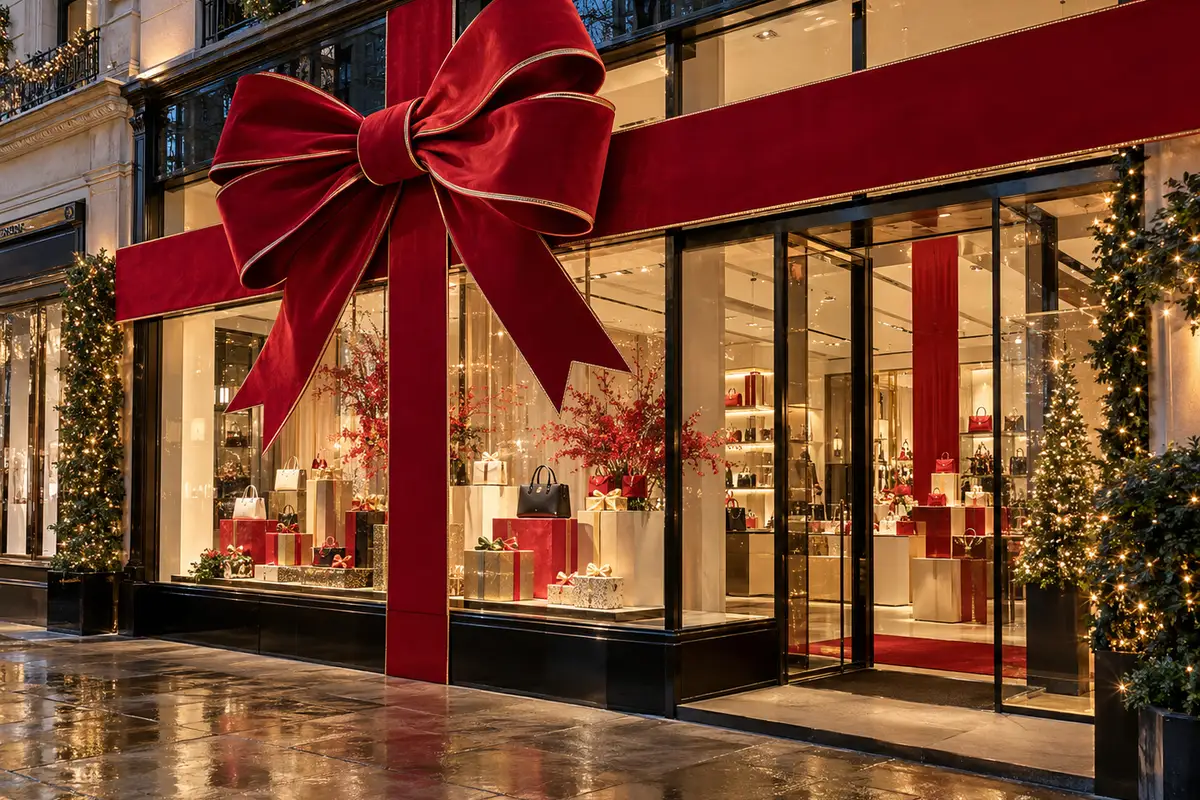 BIG IMPACT
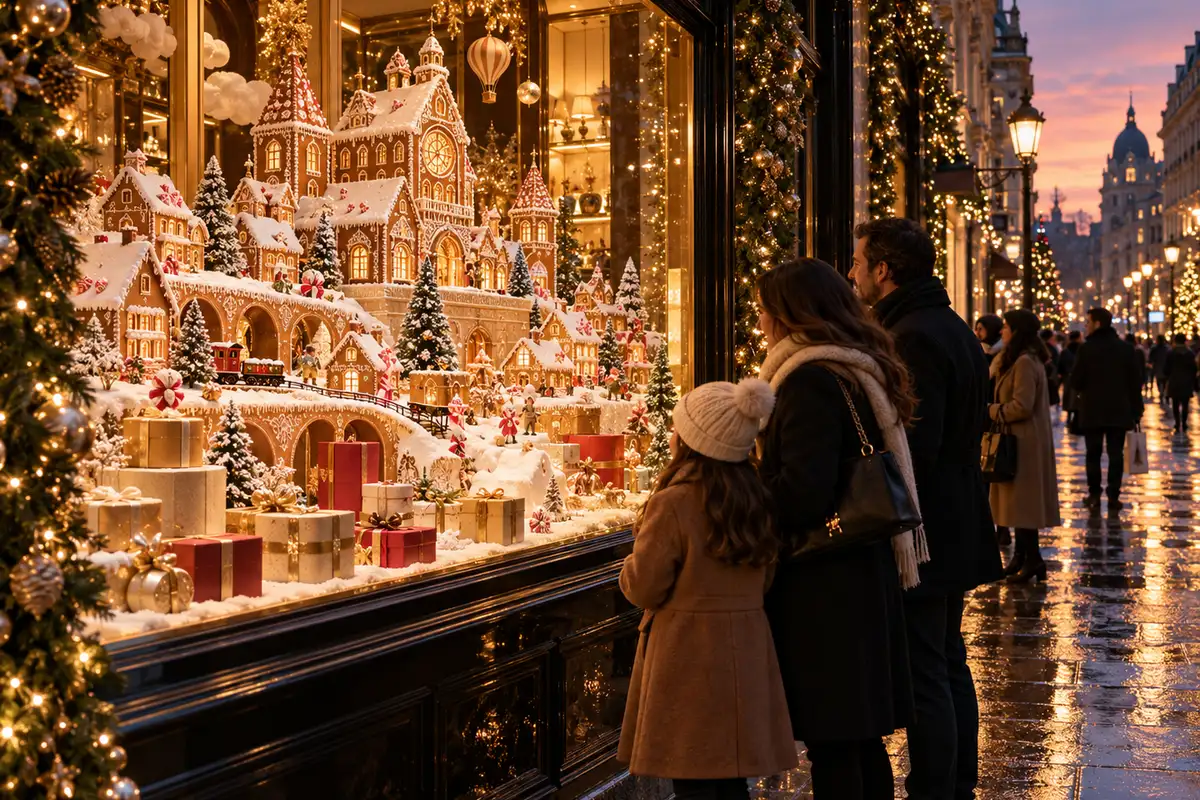 STORYTELLING
Your window has about three seconds. That is roughly how long a shopper walking at normal pace takes to pass a five-metre shopfront. In those three seconds a Christmas window has to stop them, hold their eye and make stepping inside feel like the obvious next move.
This guide gives you 50 Christmas window display ideas sorted by theme, budget and store type. Every idea includes how to build it well, why it stops shoppers and how to tell whether it worked . Most window guides skip that last part, yet it decides whether you repeat the idea next year or quietly drop it.
The Christmas window displays that stop the most shoppers share five traits. They have one clear focal point at eye level. They move or glow , which matters because many of December’s busiest hours are after dark.
They tell a story readable from across the street. They show real products with prices or gift cues. And they continue inside , giving a clear reason to come in now.
For 2026, pair that with the season’s palette: ice blue, misty grey and matt silver, with burgundy or dark blue accents. [5] Install in early November and measure how many passers-by actually enter.
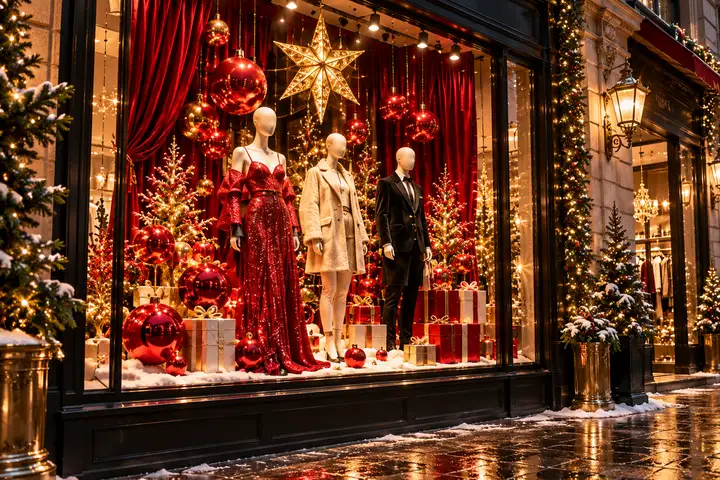 Luxury & after dark
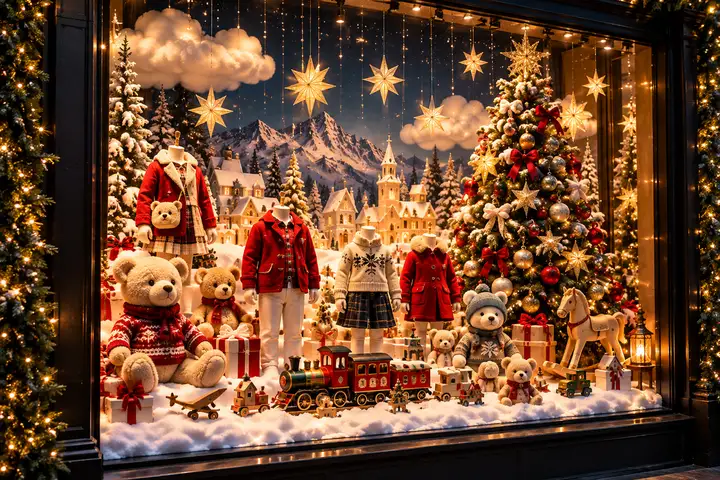 Interactive ideas
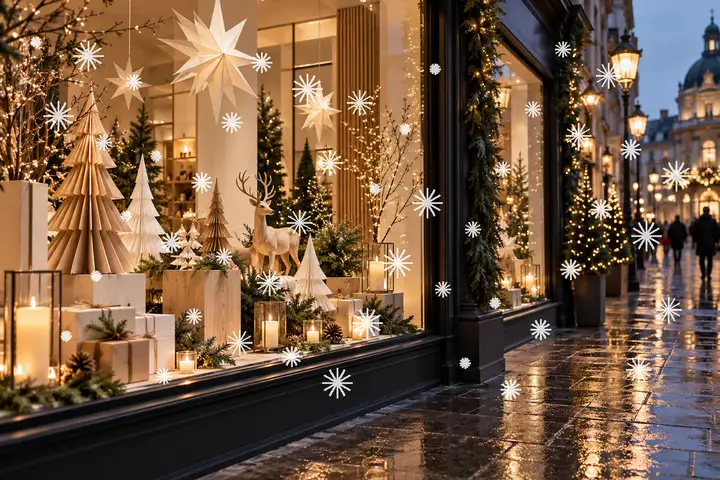 Small-budget ideas
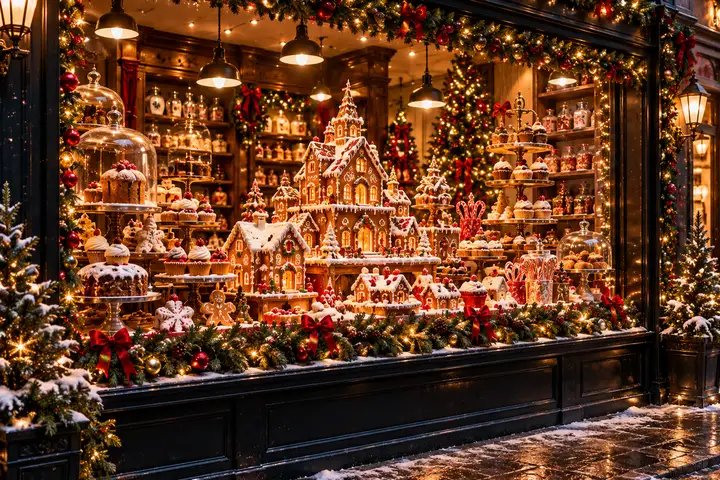 Ideas by business type
▾ See all 50 Christmas window ideas at a glance
- The Giant Gift Bow Shopfront
- The Walk-In Snow Globe
- Santa’s After-Hours Workshop
- The Midnight Gift Train
- The Christmas Eve Living Room
- Light Curtain + Three Hero Products
- Press for Snow
- The Projection-Mapped Window
- The Light Trail That Follows You
- The Sunset Switch
- The 24-Door Living Advent Window
- The Twelve Days Story Window
- The Live Elf in the Window
- The Gingerbread High Street
- The Countdown-to-Rescue Window
- Crystal Winter: Ice Blue & Matt Silver
- Burgundy After Dark
- The Floating Ornament Cloud
- The Jewel-Box Gallery
- Oversized Chrome Baubles
- The Product-Stack Christmas Tree
- The Gift Finder: Under $25 / $50 / $100
- Wrapped vs. Unwrapped Bestsellers
- One Hero, One Hundred Echoes
- The Three-Party Wardrobe
- Scan to Unlock the Hidden Gift
- The Christmas Portrait Frame
- Let the Street Vote: Window A vs. Window B
- The Hidden Ornament Hunt
- The Live Demo Stage
- The Paper Snowstorm
- The One-Colour Vinyl Story
- The Chalk-Marker Window Mural
- Ribbon Ceiling, Clear Floor
- The One-Line Window
- The Recycled Cardboard Christmas City
- The Brown-Paper Parcel Mountain
- The Foraged Winter Forest
- Ornaments Made From Our Offcuts
- The Living Tree, Replanted in January
- Santa’s Post Box, Just Inside the Door
- The Charity Wishing Tree
- The Kids’ Drawing Gallery
- The Staff-Made Ornament Collection
- The Missing Reindeer Street Trail
- Bookshops: Blind Date With a Book
- Bakeries & Cafés: The Window Theatre
- Beauty: The Gift Lab & Sample Door
- Homeware: The Christmas Table You Can Shop
- Every Store: The Window That Continues Inside
Why Christmas Window Displays Still Matter in 2026
Online shopping keeps growing, but physical stores still do much of the gifting work in December. The NRF reported a record 202.9 million US shoppers over the 2025 Thanksgiving-to-Cyber-Monday weekend. Of those, 129.5 million shopped in stores, up 3% on the year before. [2] Across November and December, US holiday retail sales grew 4.1%, in a season NRF had forecast to top $1 trillion for the first time. [2]
Shoppers also start earlier than many retailers plan for. In NRF’s October 2025 survey of 8,247 consumers, 42% said they would begin holiday shopping before November. [1] A window that goes up on 1 December misses a large share of the season.
The window is the one piece of marketing every passer-by sees for free, and research links it to the decision to go in. A study in the Journal of Retailing and Consumer Services (Sen, Block & Chandran, 2002) found that what shoppers read from a window display is related to whether they enter the store, both directly and through what the window leads them to infer about the store. [3] People judge your whole shop through the glass.
The 3-Second Rule: What Makes Someone Stop at a Christmas Window?
Average adult walking speed is about 1.4 metres per second, so a shopper passes a 5-metre frontage in about 3.5 seconds. They are talking, carrying bags, checking a phone or trying to get somewhere. Your first design problem is not decoration. It is interruption . Every idea in this guide is built to win one of three stages:
A passer-by should be able to name your window in three words: “giant present”, “frozen forest”, “paper snowstorm”.
One object far bigger, brighter or darker than its surroundings reads faster than twenty normal-size decorations.
Foreground, product plane and background give the eye somewhere to travel. A flat window is understood once and forgotten.
If shoppers remember the snow but not what you sell, the window entertained the street without selling anything.
Design from the pavement backwards. Stand where people actually approach from, decide what they must see first, and make the next step (the product, the offer, the door) obvious.
Christmas Window Display Trends for 2026
This season points in two useful directions at once: lighter, translucent and suspended designs on one side, and richer, more characterful storytelling on the other. There is no single “correct” 2026 look. The opportunity is to pick the visual language that stands out on your street .
Crystal winter
Glass, clear acrylic, frosted and milky surfaces, suspended elements at two or three heights, organic curved forms.
Palette: ice blue, lilac, misty grey, warm beige, matt silverWarm drama
Deep accents against pale bases, or a fully dark window with concentrated pools of warm light and a single metallic finish.
Palette: dark blue, burgundy, deep green, soft goldCurious & playful
Homespun warmth, cabinet-of-curiosity details, pop-culture personality and quirky touches that reward people who stop.
Palette: brand colours plus natural texturesThe crystal-winter palette comes from Messe Frankfurt’s 2026/27 winter window guidance, based on the Christmasworld Trends. It recommends pale, misty base colours with a few darker accents, combining clear, matt and translucent materials, and grouping suspended pieces at two or three heights with deliberate open space. [5] John Lewis’s 2026 Christmas range shows the playful side, with collections described as a “homespun Christmas”, a “pop-culture remix” and a “cabinet of curiosities”. [6] Use these as direction, then translate them into your own brand rather than copying a trend board.
Filter the 50 ideas by budget and store type:
Showing all 50 ideas
Ideas 1–5: Big Visual Story Windows
For windows that need instant theatre. One large, familiar idea that a passer-by can name in three words.
The Giant Gift Bow Shopfront
Turn the whole shopfront into one enormous present. Wide ribbon vinyl runs across the glass, wraps a central product plinth and finishes in an oversized bow that can be read from across the street.
- Use one ribbon colour. Several competing Christmas colours dilute the idea.
- Set the bow slightly off-centre so the eye lands on the hero product beside it.
- Continue a smaller ribbon inside the entrance so the story does not end at the glass.
Why it stops shoppers: The idea is understood in one second: this store is the gift. Scale creates the stop; the product placement gives the reason to go in.
Measure it: This is a bold, low-cost idea to use as your first Christmas window. Its capture rate becomes the number later windows need to beat.
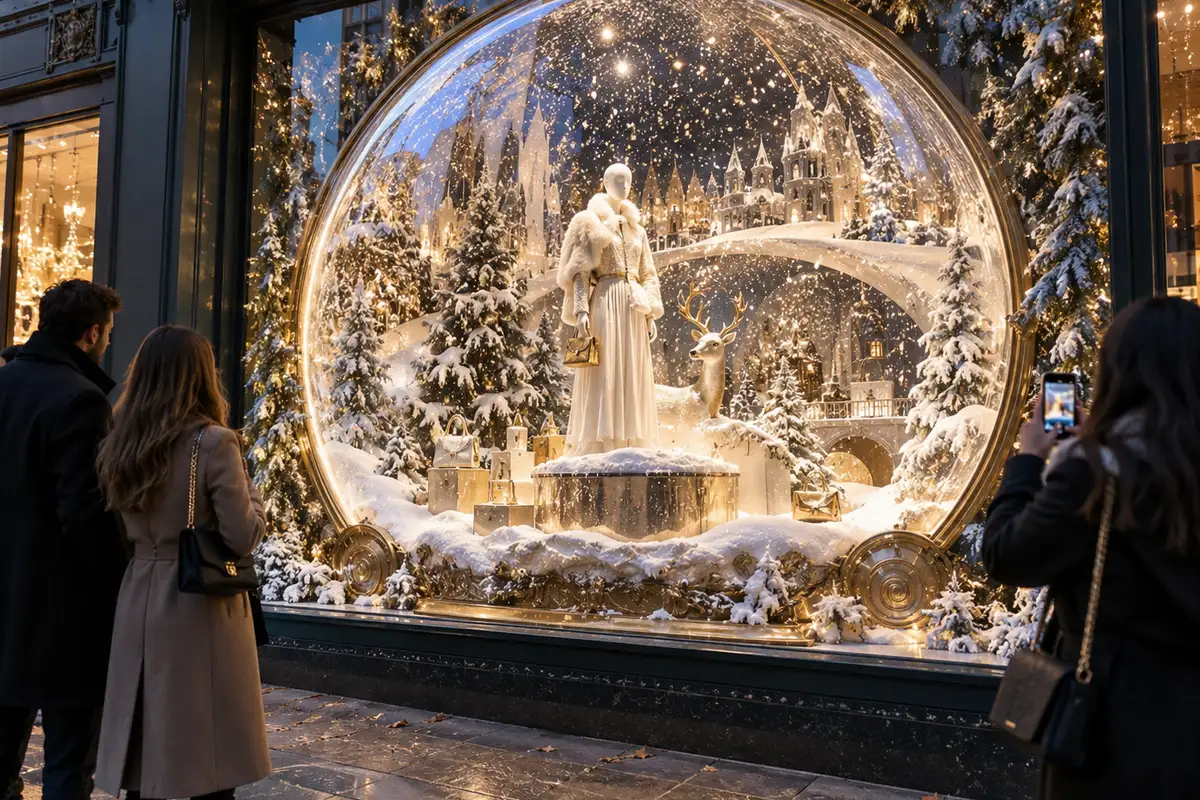
The Walk-In Snow Globe
A circular vinyl or plywood frame turns the window into a giant snow globe, with layered white scenery and a small fan keeping lightweight faux snow drifting around a mannequin, product plinth or miniature scene.
- Keep moving snow sparse so the products stay visible.
- Backlight the globe instead of flooding the window with equal light.
- Mark a photo spot on the pavement or just inside the door.
Why it stops shoppers: A round frame on a street full of rectangles breaks the scan pattern. Movement gives a reason to look twice.
Measure it: Check the display weekly. Snow piling on the window floor looks messy fast and pulls the stop rate down.
Santa’s After-Hours Workshop
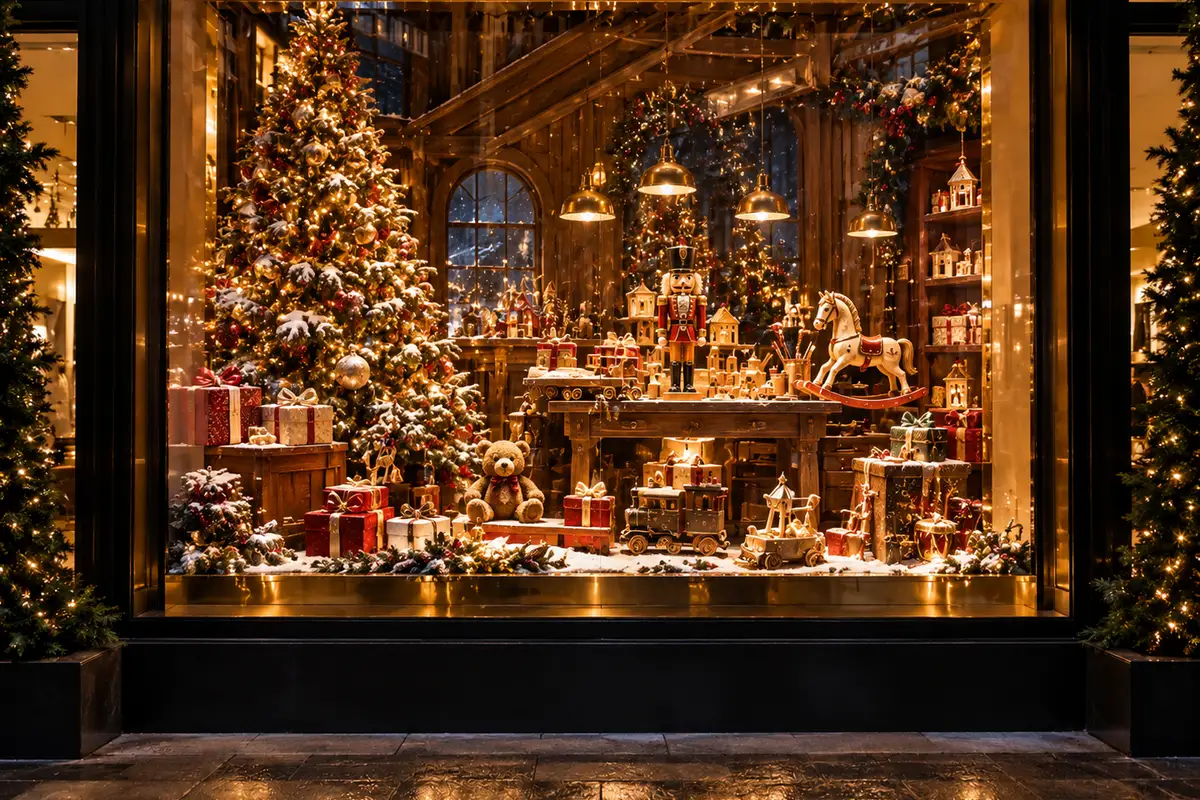
Skip the cheerful standard workshop and show the funny moment after closing time: abandoned wrapping paper, a half-finished gift, tiny ladders, labels and your products still “in production”.
- Hide one comic detail people only find on a second look.
- Repeat crates or benches at different depths to create perspective.
- Make your hero product the “finished gift” at the front of the scene.
Why it stops shoppers: People see “Santa’s workshop”, then spot the joke, then notice the product. That three-step discovery keeps them at the glass.
Measure it: Narrative windows are built for dwell. Compare window dwell with your previous display, then check it turned into entries.
The Midnight Gift Train
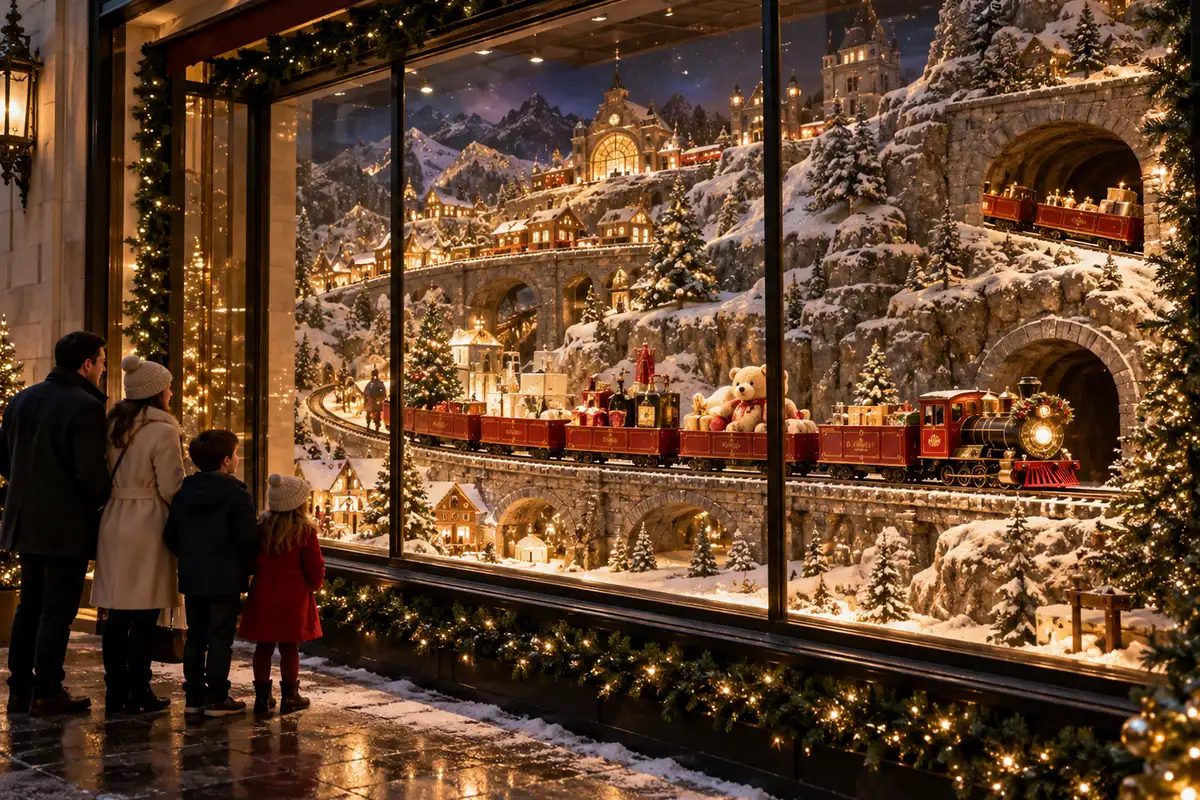
A miniature train loops through a snowy landscape, and each carriage carries a different gift category: for kids, under $50, stocking fillers, for the host. It is the oldest trick in window dressing, and it still works.
- Show three or four carriages at a time, not ten.
- Hide the return track behind a tunnel or a dark backdrop.
- Place products at child eye level (about 1 m) as well as adult eye level (about 1.5 m).
Why it stops shoppers: Movement, nostalgia and a natural left-to-right reading path. The carriages let you show several categories without the window looking like a shelf.
Measure it: Families stay for a long time at train windows. Check whether they then come in, or whether parents wait outside.
The Christmas Eve Living Room
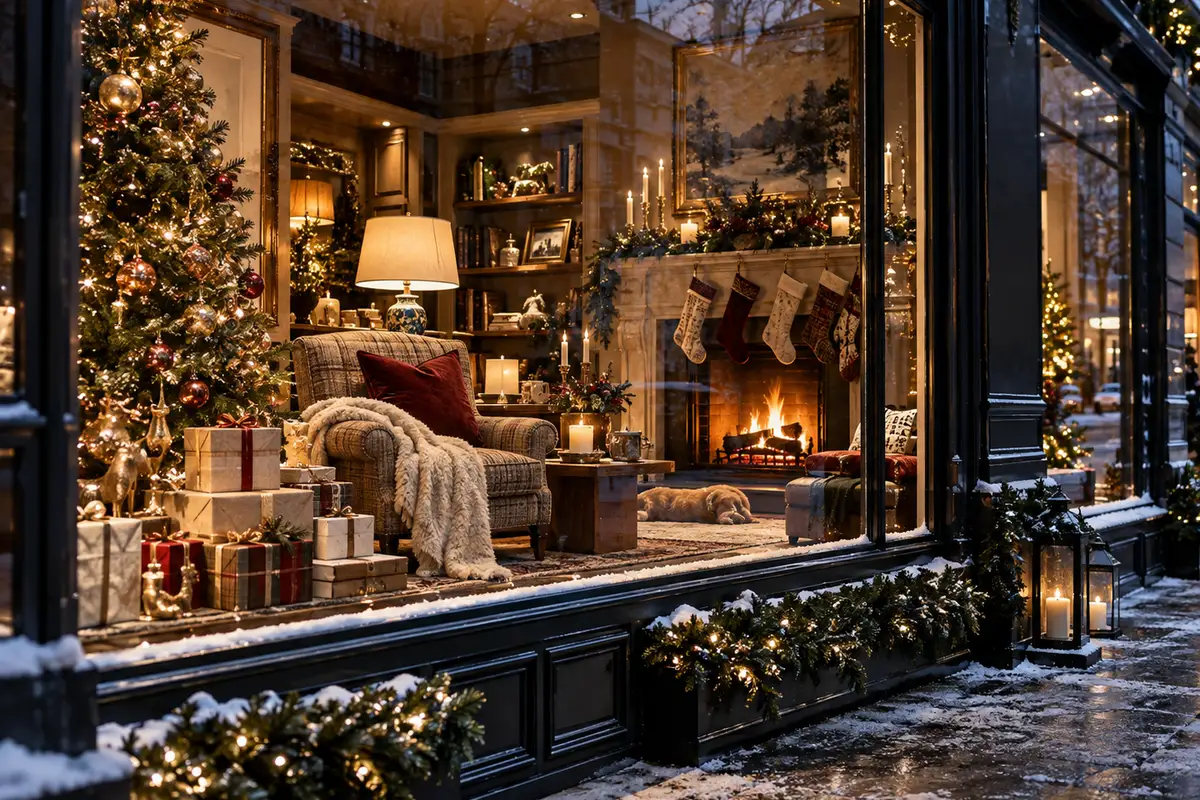
One cinematic room rather than a full house: an armchair, a lamp, a faux fireplace with LED flame, stockings on the mantel and wrapped gifts. It should feel as though someone has just stepped out.
- Add one human trace: an open book, a half-tied ribbon, a mug.
- Style products as natural objects in the room, each with a small price tag.
- Keep the light warm while the street outside is cold and blue.
Why it stops shoppers: Contrast is the hook. A warm, intimate scene behind glass feels most inviting on a dark, cold evening.
Measure it: Cosy windows tend to do their best work after dark. Compare evening capture rate with the same hours before the change.
Ideas 6–10: Light, Motion & After-Dark Windows
In mid-December the sun sets before 4 pm in London and around 4:30 pm in New York. Many of your busiest trading hours happen in the dark, so a window built only for daylight goes dark just when footfall peaks.
Light Curtain + Three Hero Products
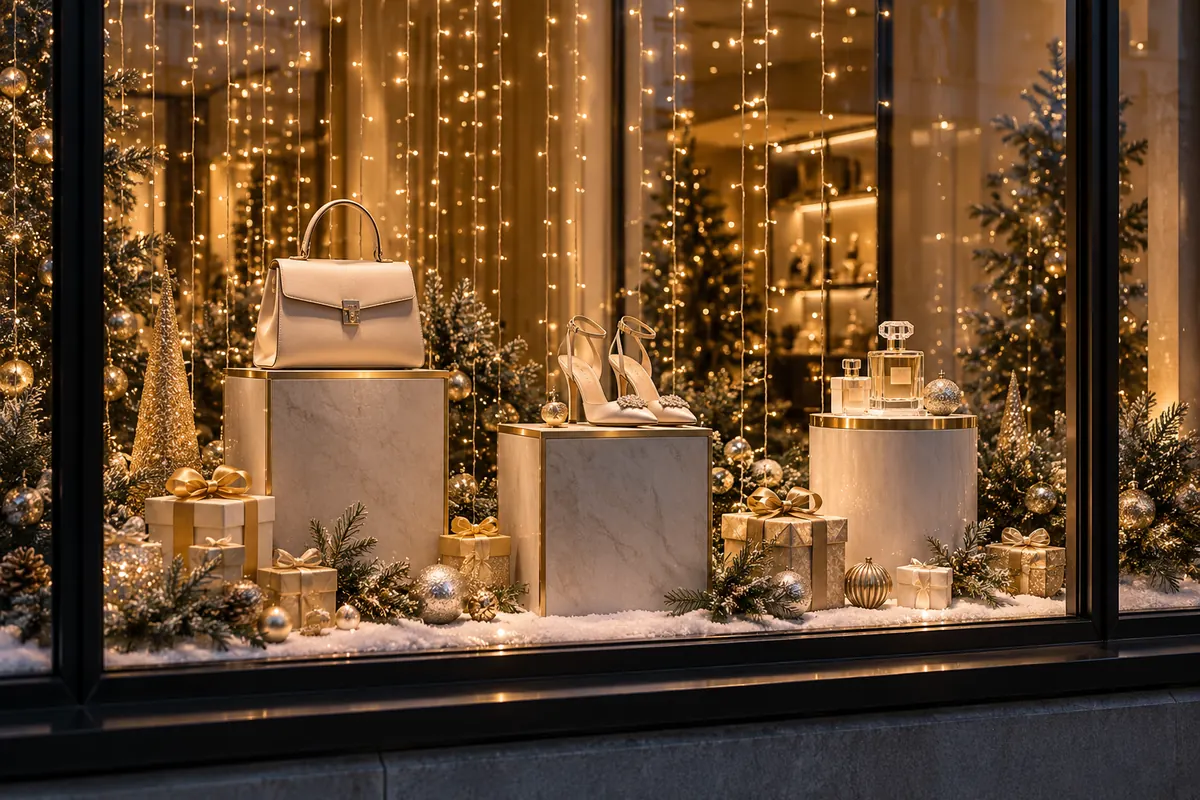
Hang vertical strands of warm-white LED lights as a full backdrop, 5–10 cm apart. In front, place three carefully spaced hero products, each in its own pool of light. Nothing else.
- Use dimmable lights so the products stay brighter than the backdrop.
- Create three separate pools of product light.
- Hide every cable from the pavement view.
Why it stops shoppers: When budget and time are tight, discipline beats props. A good light field and three great products can outperform a crowded window.
Measure it: Compare capture rate before and after sunset. A sharp evening drop means the product lights are too weak.
Press for Snow
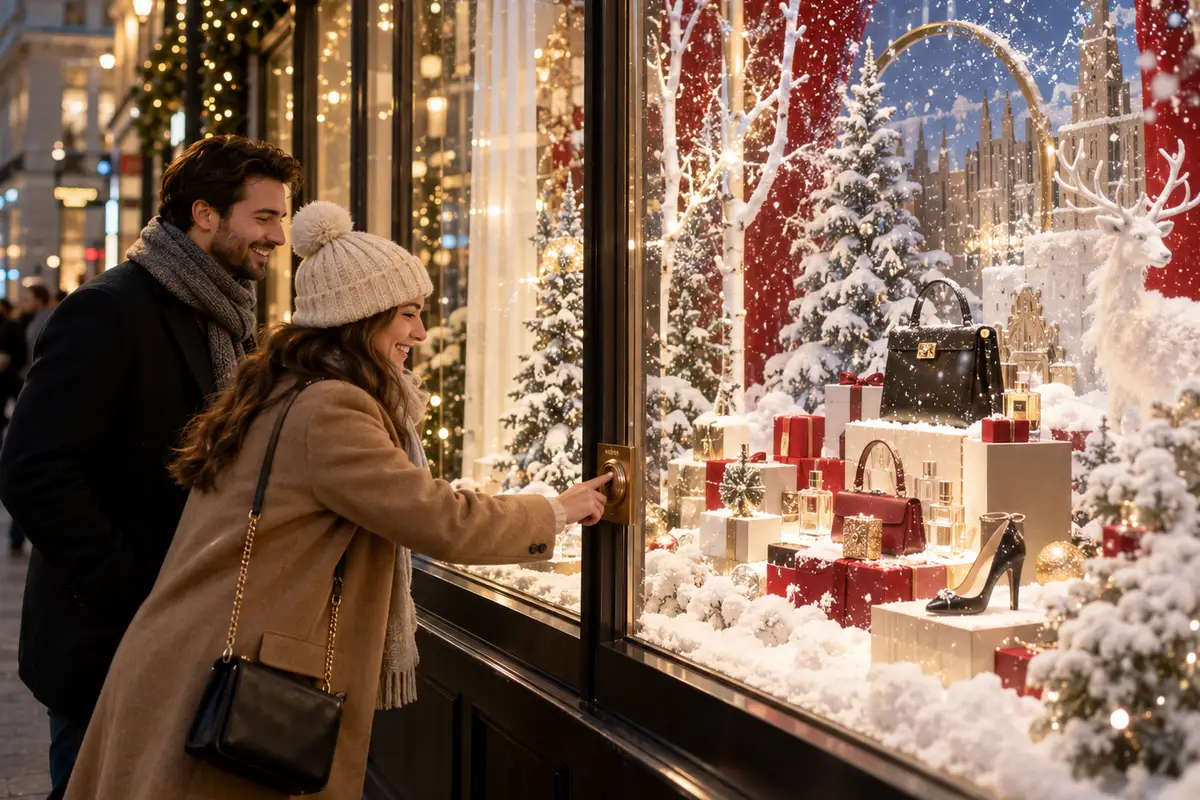
Give passers-by one obvious action: a big “Press for snow” button on the glass, or a motion sensor that triggers a short burst of snow, light or movement when someone pauses.
- Make the effect reset within seconds.
- Keep the mechanism away from the product zone.
- Check that people pressing the button do not block the entrance.
Why it stops shoppers: The window changes from something to see into something to do. People nearby see the result, so one stop creates the next.
Measure it: Crowds attract crowds. See whether the stop rate jumps when two or more people are already at the glass.
The Projection-Mapped Window
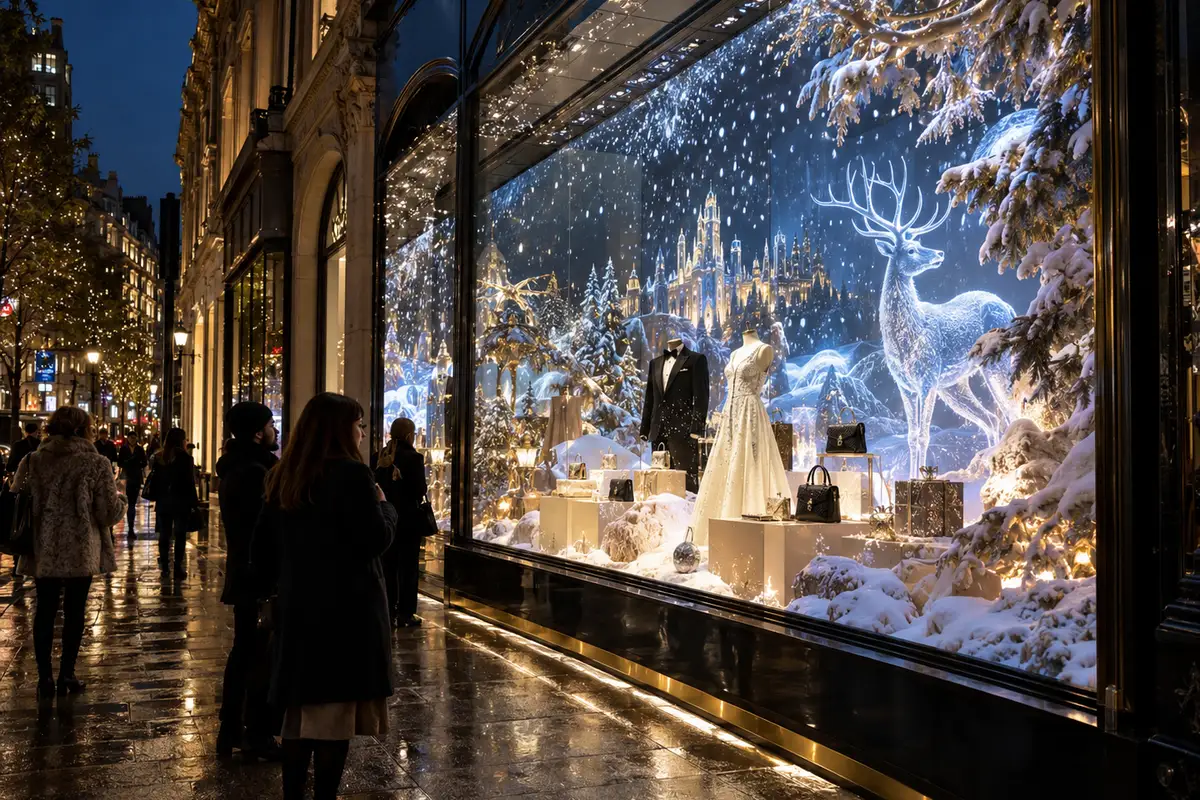
Rear-projection film on the glass runs a 30–60 second animated loop after dusk: snow falling over your logo, a sleigh crossing, your products appearing one by one. By day the film shows a static graphic.
- Keep the loop short so a passer-by sees one complete moment while walking past.
- Keep screen brightness below the product spotlights.
- Test the image from the opposite pavement, not from inside.
Why it stops shoppers: Moving light at scale is hard to ignore, and it turns a dark street into your stage.
Measure it: Compare the loop length with average window dwell. If people stay for less than one loop, cut the loop in half.
The Light Trail That Follows You
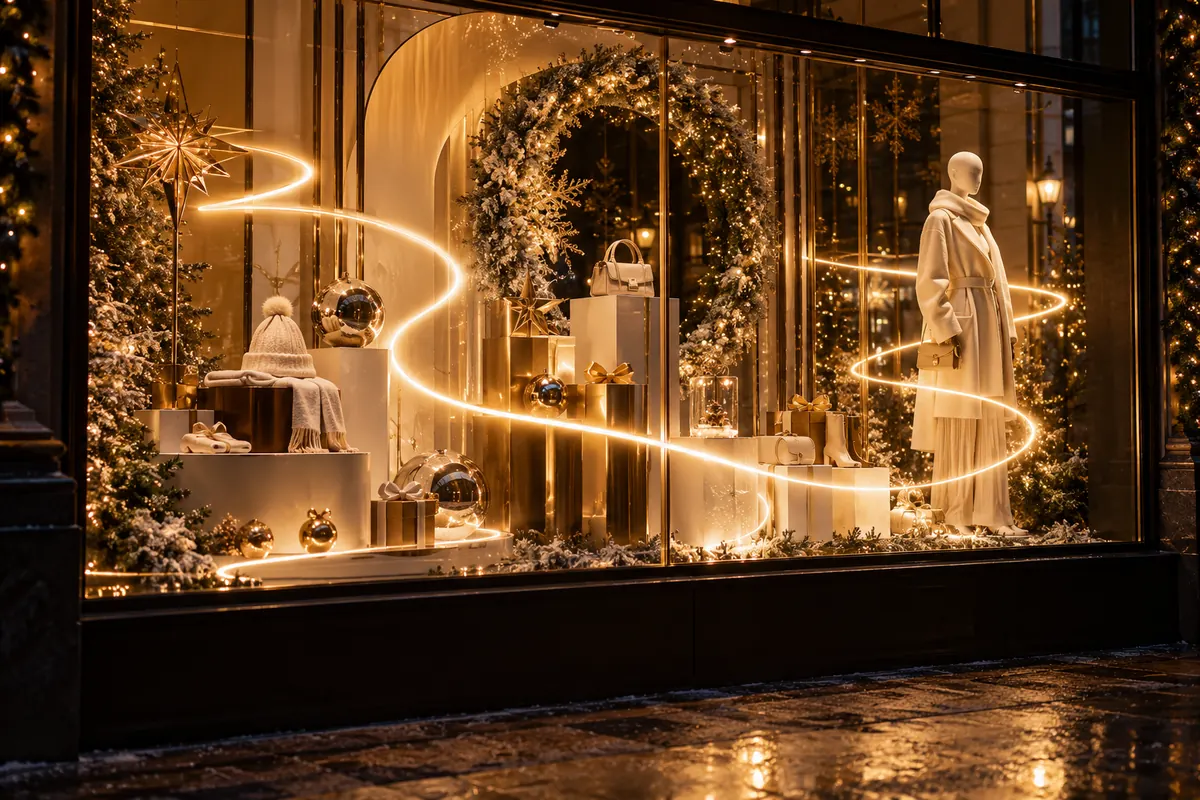
Proximity sensing triggers a ribbon of light that travels along the glass as a pedestrian walks past, and leads the eye to the hero product or the door.
- Keep the response subtle, so heavy foot traffic does not turn it into chaos.
- Build a static default scene for quiet periods.
- Use anonymous motion sensing only. No personal data is needed.
Why it stops shoppers: The window seems to notice the passer-by, and that feeling is naturally hard to ignore.
Measure it: Point the light trail at the entrance and compare capture rate with the trail on and off at the same hours.
The Sunset Switch
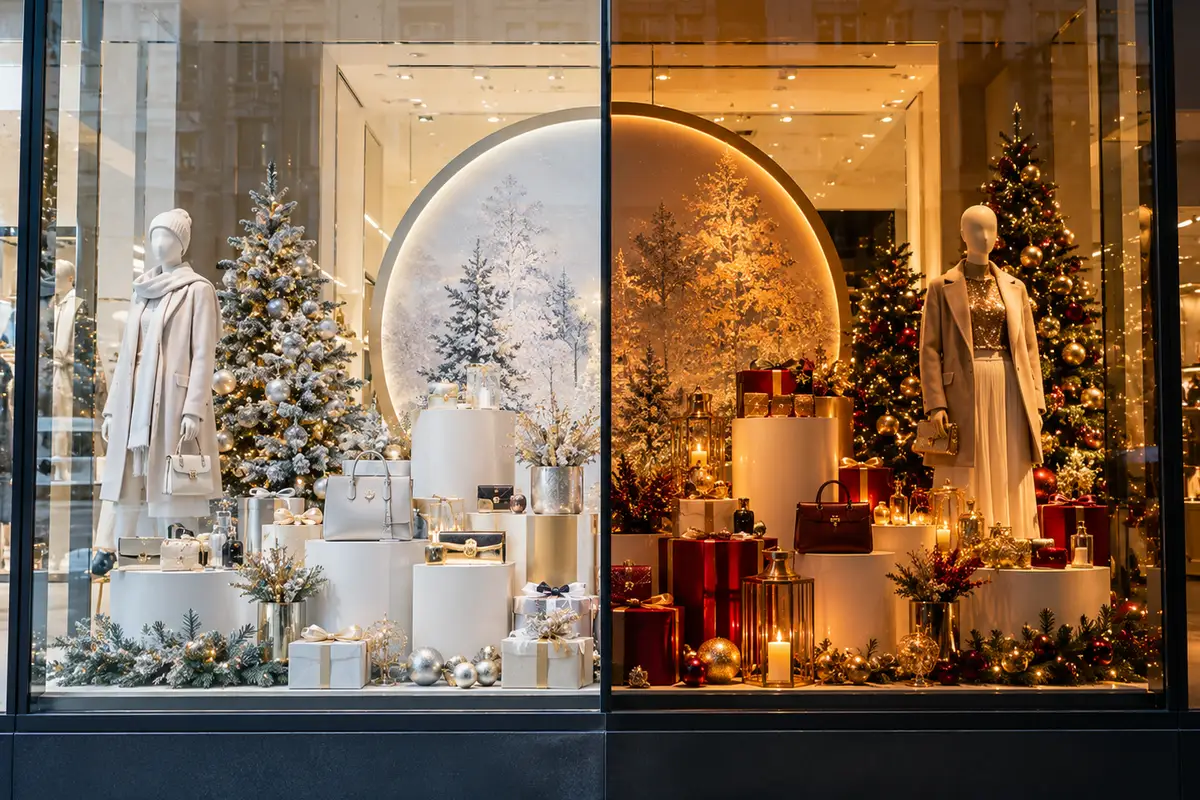
Design two lighting scenes for the same window. Day mode uses brighter, cooler light that beats glass reflections. Night mode uses warm spotlights and fairy lights. A smart timer switches between them at local sunset.
- Keep the window lit for at least an hour after closing, when people walk home past it.
- Check day mode at 10 am and 3 pm, when low winter sun causes glare.
- Label the timer so staff do not switch it off at closing.
Why it stops shoppers: The same display gets two chances to work: one for daytime shoppers and one for the dark, busy evenings.
Measure it: Chart capture rate by hour for a week. The hour where the rate falls is where your lighting fails.
Ideas 11–15: Storytelling Windows That Change Through December
A window that changes gives the same commuter a reason to look again tomorrow. These ideas are built to evolve, so repeat passers-by keep finding something new.
The 24-Door Living Advent Window
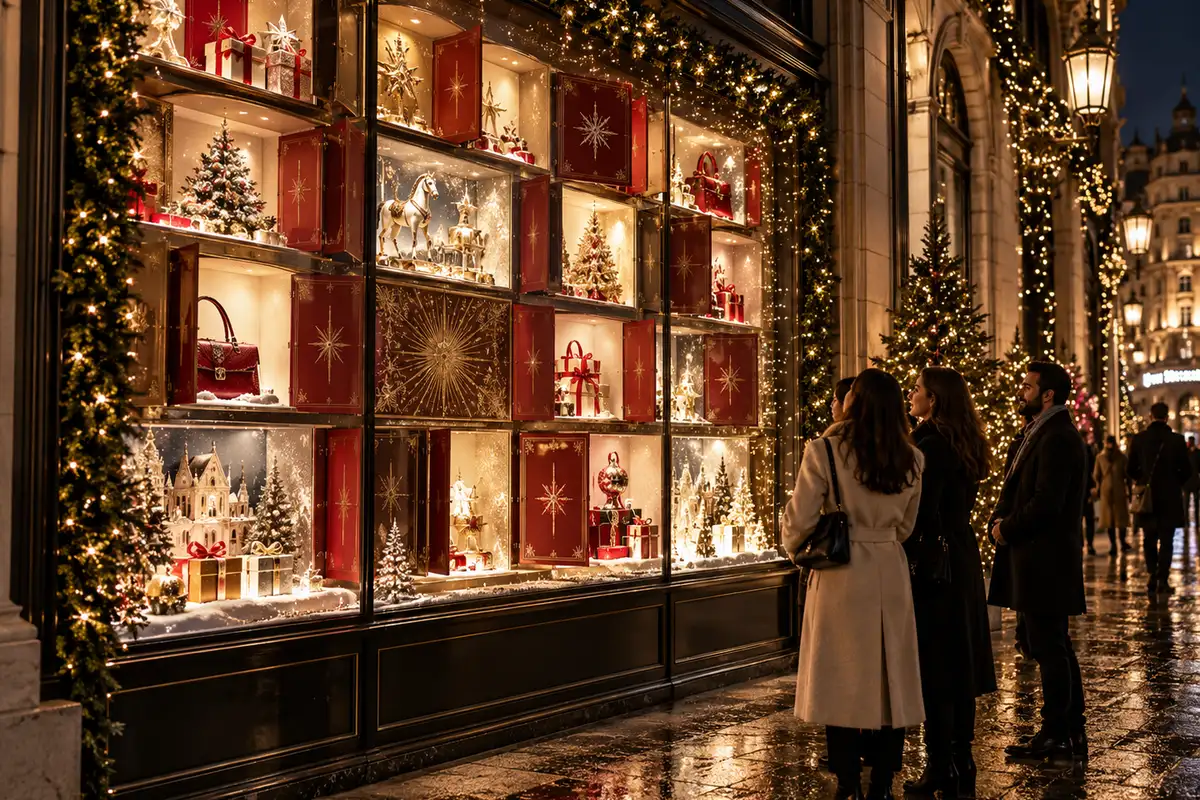
Cover the window with 24 numbered doors. Each morning in December, staff open one to reveal a product, a daily in-store offer or a small scene. The window visibly fills up through the month.
- Make the numbers large enough to read from the pavement.
- Plan which product goes behind which door to avoid stock problems.
- Post each reveal on social at the same time every day.
Why it stops shoppers: Regular passers-by start checking daily, and a daily offer behind each door turns curiosity into a visit.
Measure it: Track daily entries against the offer behind each door. The best doors are your January sale list.
The Twelve Days Story Window
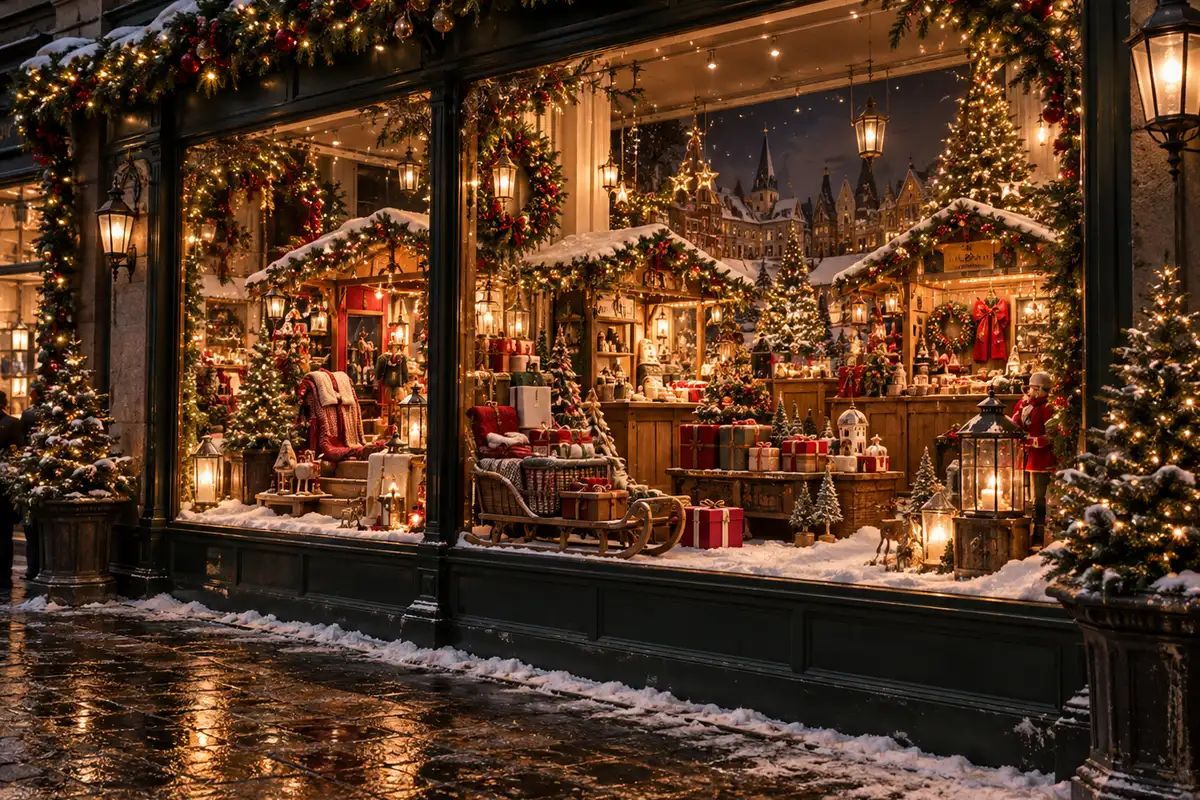
Tell one story across several bays, like chapters. Use the Twelve Days of Christmas, or your own story, with one object, colour or silhouette per day, building left to right and ending next to the door.
- Use repetition to tie very different objects together.
- Give the viewer one obvious starting point.
- Put the final chapter next to the entrance.
Why it stops shoppers: Sequences make people want to decode the pattern, and they walk the whole frontage to do it.
Measure it: Compare capture rate with a single-scene window at a comparable store in your chain.
The Live Elf in the Window
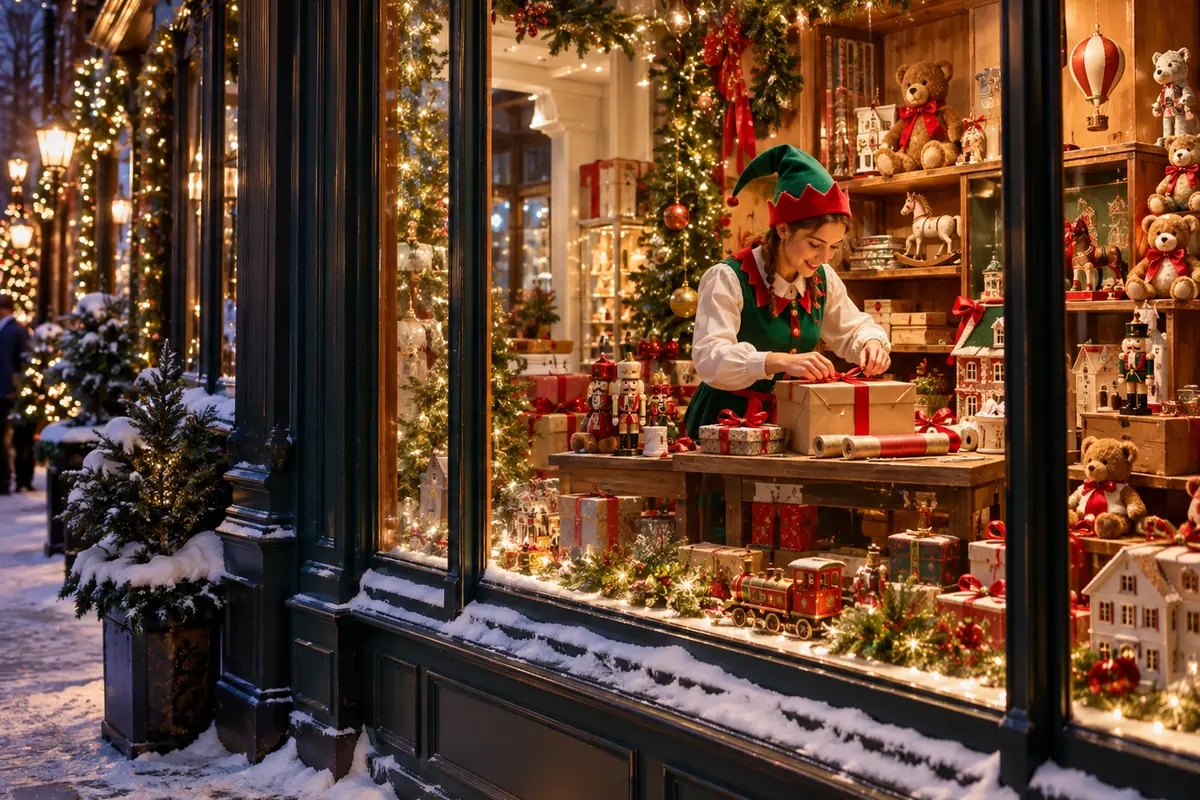
At peak hours, put a real person in the window: a staff member wrapping gifts, engraving, icing biscuits or personalising products. Hang one line: “Free gift wrapping inside today.”
- Schedule set hours and post them on the glass.
- Face the work towards the street.
- Keep the offer simple and tied to an in-store service.
Why it stops shoppers: People stop for people. Movement, a human face and a clear offer together cover all three stages: stop, look, enter.
Measure it: Compare capture rate in live-elf hours with the same hours on days without one.
The Gingerbread High Street
Rebuild your own street as a snowy gingerbread or paper village: the station, the market square, the neighbouring shops and a tiny version of your own shopfront with its lights on.
- Use real local details, not a generic village.
- Light one interior scene inside the miniature version of your shop.
- Invite a school or model club to help, and credit them on the glass.
Why it stops shoppers: Local recognition makes people stop. They look longer when they find their own street.
Measure it: Local press coverage often matters more than the model itself. Log coverage dates and check footfall in the days after.
The Countdown-to-Rescue Window
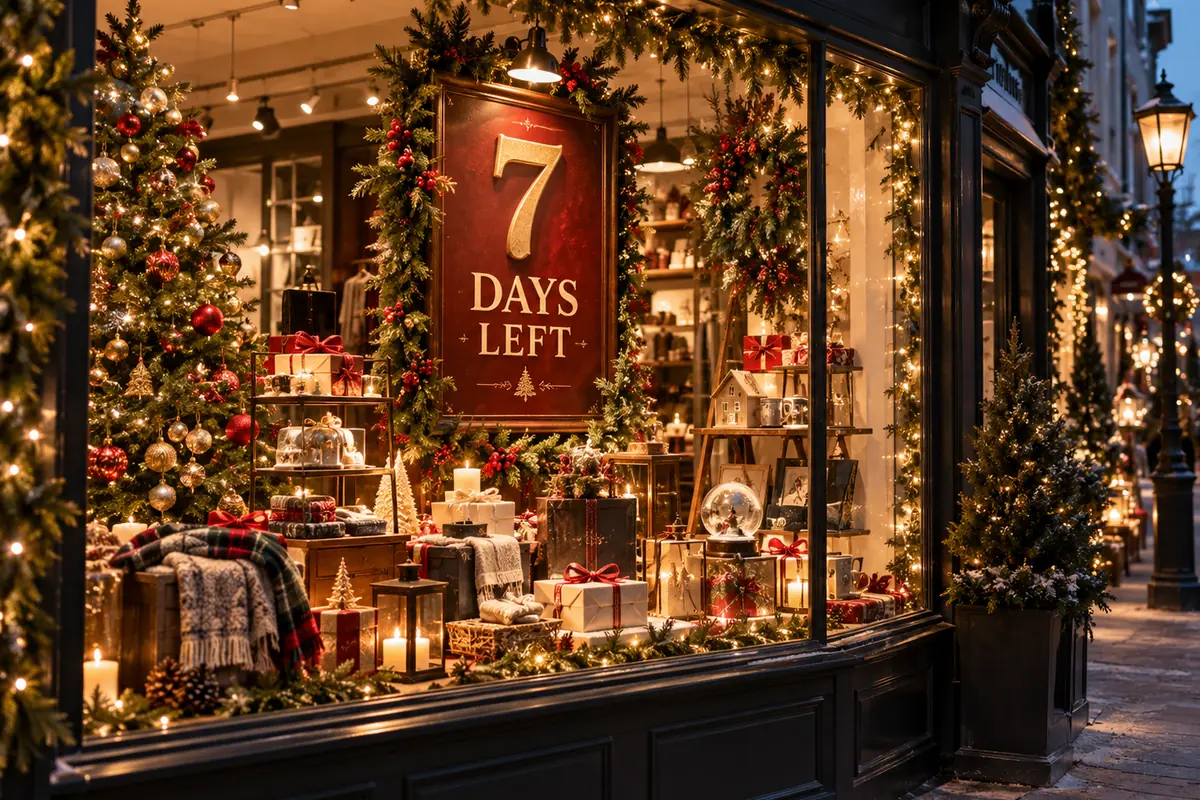
A big, changing countdown number: “12 days to Christmas”. When online delivery cut-offs pass, around a week before Christmas, the window switches to “Too late to ship? We’re open. Wrapped in 5 minutes.”
- Make the number the largest element in the window.
- Show one deadline at a time, never several.
- Pair the number with one action: “Quick gifts inside”.
Why it stops shoppers: A changing number makes the window feel alive. In the final week it answers the only question shoppers have left: can I get it in time?
Measure it: Compare capture rate in the rescue week with the same weekdays one week earlier.
Ideas 16–20: 2026 Trend & Luxury Christmas Windows
Restraint, transparency and one strong light source. These windows use the 2026/27 winter palette and win by standing apart from the red-and-gold crowd.
Crystal Winter: Ice Blue & Matt Silver
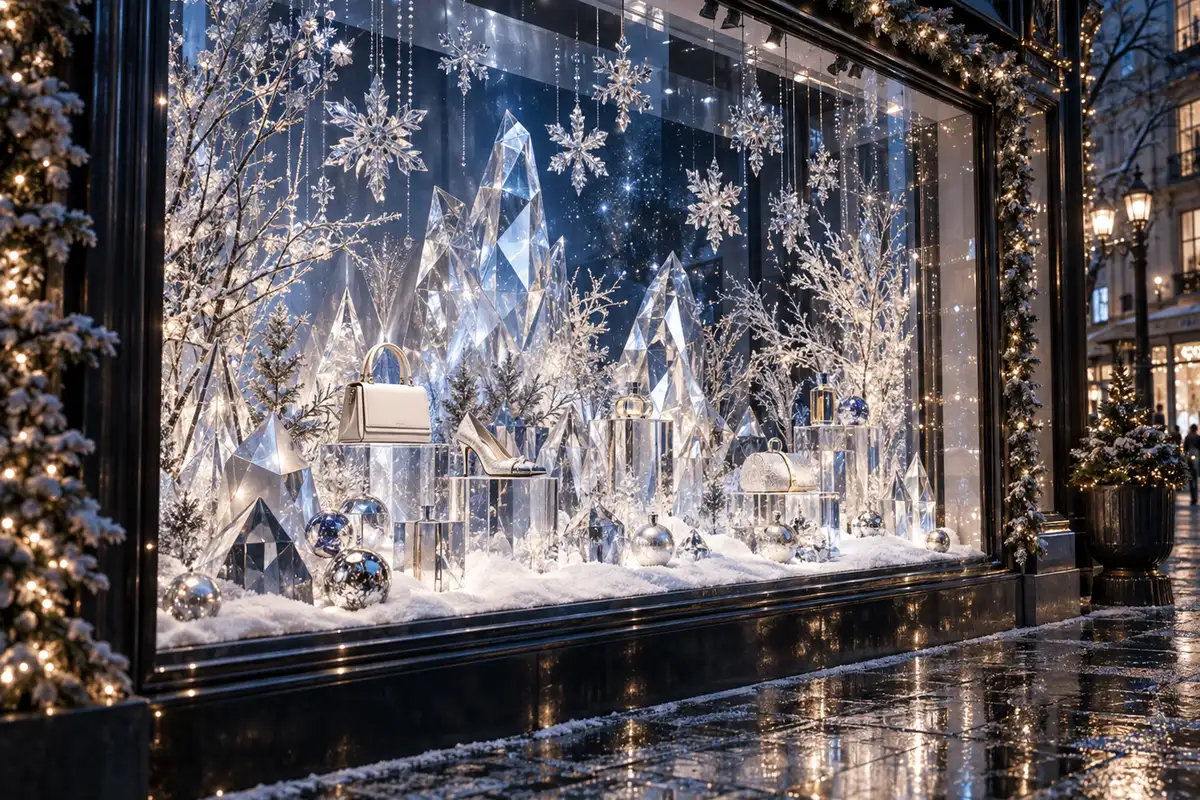
Clear acrylic, frosted panels, ice blue, misty grey and matt silver. These are straight from the 2026/27 winter trend palette. Products appear to float between transparent layers instead of sitting in a traditional scene.
- Mix clear, frosted and matt finishes so the scene has depth.
- Add one dark blue or burgundy accent so it does not disappear in daylight.
- Control reflections so the street does not overpower the product.
Why it stops shoppers: It looks wintry without Santa, red bows or fake snow, and it can stay up into January.
Measure it: Pale schemes can vanish after dark. Compare capture rate before and after sunset in the first week.
Burgundy After Dark
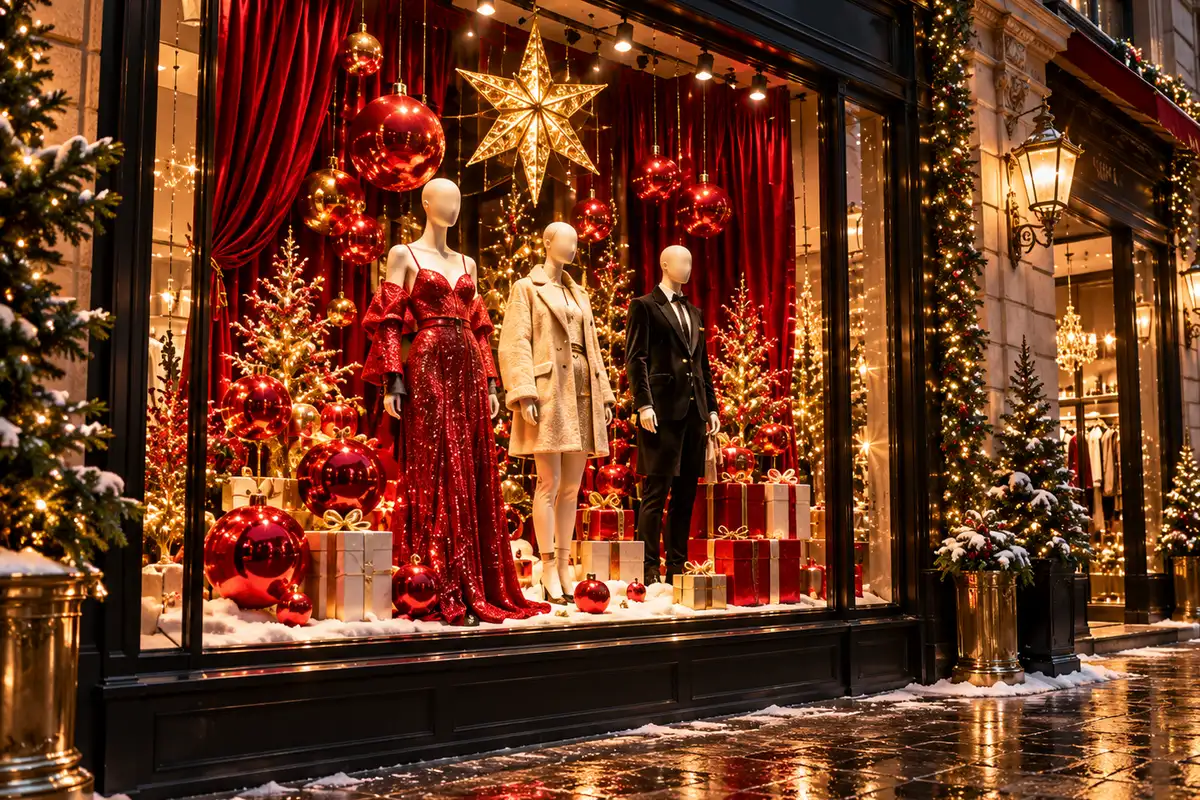
A rich evening palette of burgundy, dark navy and soft gold, with velvet textures, low pools of warm light and just a little greenery. A grown-up Christmas mood.
- Use warm spotlights, not bright overall lighting.
- Repeat one metallic finish across plinths, ribbon and props.
- Keep text tiny or absent and let the materials carry the mood.
Why it stops shoppers: Most festive windows compete in bright red and green. A darker palette stands out on the street and makes a small display look expensive.
Measure it: Premium windows often produce fewer but longer stops. Watch dwell and purchase conversion, not just stops.
The Floating Ornament Cloud
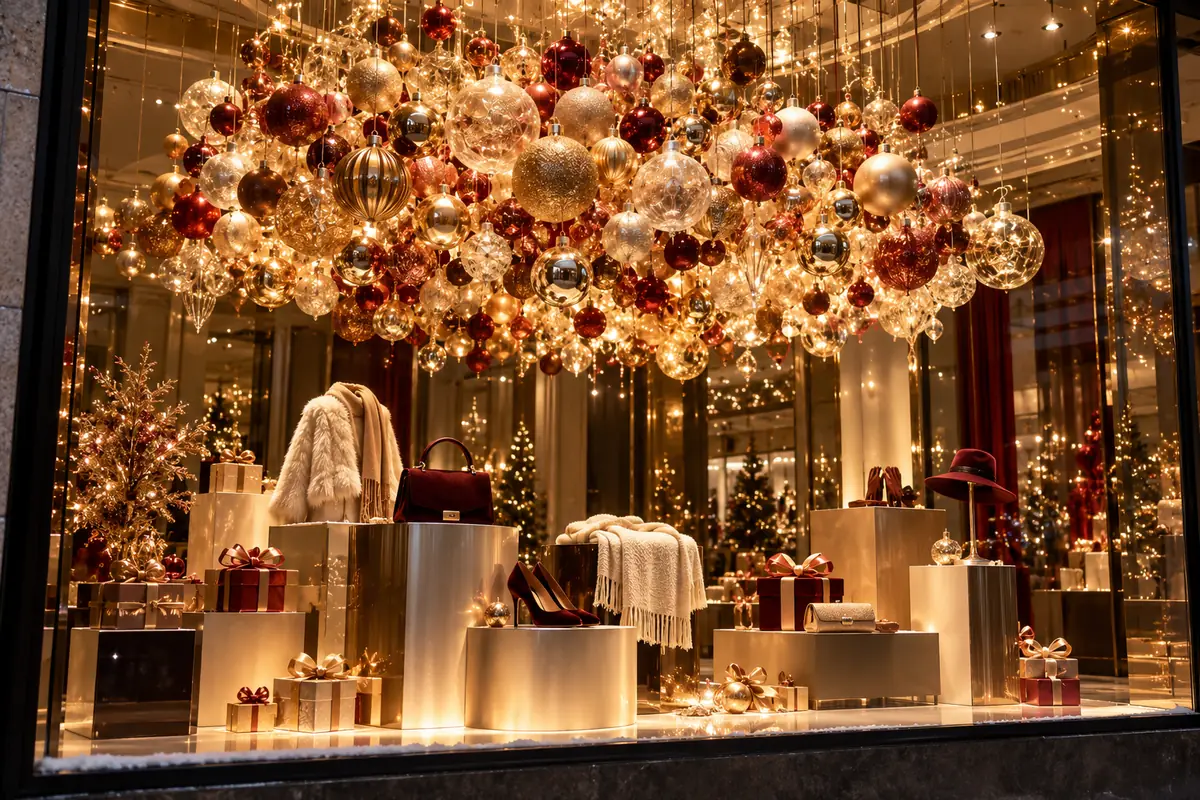
Baubles, clear discs or paper forms hang at varied heights and form a cloud above a clean product zone. Use different sizes but a tight palette.
- Group the ornaments at two or three heights, not spaced evenly.
- Leave deliberate empty gaps where the eye can rest.
- Put the densest part above the hero product, not in front of it.
Why it stops shoppers: Overhead volume makes a shallow window look bigger and keeps the floor free for merchandise.
Measure it: Check glare from mirrored baubles in low winter sun. Shoppers look away from glare.
The Jewel-Box Gallery
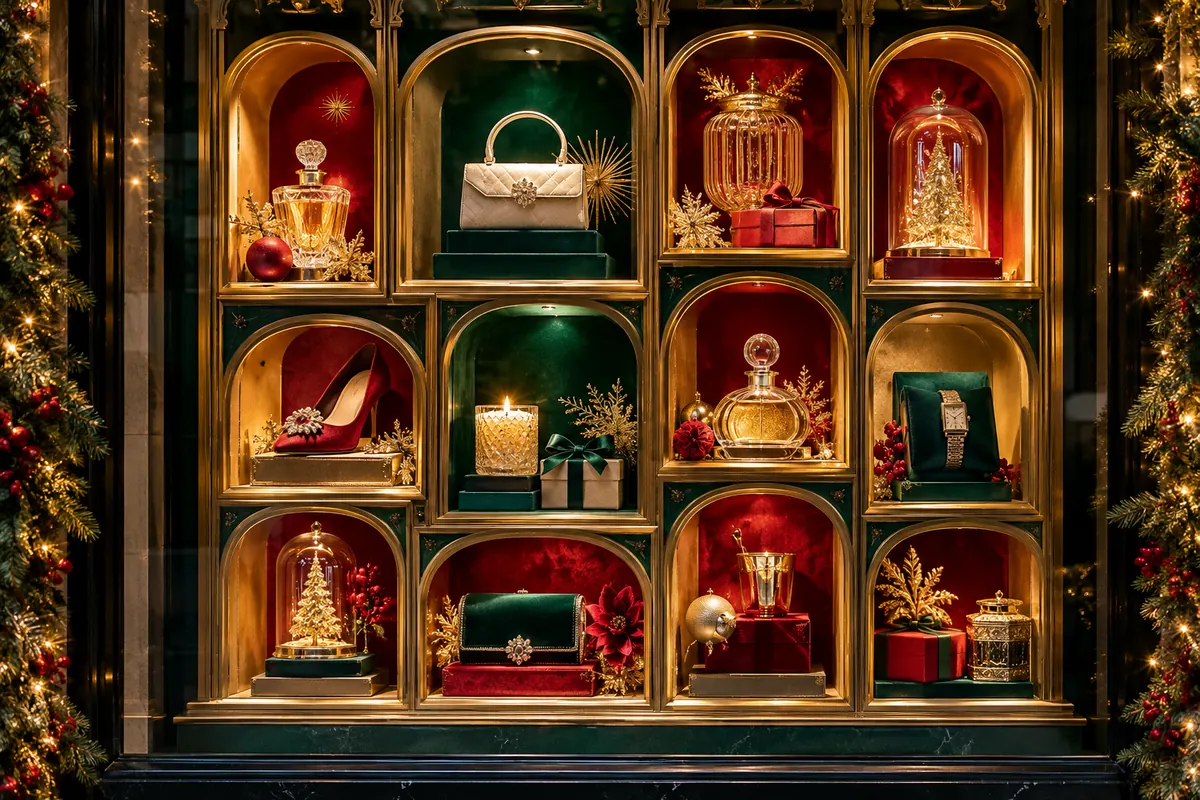
Treat each product like a museum object: a small velvet stage or clean plinth, one narrow-beam spotlight, generous empty space and a small editorial label. Christmas is the frame, not the subject.
- Show only the few products that deserve attention.
- Use precise, narrow-beam lighting.
- Give each object enough space to be understood on its own.
Why it stops shoppers: When everyone else fills the window, empty space signals confidence and value. The small scale makes people step closer, and a step closer is halfway to the door.
Measure it: Minimal windows can win attention and lose entries if nothing says “come in”. Watch stop rate and capture rate side by side.
Oversized Chrome Baubles
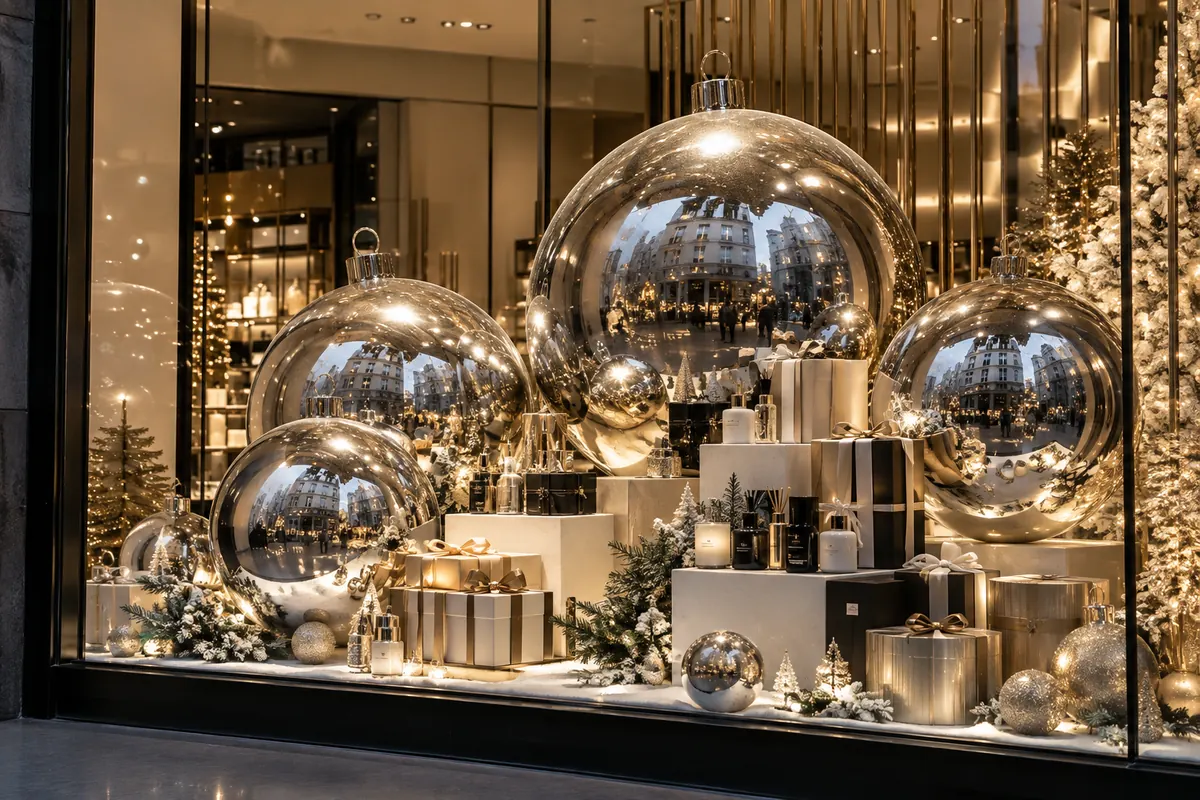
Two or three person-sized reflective baubles are the whole spectacle. Products sit on or around them rather than competing with dozens of small decorations. Mirrored side walls can turn them into an endless corridor.
- Use matt floors and backdrops to control reflections.
- Make them big enough to read from across the street.
- Angle them away from drivers’ and pedestrians’ eye lines.
Why it stops shoppers: A familiar object at unfamiliar scale becomes surprising again.
Measure it: Photograph the window from the opposite pavement in daylight and at night. Reflections can hide the products entirely.
Ideas 21–25: Product-Led Christmas Windows That Sell
The safest way to make a Christmas window sell is to build the decoration out of the stock. Shoppers see the festive idea and the product in the same glance.
The Product-Stack Christmas Tree
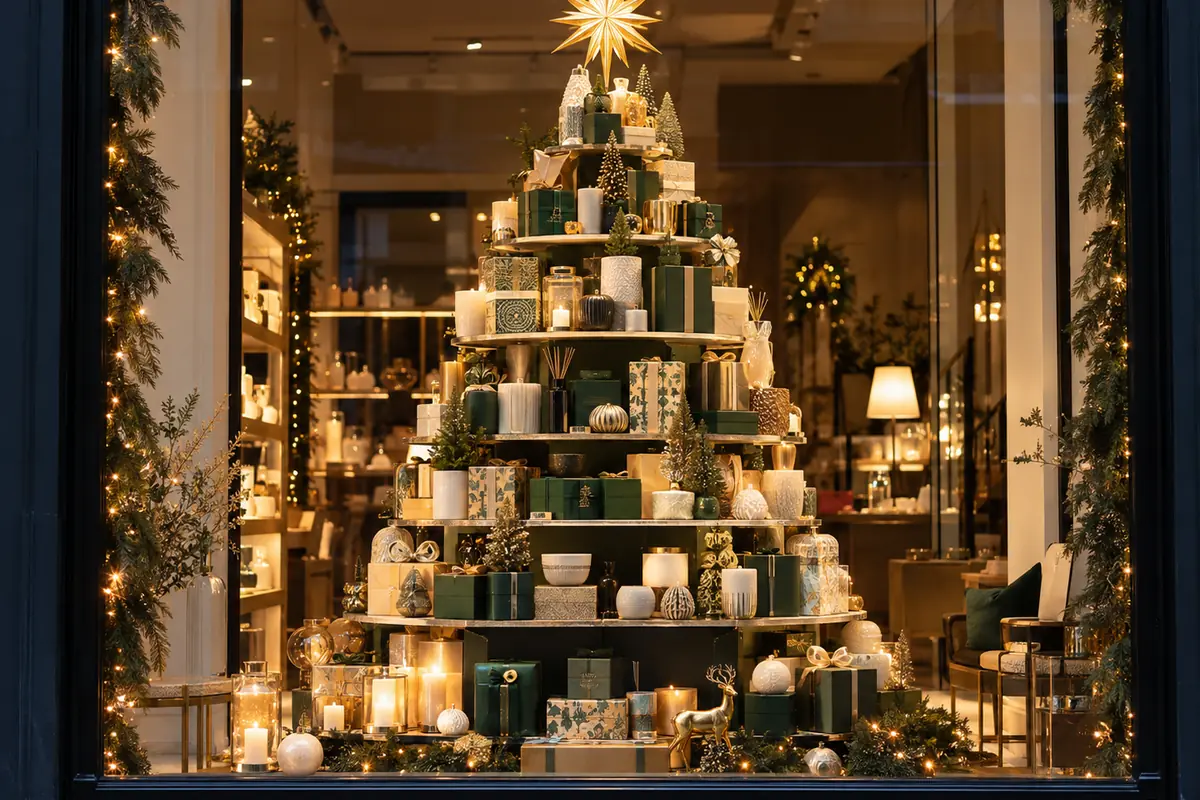
Build the tree from your own stock: books spiralling upward, shoe boxes in a pyramid, jars, candles, tins or folded knitwear, topped with a star made of your packaging.
- Choose items with enough repetition for a clean outline.
- Use a hidden frame for valuable or unstable products.
- Put a hero product in the star or base position.
Why it stops shoppers: Shoppers see the Christmas idea and your merchandise in the same glance. Admiring the props and buying the stock become the same thing.
Measure it: Track sales of the items used in the tree, and restock from the front so the shape never gaps.
The Gift Finder: Under $25 / $50 / $100
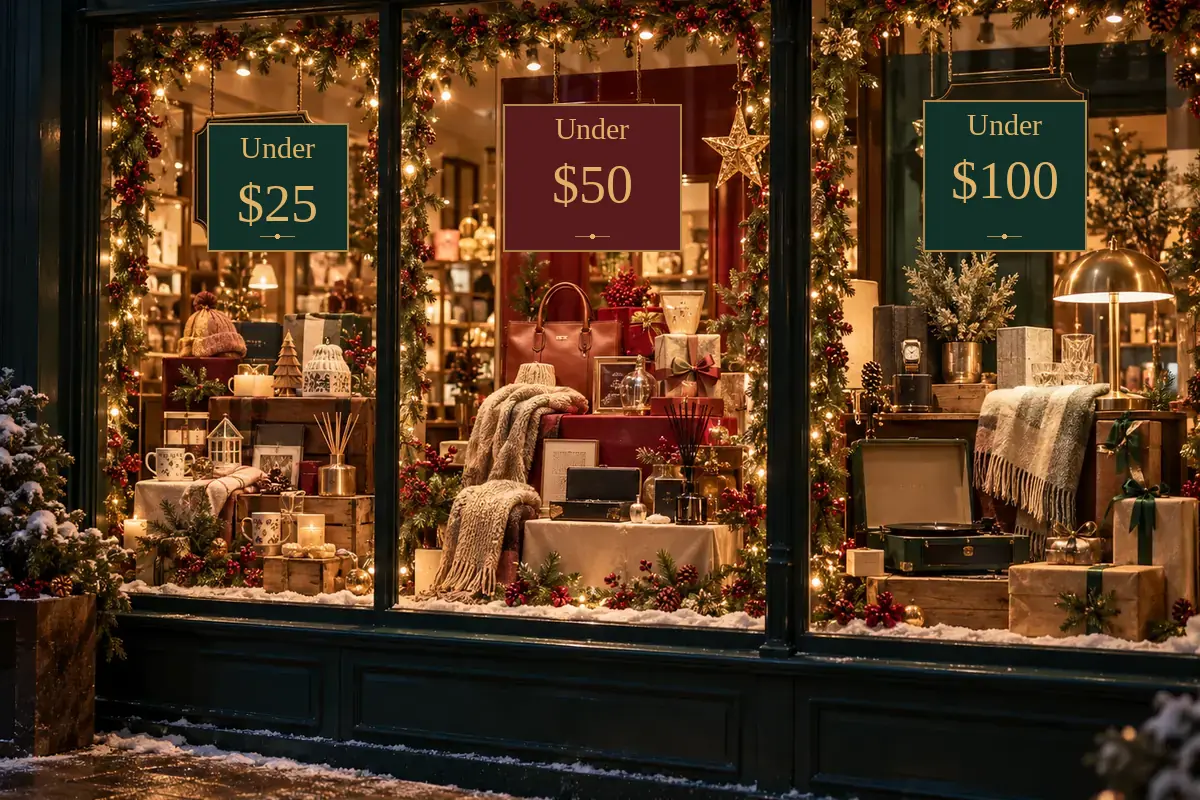
Split the window into three clear budget zones with big price labels and a small curated set in each. It answers the question every December shopper is carrying: “What do I buy, for how much?”
- Use three price bands at most.
- Give each band its own height or background colour.
- Replace sold-out items the same day so the window stays true.
Why it stops shoppers: December shoppers arrive with a person and a budget, not a product. Useful windows pull mission-led shoppers in.
Measure it: Ask staff to note which zone shoppers mention. Rotate the weakest zone every week.
Wrapped vs. Unwrapped Bestsellers
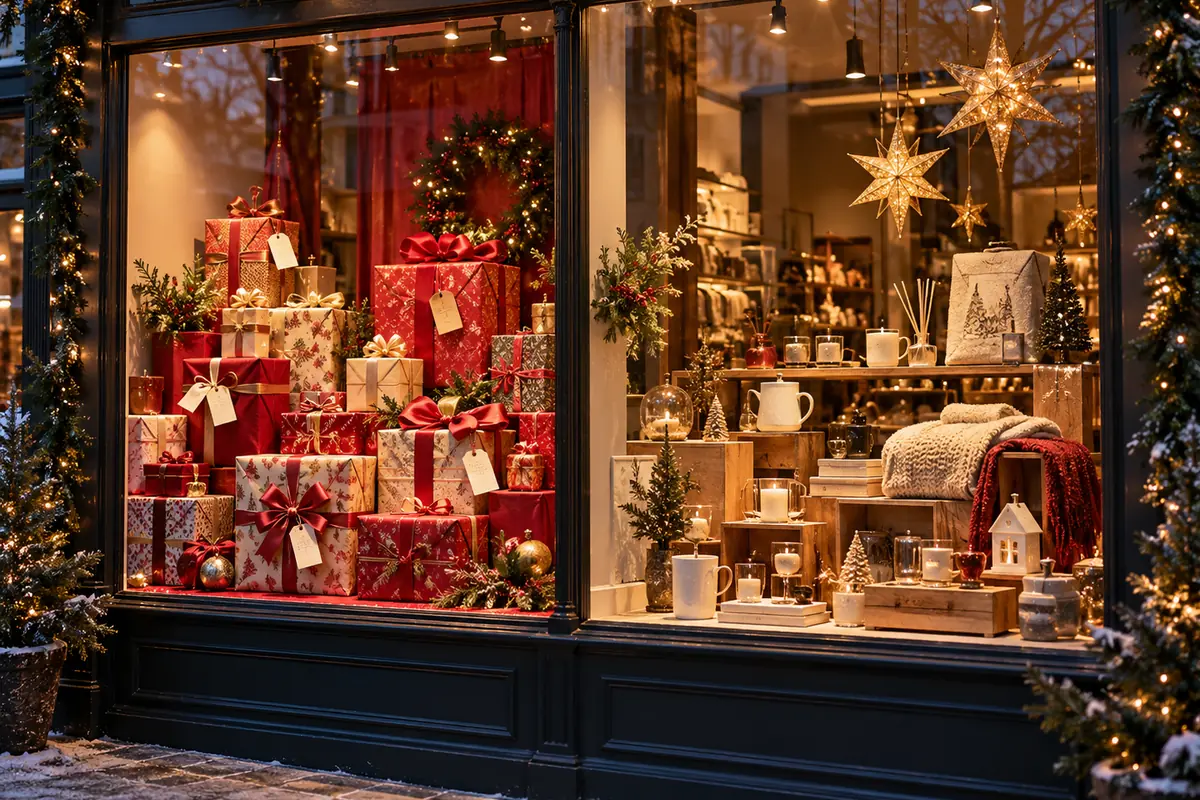
Pair wrapped gift boxes with the real product beside each one. The wrapped side creates mystery; the unwrapped side shows exactly what you can buy.
- Use one wrapping style across every product.
- Choose proven bestsellers or strategic products only.
- Keep boxes in proportion so small items are not lost.
Why it stops shoppers: It scans in two beats, gift then product, and removes the “what is it?” friction.
Measure it: Put the same pairs on the first table inside and track what sells from it.
One Hero, One Hundred Echoes
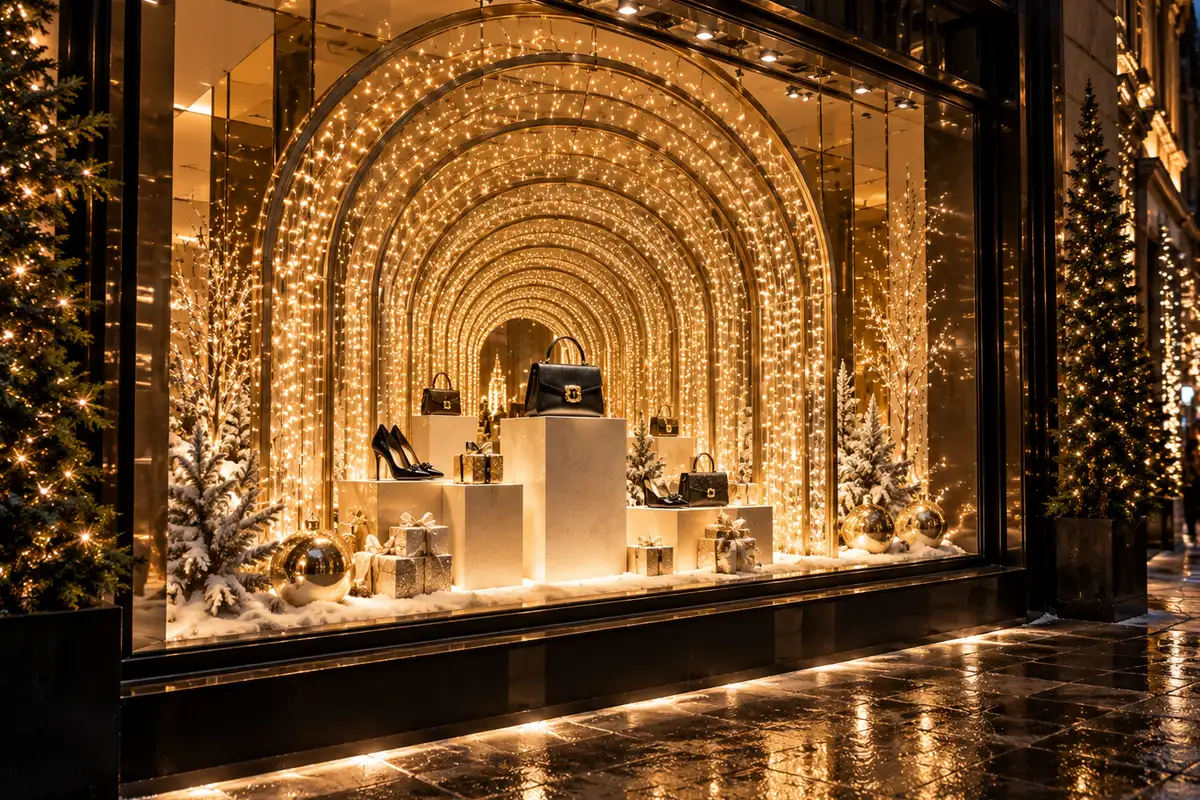
One real hero product sits in the centre. Around it, dozens of simplified paper, acrylic or light “echoes” repeat its silhouette. The copies create the spectacle, and the real one stays unmistakable.
- Simplify the echoes so they never look like fakes.
- Give the central plinth much stronger light.
- Repeat the shape, not the branding.
Why it stops shoppers: Repetition reads from far away, and the single real object is the commercial anchor. It suits a launch or the gift of the season.
Measure it: Track sales of the hero product during the window run against the weeks before it.
The Three-Party Wardrobe
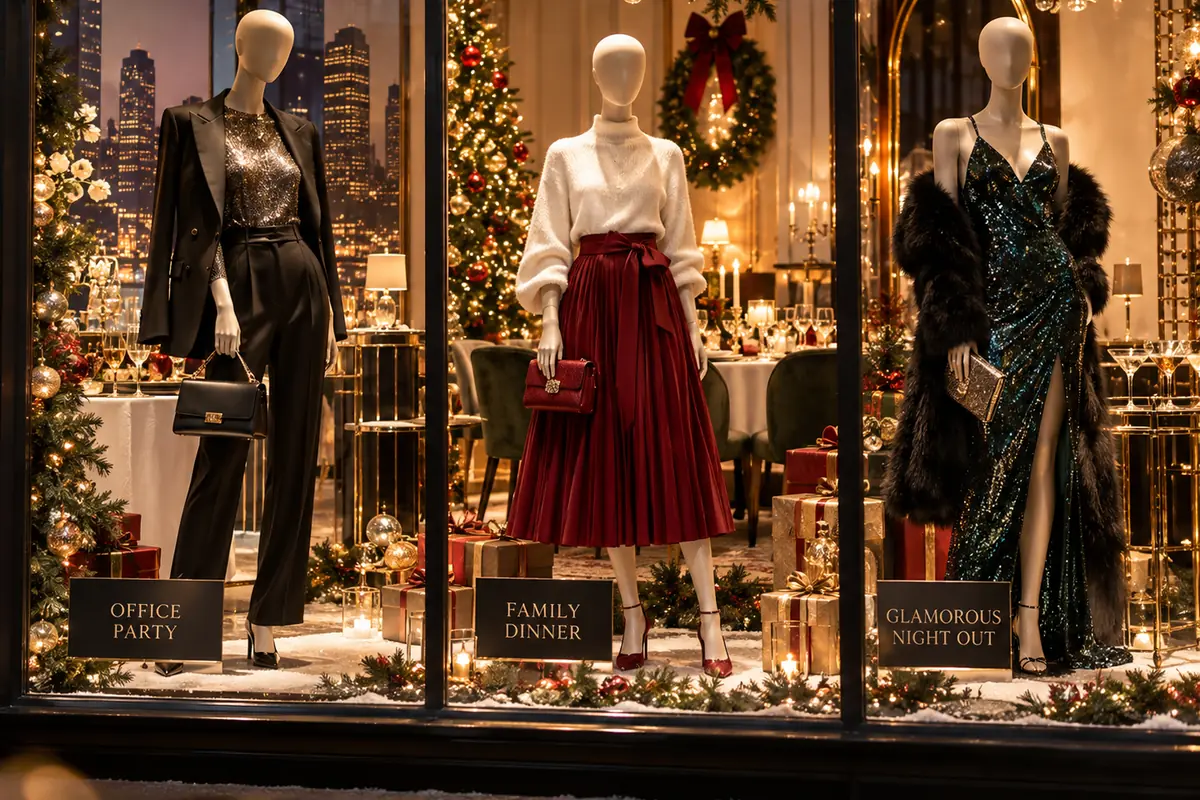
Three mannequin groups for three occasions: “The Office Party”, “Family Dinner”, and “Glamorous Night Out”. Each wears a full outfit with one total-price card.
- Give each window bay one occasion.
- Put accessory call-outs next to the mannequin, not in a separate mini-display.
- Repeat the same edit on the first fixture inside the door.
Why it stops shoppers: It sells an outcome, not items. It answers “what do I wear to…?” and reduces the mental work for the shopper.
Measure it: Track full-outfit sales and swap the weakest occasion after two weeks.
Ideas 26–30: Interactive & Shareable Christmas Windows
These windows ask the passer-by to do one thing. Every action makes the stop longer, and a longer stop gives the window more time to earn the entry.
Scan to Unlock the Hidden Gift
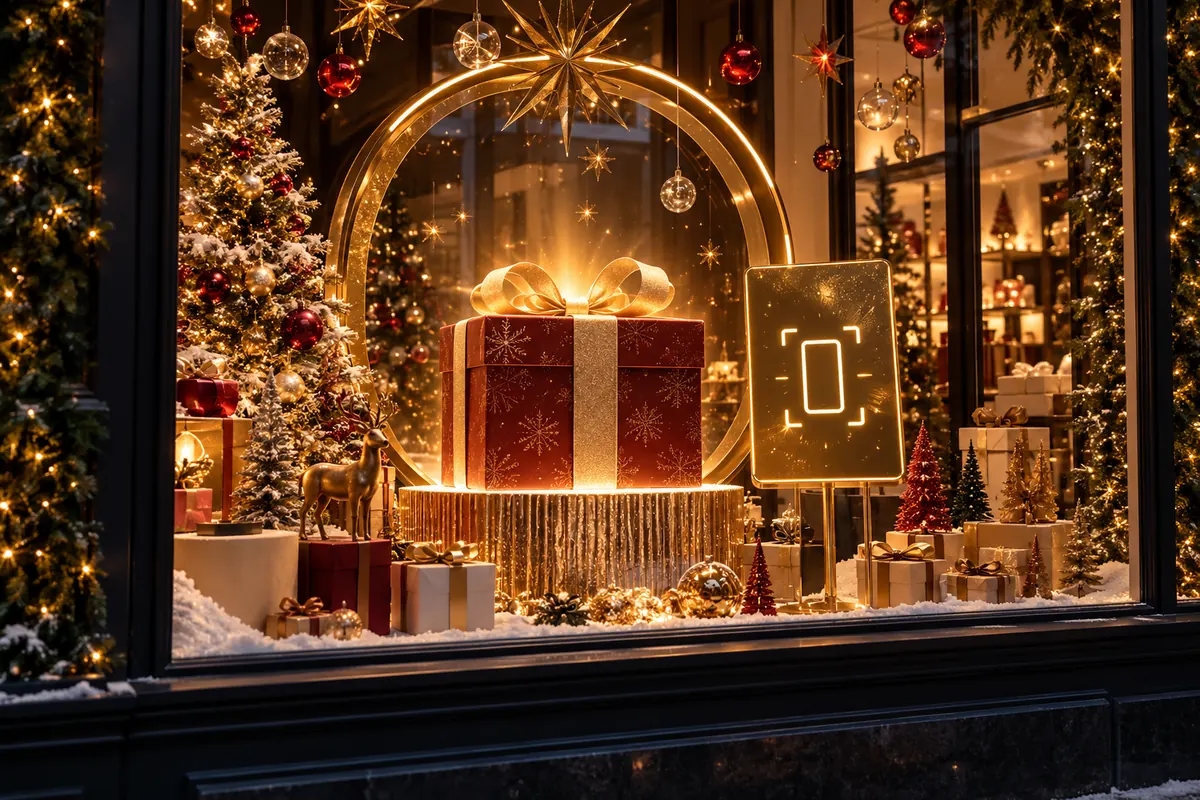
A “locked” gift box in the window with one large QR code beside it. Scanning reveals a digital gift guide, a clue or an in-store-only offer, plus click-and-collect for people passing after closing time.
- Say exactly what the scan unlocks. “Scan for more” gets ignored.
- Build a short, fast mobile page.
- Add UTM tags so scans show up separately in your analytics.
Why it stops shoppers: Curiosity drives the scan, and an in-store-only reward turns the scan into a visit.
Measure it: Compare scans after closing time with passing traffic at those hours. Most stores never see this out-of-hours window performance.
The Christmas Portrait Frame
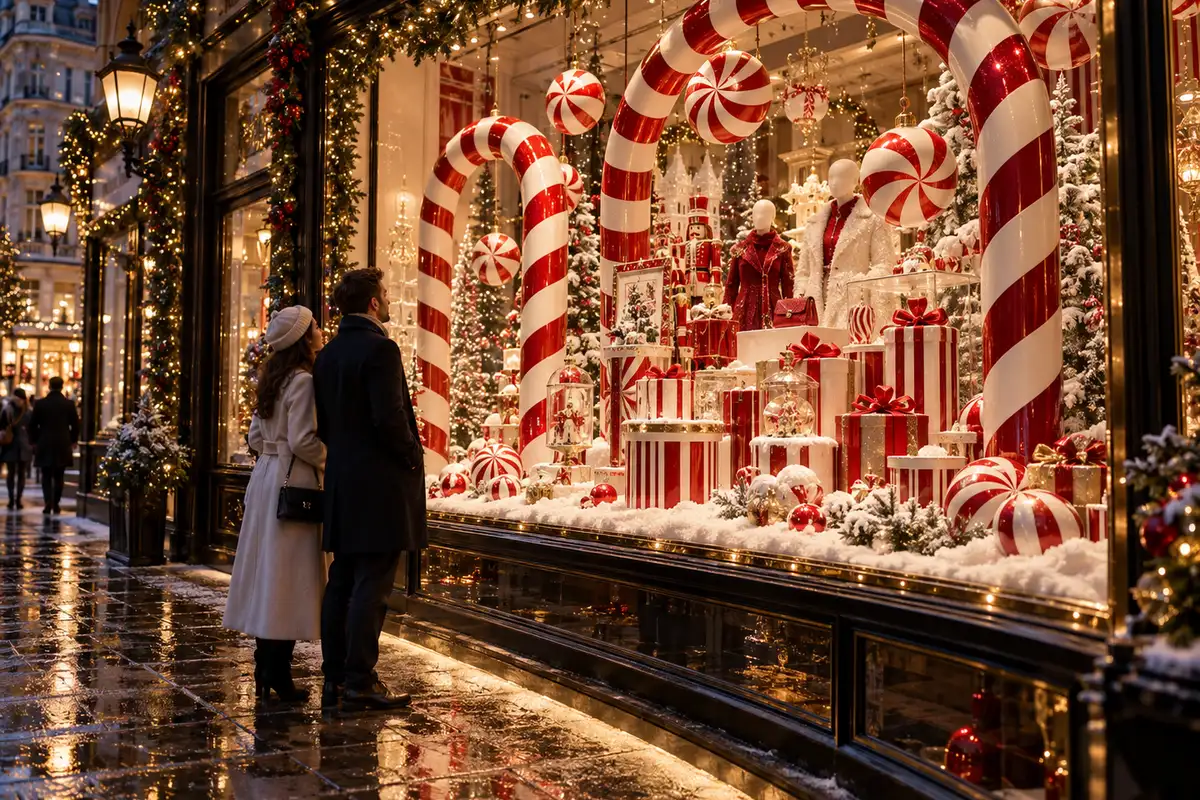
An ornate frame painted or applied on the glass, with flattering light, your name at the bottom and a “Stand here” mark on the pavement.
- Design for both daytime and night photos.
- Keep the photo spot out of the main walking line.
- Offer a small in-store treat for anyone who shows their post.
Why it stops shoppers: Groups stop together, and your shopfront travels onto social feeds. The offer pulls the group inside.
Measure it: Hashtag uses show reach; offer redemptions show entries. Track both, because they measure different things.
Let the Street Vote: Window A vs. Window B
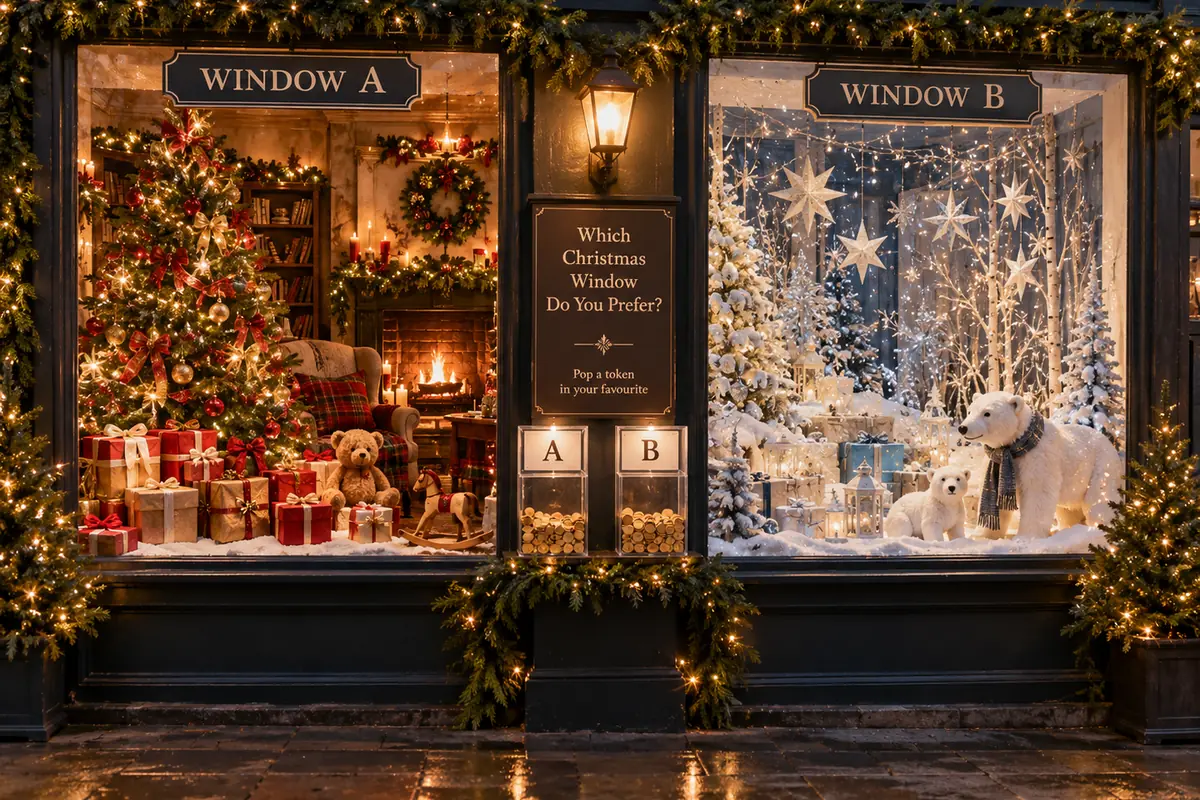
Two neighbouring windows, two named themes (for example “Frost” and “Fireside”) and one question: which is better? Passers-by vote by QR or with a token dropped in a jar just inside the door.
- Name the concepts; never call them “A” and “B” in public.
- Keep the products the same, so the creative idea is the only variable.
- Run the vote for a fixed period and announce the winner on the glass.
Why it stops shoppers: Voting creates participation, and a token vote inside the door creates entries. It also turns the window into a real test.
Measure it: Compare votes with capture rate for each window. The most popular window and the one that brings in more people are not always the same.
The Hidden Ornament Hunt
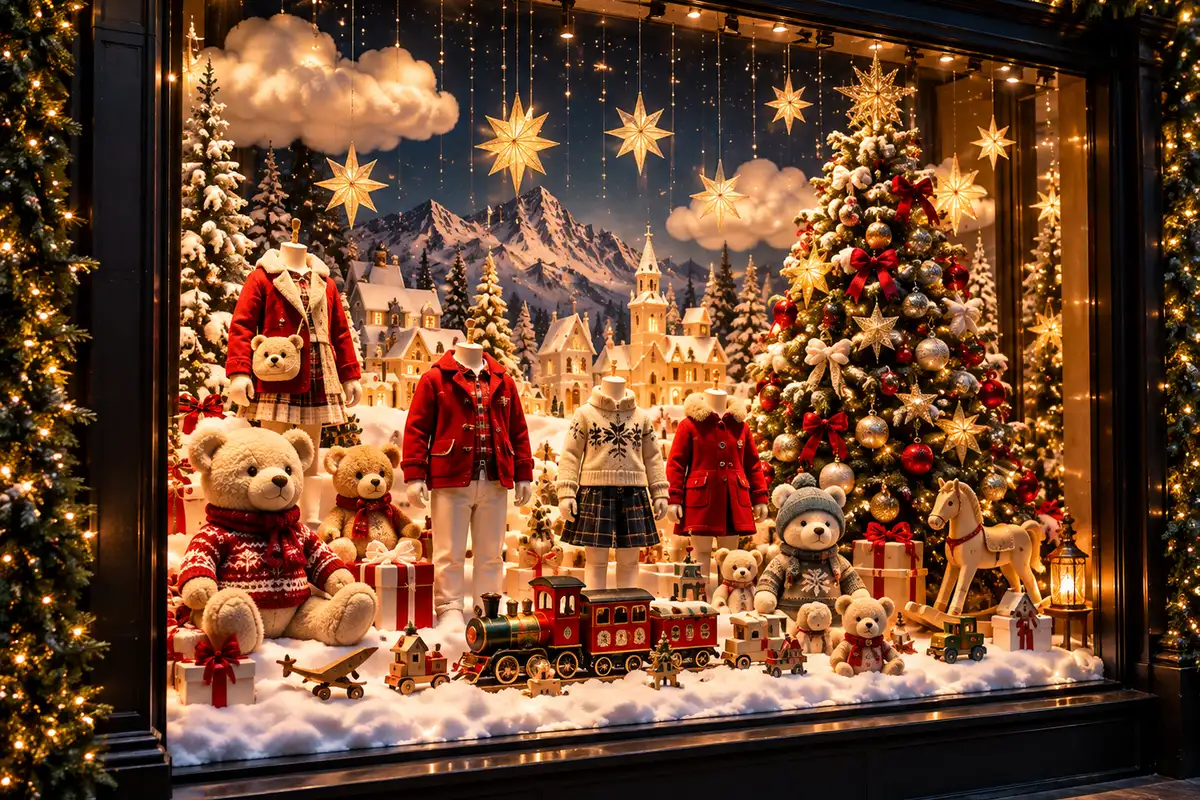
Hide five to seven unusual ornaments, or one tiny recurring character, inside a stylish window and challenge people to find them. Move the character every few days and post clues. An optional web AR layer can add hidden animations.
- Five to seven hidden elements, not dozens.
- Place them at different depths and heights.
- Continue the hunt inside the store with one final clue near the till.
Why it stops shoppers: Searching makes people study the whole window, and it is cheap to refresh.
Measure it: Count how many people claim the in-store “found it” reward against entries in the same week.
The Live Demo Stage
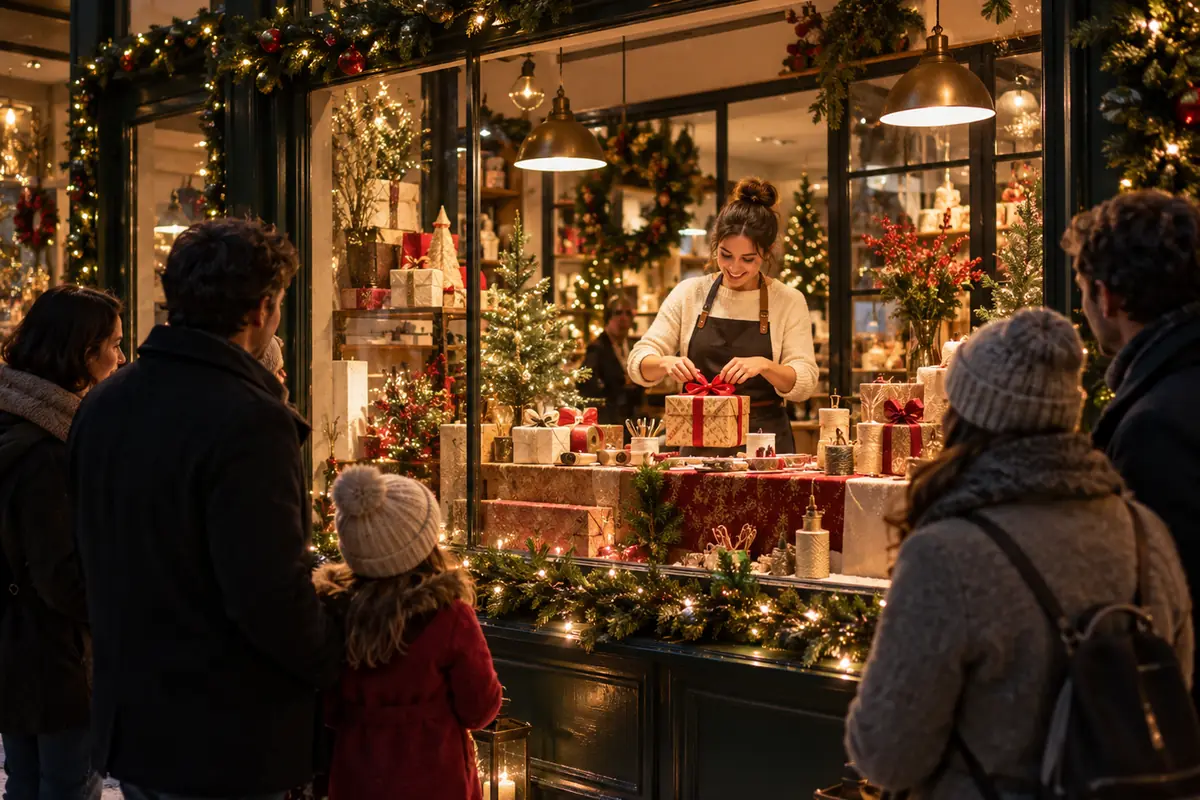
The season’s hero product working live: a robot moving, a drone hovering in a safe enclosure, a game on a big screen. Frame it as a “Holiday Control Room” if the product is technical. Add one line: “Try it inside.”
- Use short animated loops rather than long videos.
- Translate features into one simple mission per product.
- Keep a working spare, because a dead demo is worse than none.
Why it stops shoppers: Products in action stop people better than any decoration, and “try it” is a direct reason to enter.
Measure it: Compare capture rate with the demo running and switched off, at the same hours on comparable days.
Ideas 31–35: Christmas Window Ideas for Small Shops on a Small Budget
A small shop does not need a big budget. It needs one bold idea done cleanly. Every idea here can be built for under $200 with craft-store materials and an evening of work.
The Paper Snowstorm
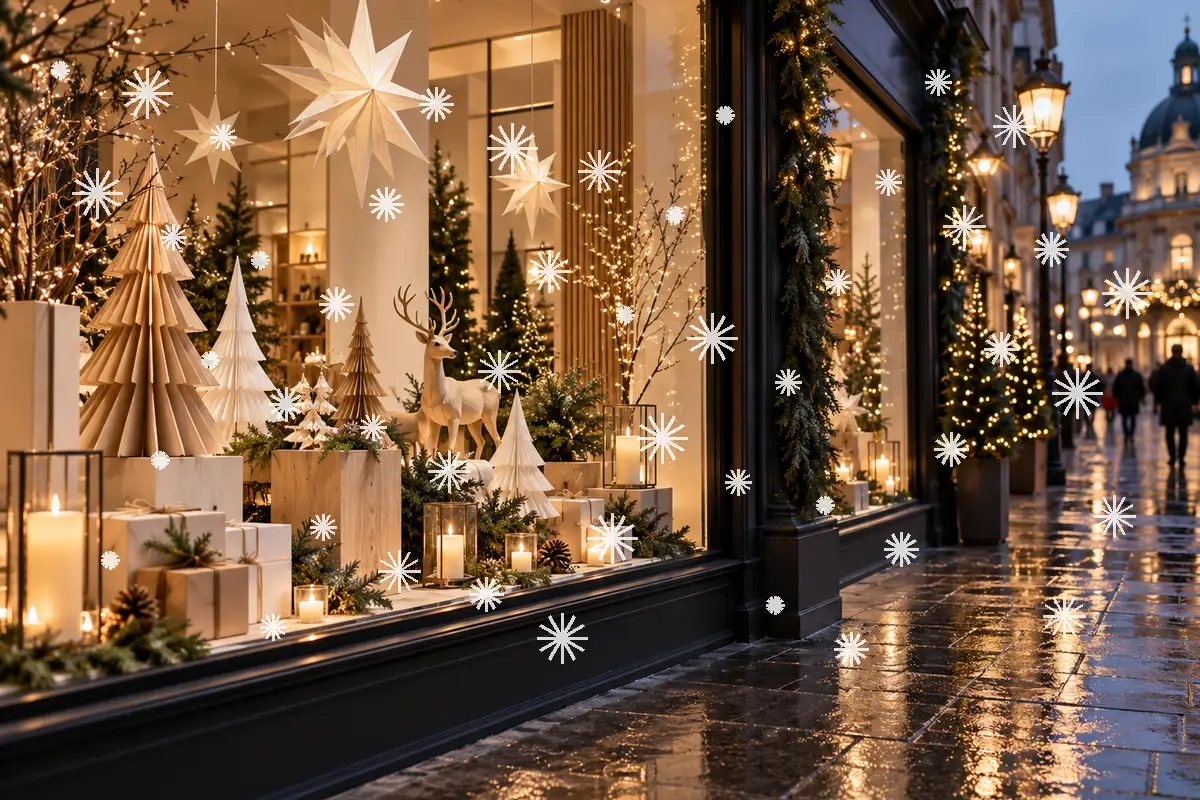
Hundreds of white paper snowflakes on fishing line, hung in a deliberate gradient: dense at the top, thinning towards one product or sign in a clear space.
- Use only three or four snowflake designs.
- Vary size more than colour.
- Pre-build hanging strips on a table, then hang them in one go.
Why it stops shoppers: Quantity alone is not the idea. The stop comes from turning cheap material into a controlled, deliberate field.
Measure it: Paper droops and yellows near warm lights. Refresh the front layer halfway through the season.
The One-Colour Vinyl Story
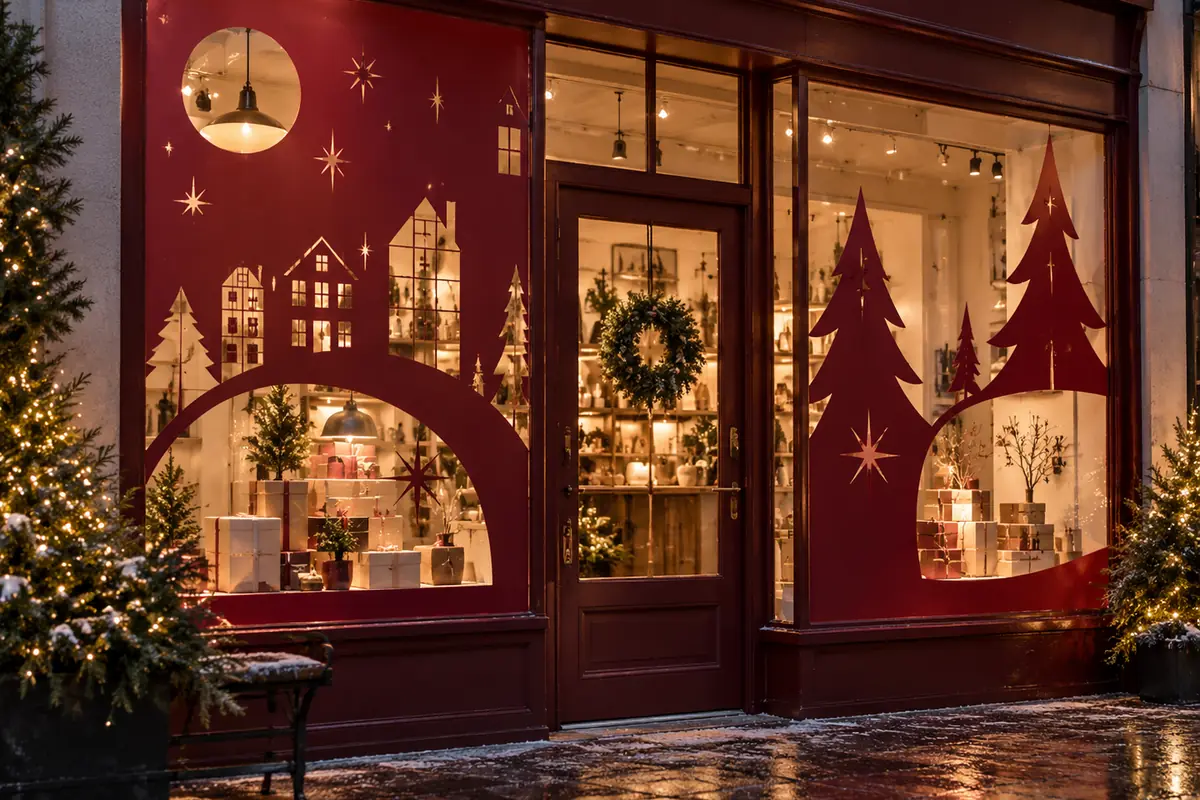
One colour of removable vinyl draws a whole scene on the glass: branches, stars, a skyline, gifts or lettering. The shop interior stays visible behind it.
- Design around the natural sightline into the store.
- Use large shapes that read before small details.
- Test it in daylight and at night, because the background changes.
Why it stops shoppers: It is the fastest way to transform a small window without props, and it keeps the openness that service businesses need for trust.
Measure it: Leave the centre of the glass clear. Designs that block the view inside can reduce entries.
The Chalk-Marker Window Mural
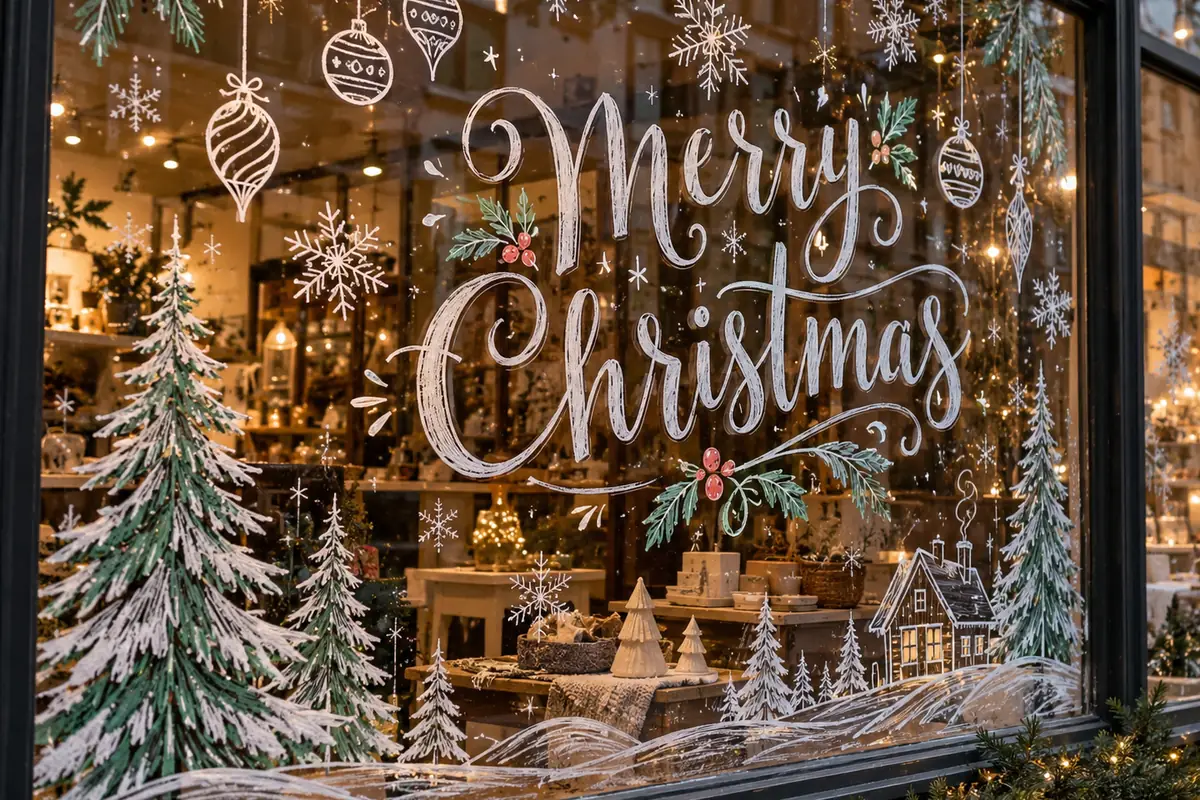
A local illustrator or art student draws a festive scene straight onto the glass in liquid chalk, wrapping it around your products. Film it as a time-lapse for social media. It wipes off in January.
- Sketch at full size on paper before drawing on the glass.
- Use two line weights so the design has hierarchy.
- Keep any text short and big enough to read while walking.
Why it stops shoppers: Hand-drawn work feels human and local, and big chains cannot copy it.
Measure it: Change one element weekly and note it in your log, so you can see which version performed best.
Ribbon Ceiling, Clear Floor
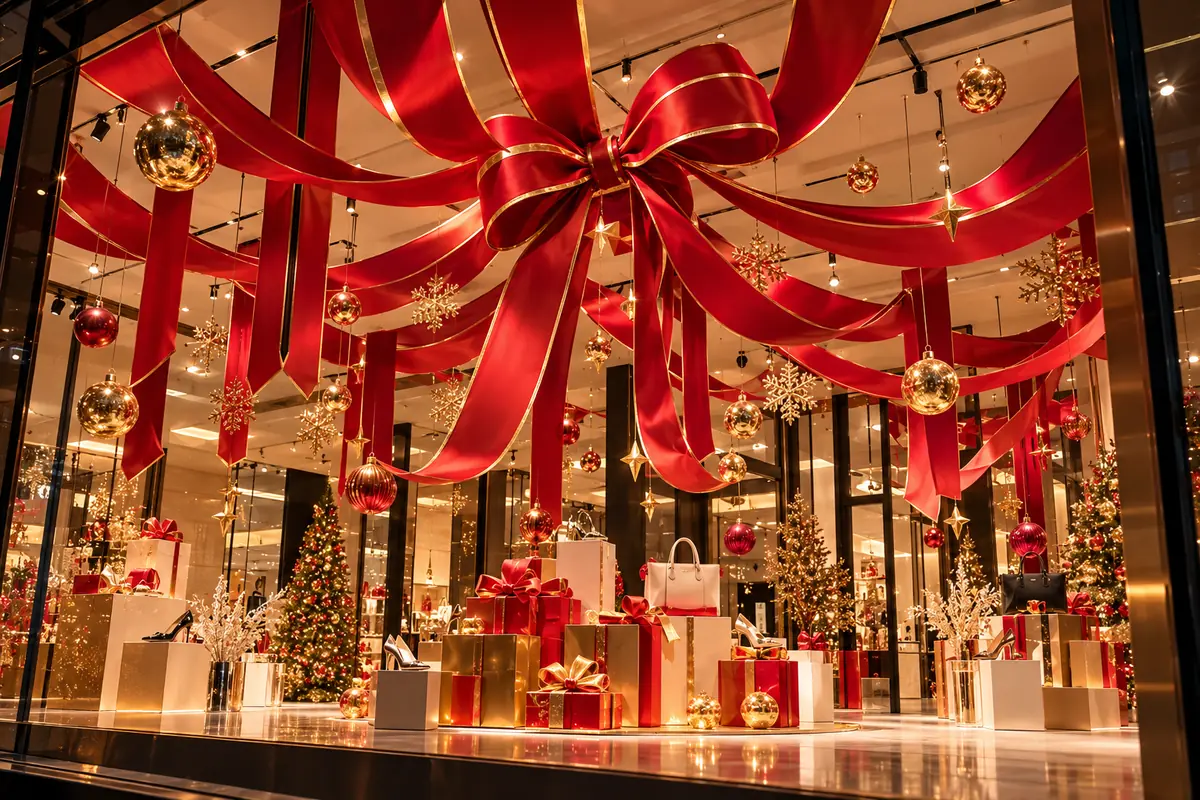
Ribbons, streamers or garlands hang from the ceiling in a dense canopy, while the lower window stays almost empty for products.
- Vary hanging lengths in groups.
- Stick to one material family, not mixed tinsel, ribbon and foliage.
- Keep the entrance clear and check local fire rules for hanging decorations.
Why it stops shoppers: Small shops often fill their precious floor space with props. Moving the decoration up protects the product zone.
Measure it: Check sightlines from the pavement: the canopy should frame the products, not hide them.
The One-Line Window
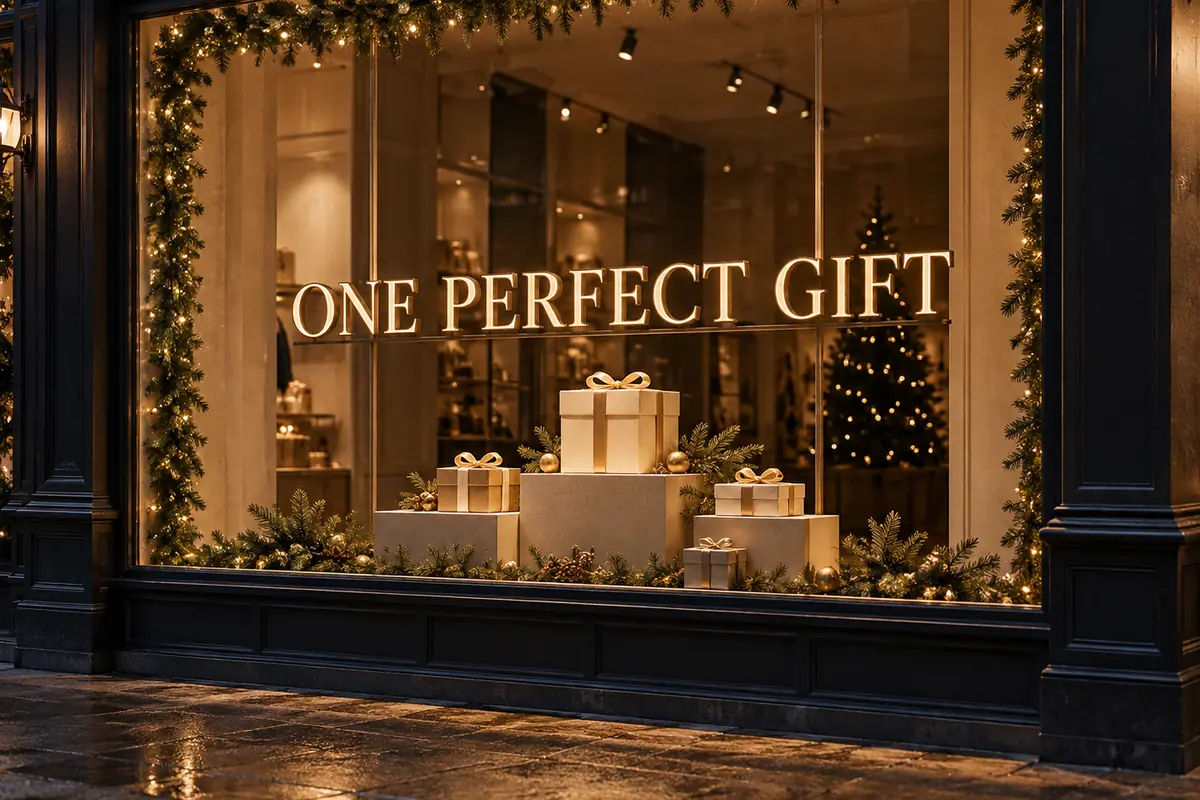
One giant word (JOY, GIVE, MERRY) or one witty line fills the glass: “Gifts so good you’ll want to keep them. We won’t tell.” Letters can be foam board covered in product, lights or tinsel.
- It must be readable from the opposite pavement in one glance.
- Keep humour kind and on-brand.
- Rotate two or three lines over the season.
Why it stops shoppers: One line reads in under a second, faster than any detailed scene. A good line gets photographed and repeated.
Measure it: Run each line for a week and compare capture rate by week.
Ideas 36–40: Sustainable & Natural Christmas Windows
Natural and reused materials photograph well, can be stored for next year and match what many shoppers now expect. Most of these ideas cost less the second time.
The Recycled Cardboard Christmas City
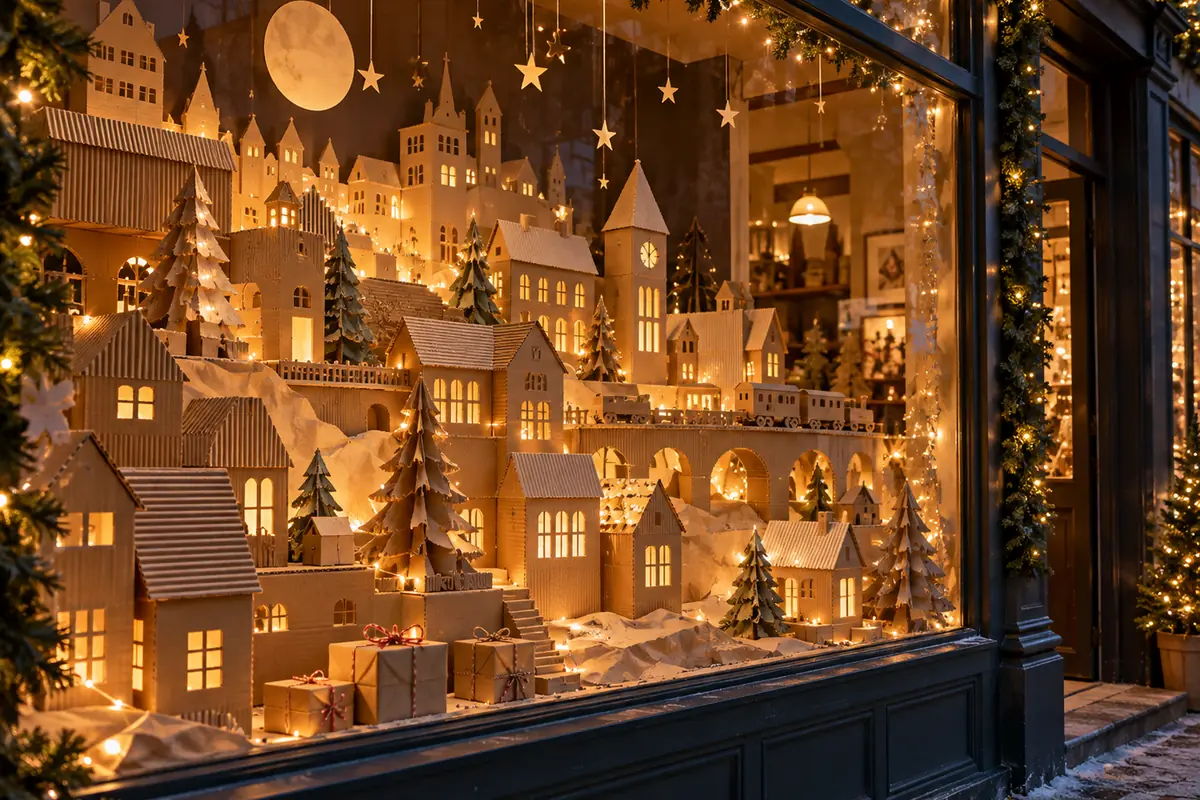
Reclaimed cardboard cut into layered façades, trees and rooftops, with edges left visible and little paint. Battery fairy lights inside the cut-out windows make the city glow after dark.
- Build depth with three silhouette layers.
- Light from inside so windows cast shadows.
- Design it flat-pack so it can be stored or recycled.
Why it stops shoppers: Done with consistent craft, it looks deliberate, not cheap, and the material is the sustainability story.
Measure it: Battery lights fade. Use timers or rechargeable packs and check every evening, because a dark city looks closed.
The Brown-Paper Parcel Mountain
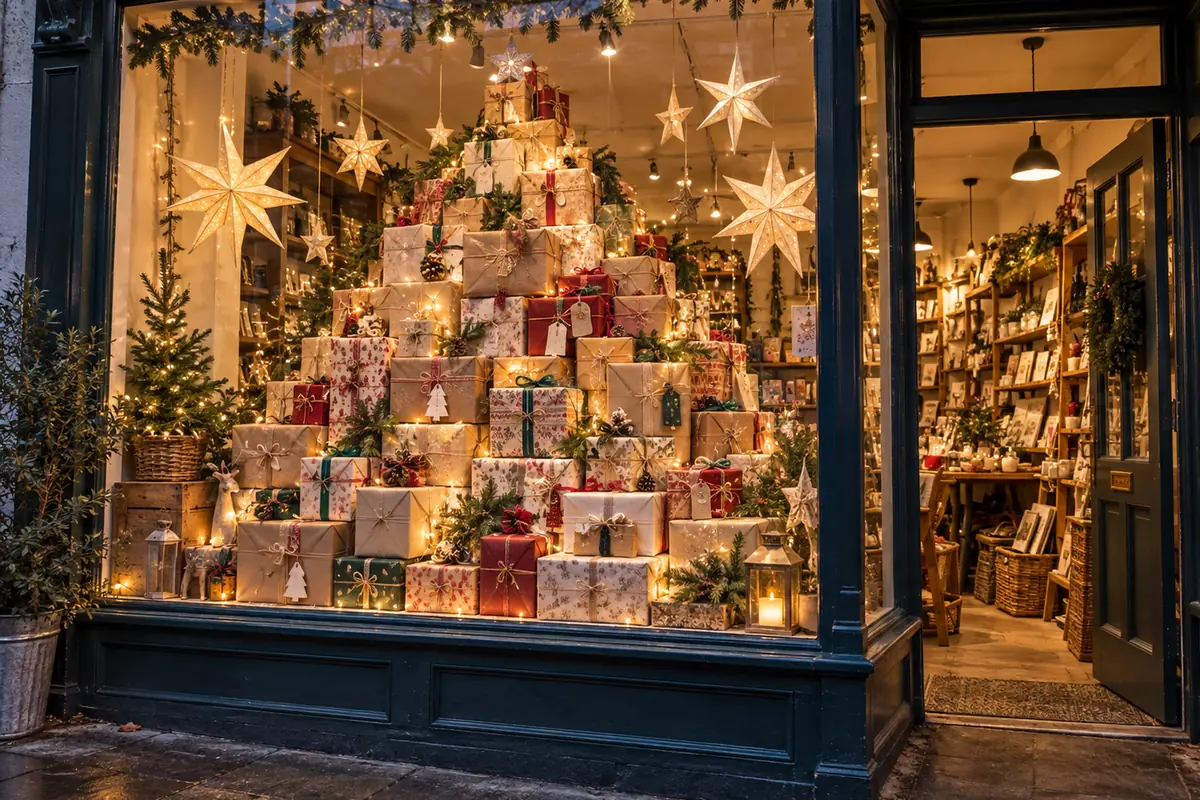
Boxes in plain kraft paper with one ribbon colour and hand-written tags, stacked into a sculptural mountain or staircase: “For the friend who has everything, $18.”
- Use empty, light boxes for volume.
- Anchor stacks so they cannot shift.
- Place real products only at chosen focal points.
Why it stops shoppers: Cheap material plus a strict palette looks designed. Parcels mean “gift” without any traditional Christmas icon.
Measure it: Tags that name a person (“for your dad”) often beat tags that name a product. Test two styles over two weeks.
The Foraged Winter Forest
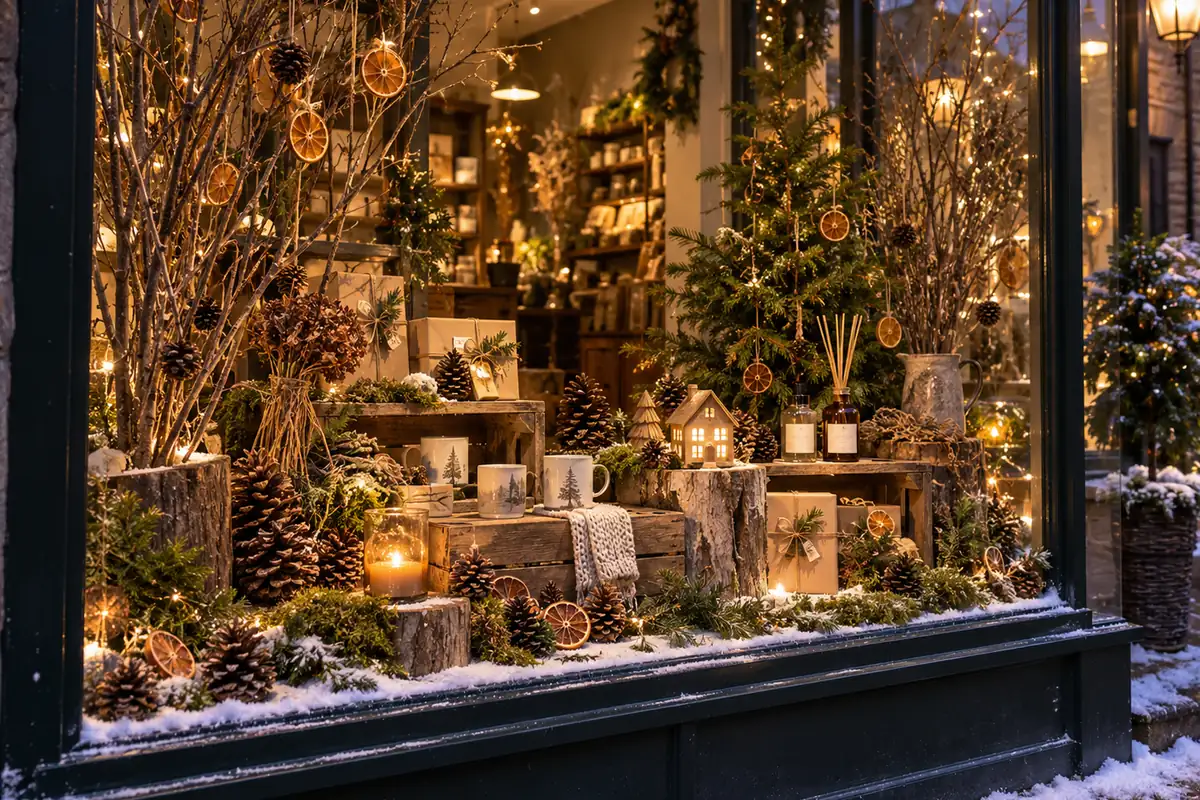
Bare branches, pine, seed heads, dried orange slices and cinnamon sticks, arranged as a small winter forest with products tucked in, all compostable in January.
- Repeat one organic shape through the scene.
- Mix rough and smooth textures.
- Use cool-running LED spotlights, because real greenery dries under heat.
Why it stops shoppers: It gives relief from synthetic sparkle and can move gracefully into January with a few swaps.
Measure it: Say on the glass that everything will be composted. It becomes part of the story.
Ornaments Made From Our Offcuts
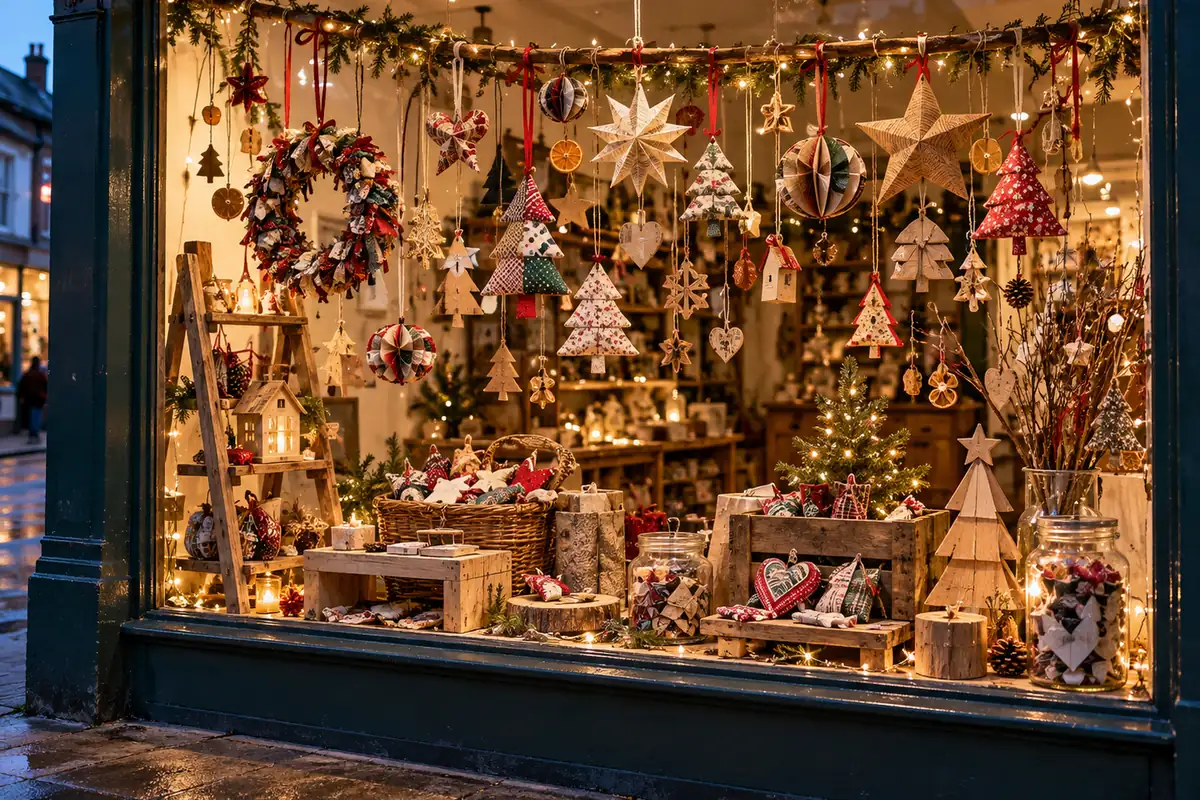
Every ornament is made from your own waste: fabric scraps, leather offcuts, wood shavings, old packaging. The label on the glass reads: “Everything you see was going in the bin.”
- Keep shapes simple and repeated.
- Show one “before” pile of offcuts next to the finished ornaments.
- Sell the ornaments at the counter for charity.
Why it stops shoppers: It shows your values without a lecture and costs almost nothing.
Measure it: Ornament sales at the counter show you how many shoppers the story brought in.
The Living Tree, Replanted in January
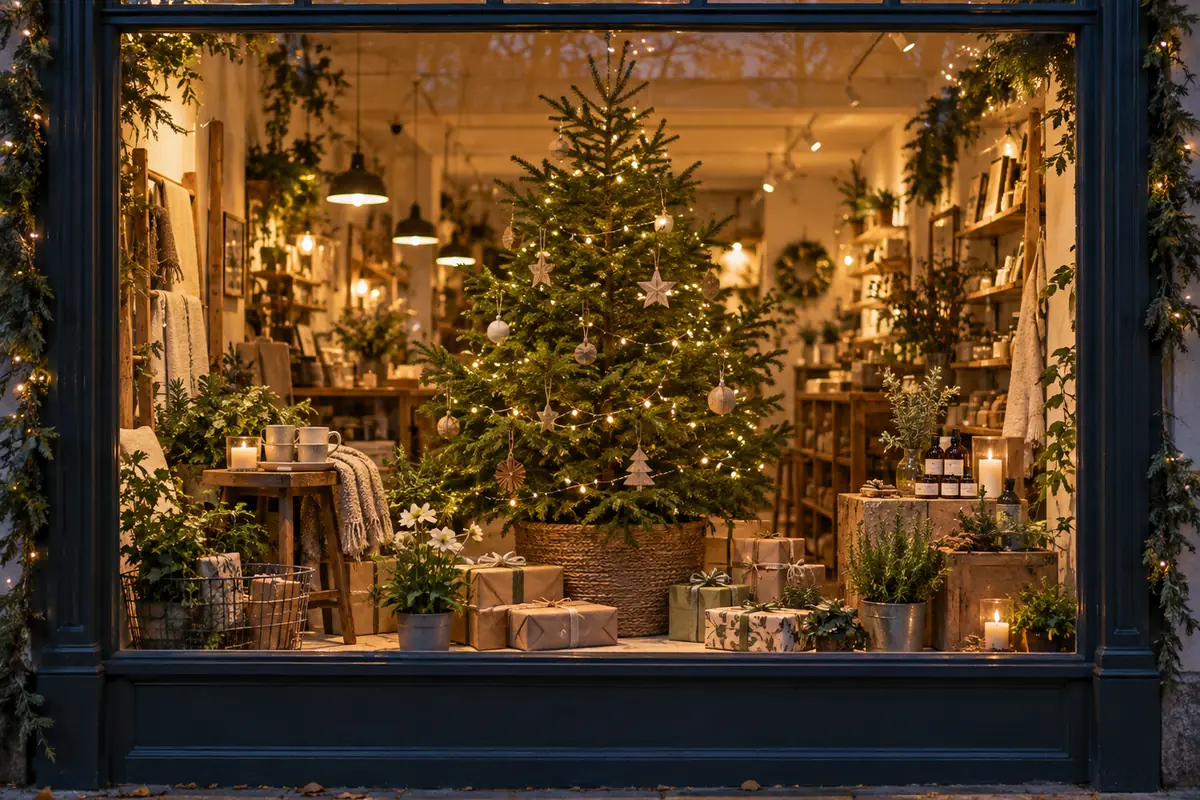
A potted living tree is the centrepiece, with a window promise that it will be planted in a local park in January and an invitation to join the planting morning.
- Agree the planting with your council or park first.
- Collect sign-ups in store, not online.
- Share photos of the planting on the empty window in January.
Why it stops shoppers: A decoration becomes an event, and you get a reason to contact customers in the quietest month.
Measure it: Sign-ups for the planting morning are an early list of your most engaged local customers.
Ideas 41–45: Community & Heart-Led Christmas Windows
Some of the strongest Christmas windows are about the neighbourhood, not the products. They earn goodwill, local press and, most usefully, repeat visits.
Santa’s Post Box, Just Inside the Door
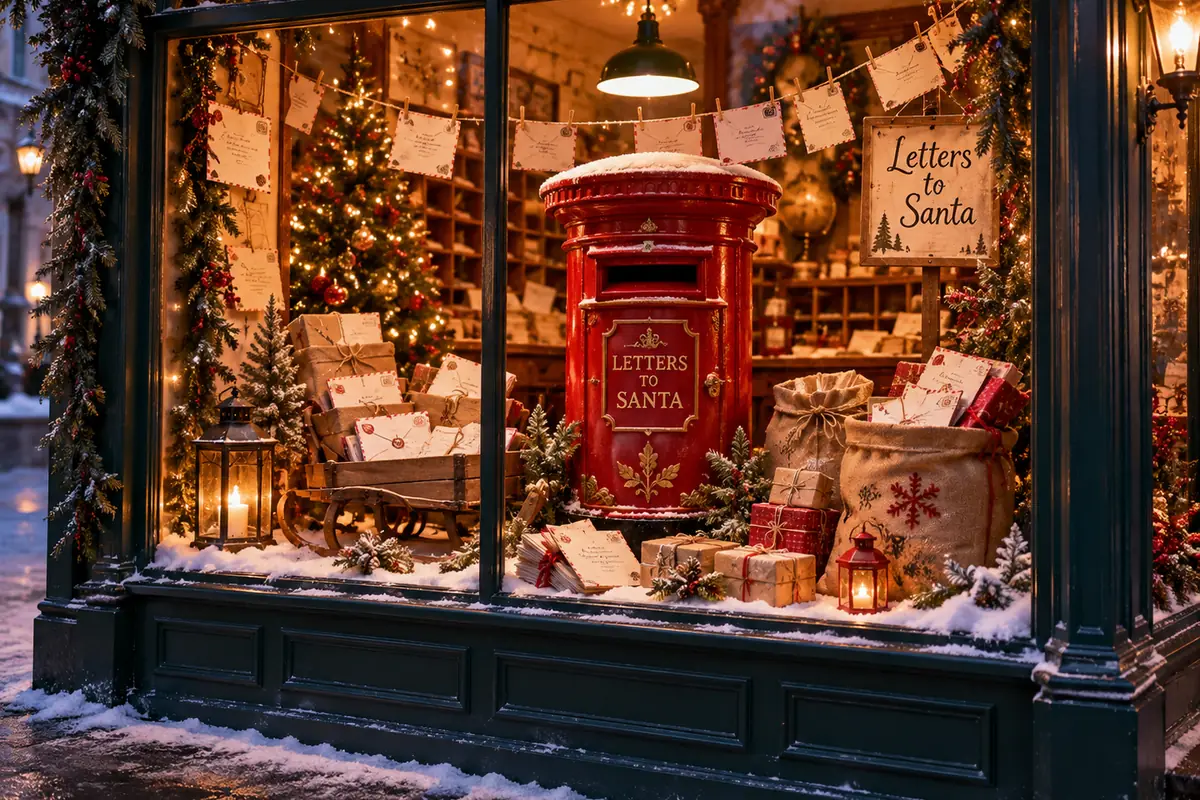
A North Pole post room in the window, with oversized envelopes, stamps and parcels. The sign reads: “Santa’s post box is just inside →”. The real box sits inside the entrance, so every letter is an entry.
- Offer free letter paper at the counter.
- Reply to each letter that includes an address.
- Keep the path from the door to the box short and clear.
Why it stops shoppers: It is one of the few window ideas designed to create entries, not just attention. Macy’s used a version in 1948: children posted letters into a street mailbox linked to an animated Santa inside the window.
Measure it: Letters per day against your door count shows how many families came in without posting one.
The Charity Wishing Tree
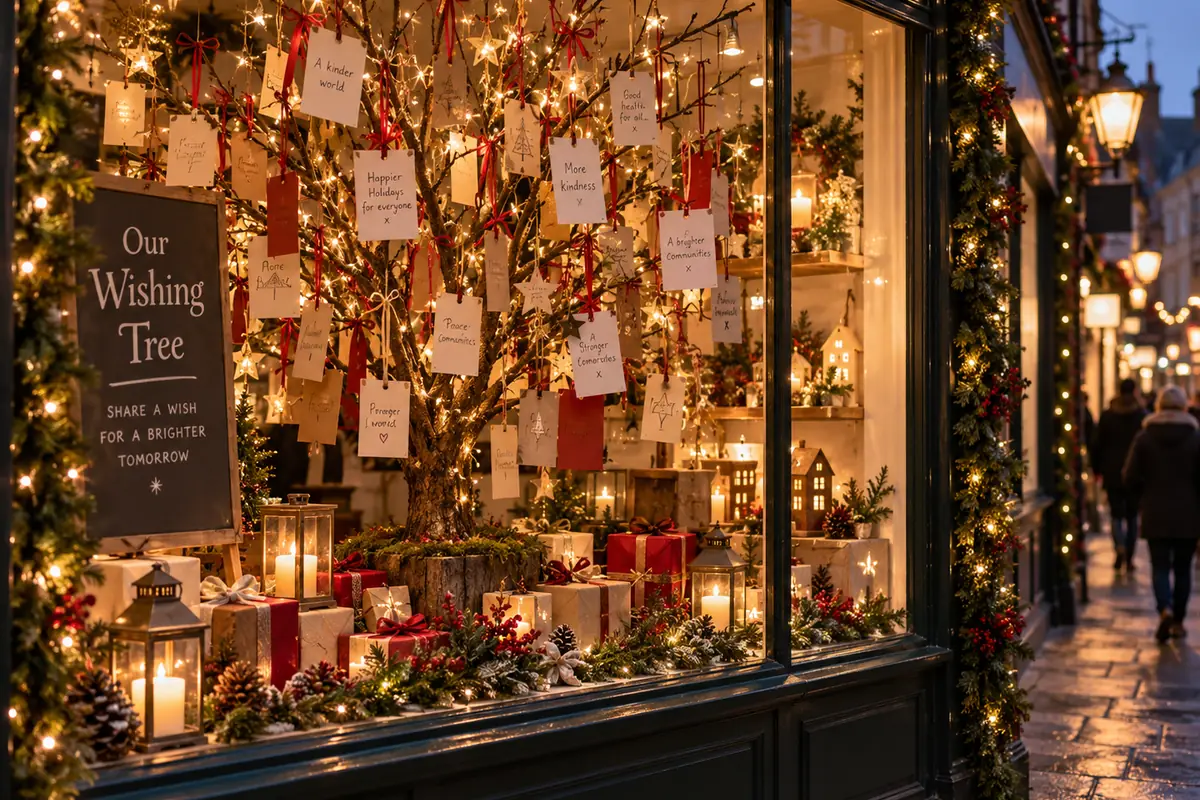
A tree hung with tags, each carrying a real wish from a local charity, shelter or care home. Shoppers come in, take a tag, buy the gift and bring it back wrapped. The tree visibly empties as the town takes part.
- Work with one named local charity.
- Keep the tags inside, next to the tree near the door.
- Show a running total on the glass.
Why it stops shoppers: The mechanic builds in two visits, and the emptying tree is a story the whole street follows.
Measure it: Tags taken and gifts returned are your engagement numbers. Share the final total in January.
The Kids’ Drawing Gallery
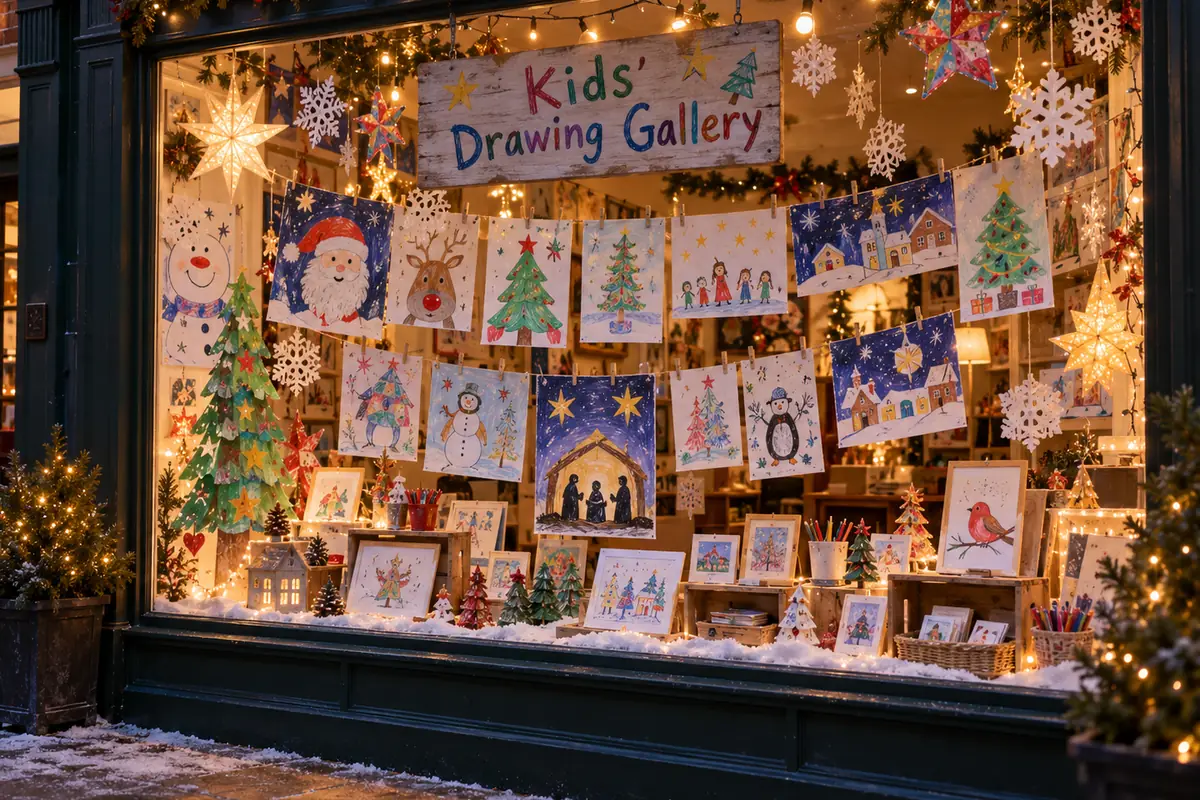
Run a “Draw my Christmas” competition with a local primary school and fill the window with every entry. The winner collects their prize in store.
- Display every entry, not only the winners.
- Mount the drawings at child height.
- Announce the unveiling date in advance.
Why it stops shoppers: Every child brings their family to find their drawing. It is one of the most reliable local-footfall ideas there is.
Measure it: Mark the unveiling date and compare footfall that week with the week before.
The Staff-Made Ornament Collection
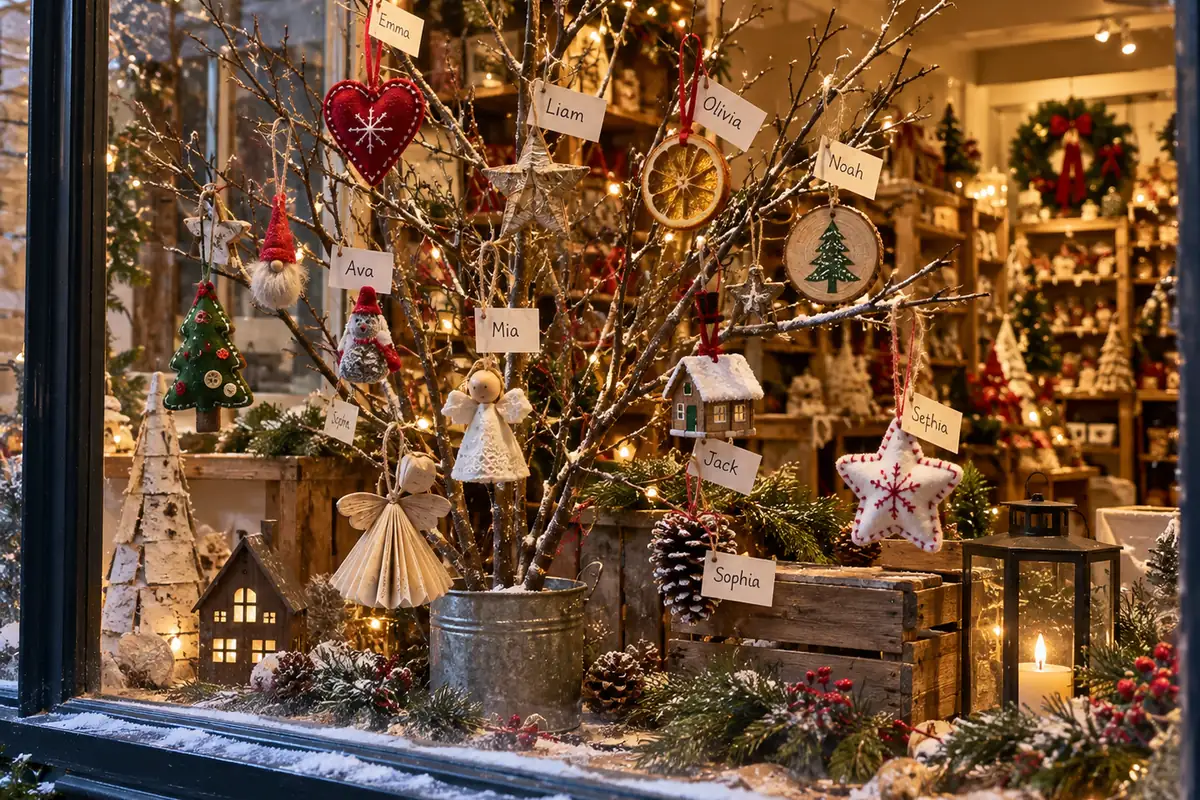
Each team member makes or chooses one ornament that represents them, displayed with a first name. The visual treatment is kept consistent across the set.
- Give everyone the same base size or hanging system.
- Keep labels to a first name and one line.
- Put fuller staff stories on social or a card inside.
Why it stops shoppers: It gives the business a human face without portraits, which matters where customers return for the people.
Measure it: Ask staff to note how many customers mention their ornament. It is an easy signal of window engagement.
The Missing Reindeer Street Trail
Team up with 6–10 neighbouring shops. Each window hides one lost reindeer and a letter. Families collect the letters on a trail map, available inside each shop, to spell a word and claim a prize.
- Keep the trail walkable in 20 minutes.
- Put the maps inside, not in the window.
- Add a one-week neighbour window swap to cross-promote each other.
Why it stops shoppers: The whole street shares the footfall, and the map gives families a reason to step inside every shop.
Measure it: Share entry counts with your neighbours at the end. The trail proves itself only if the whole street’s numbers move.
Ideas 46–50: Christmas Window Ideas by Store Type
Each retail category has its own advantage at Christmas. Use it, and finish with the one idea every store needs.
Bookshops: Blind Date With a Book
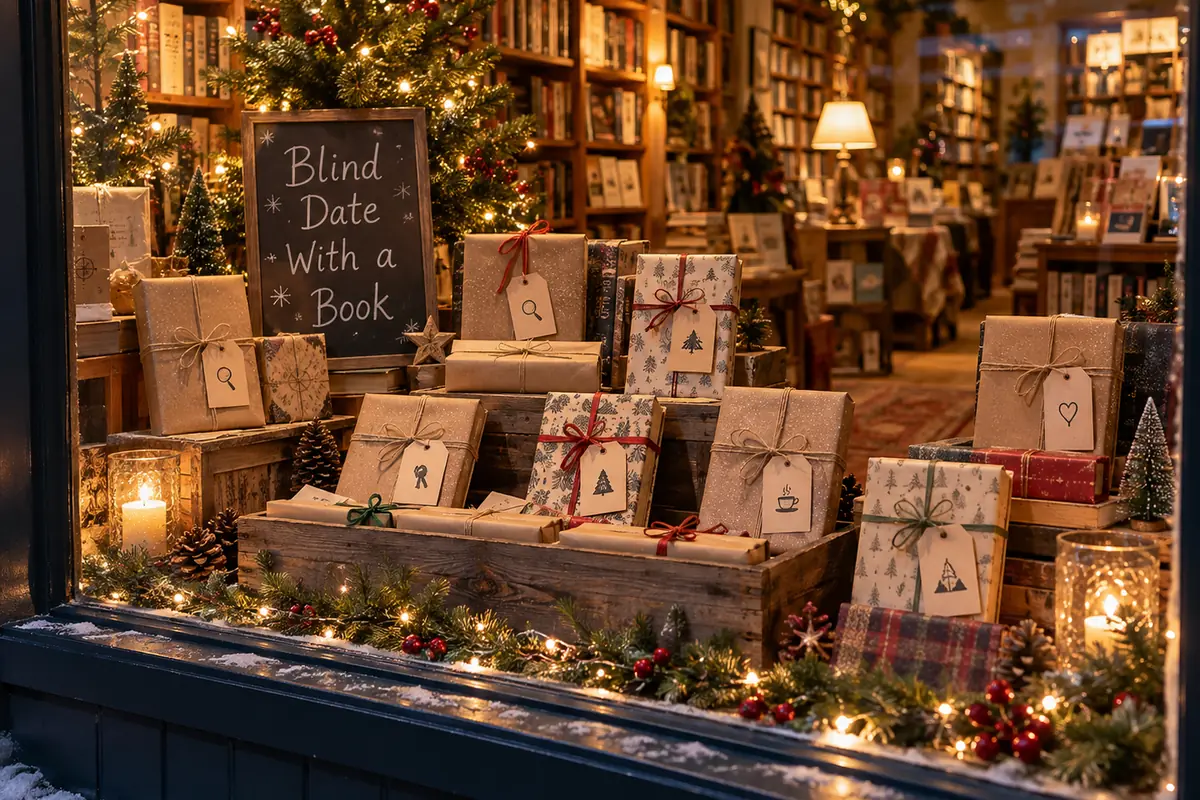
Books wrapped in brown paper with three hand-written hints (“Snowbound. A secret. You’ll cry on page 200.”) stacked into a tree or fireplace, with small reading nooks between the stacks.
- Use display copies where stacking could damage stock.
- Keep some real covers facing out at key focal points.
- Put the matching table right inside the door.
Why it stops shoppers: Mystery makes people curious, and curious people come in to read the hints up close.
Measure it: Blind-date books sell as impulse gifts. Track what sells from the table by the door.
Bakeries & Cafés: The Window Theatre
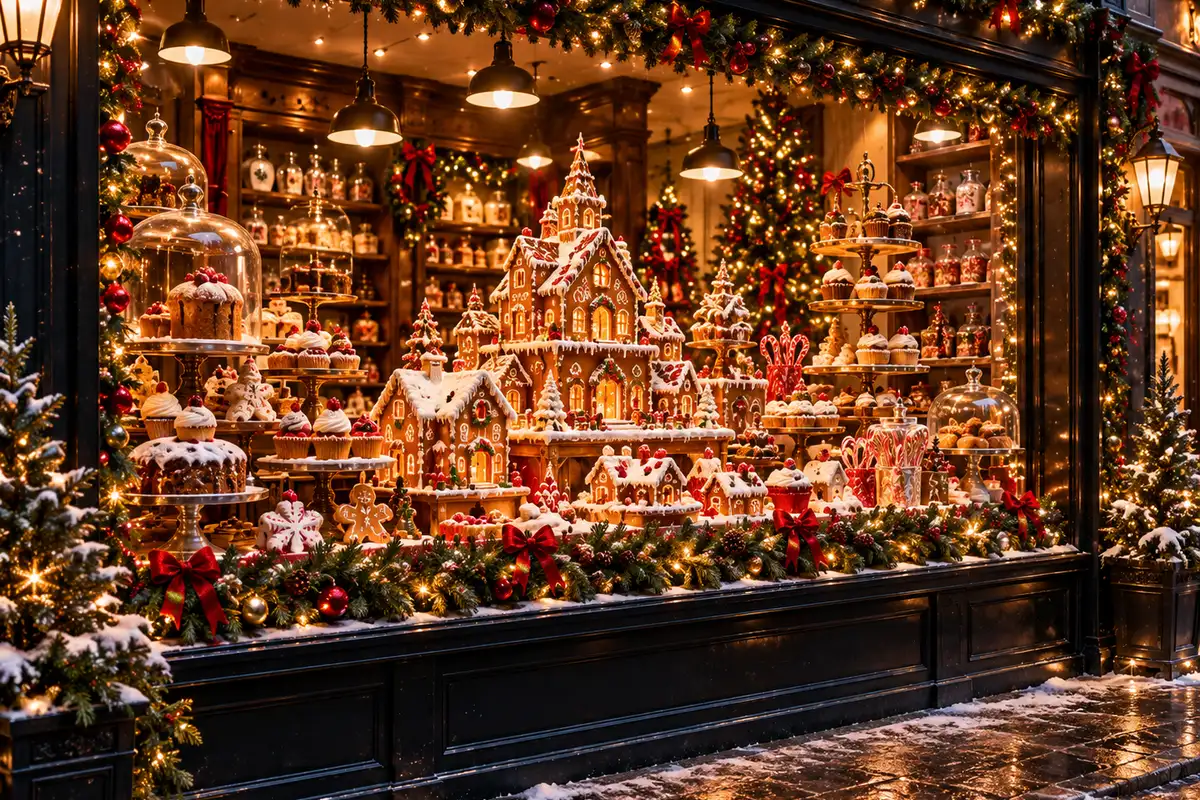
Show the making ritual: trays, piping bags, flour marks and a gingerbread house being iced live by staff at set times. Put a line on the glass: “Smell that? Fresh gingerbread inside.”
- Post the live icing times on the glass.
- Keep real food within safe display conditions.
- Use warm light and strong contrast so products stay visible after dark.
Why it stops shoppers: Food windows win when people can almost smell them. Showing the process adds craft and appetite.
Measure it: Compare entries during icing hours with the same hours on other days.
Beauty: The Gift Lab & Sample Door
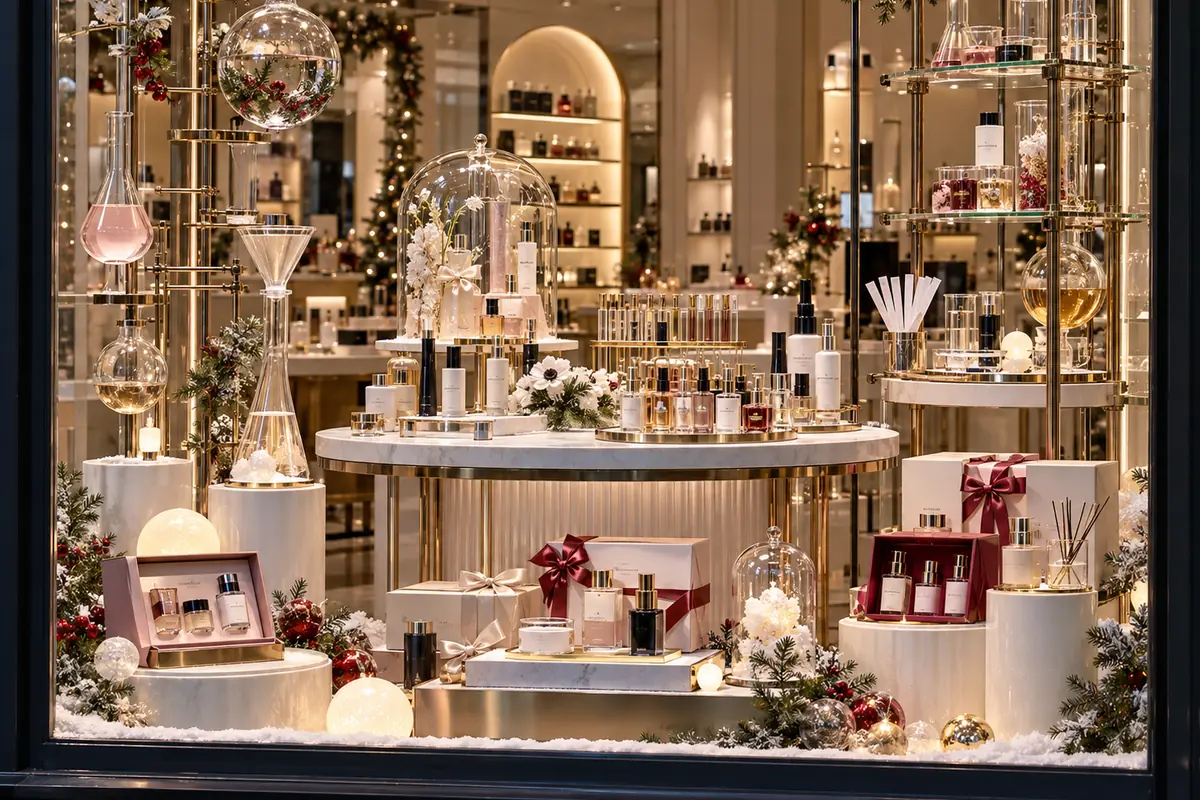
A playful laboratory of clear vessels, glowing “formulas” and gift sets on specimen stands, colour-coded by product family. A sample station just inside the entrance promises: “Try today’s scent.”
- Keep liquids and effects decorative and safe.
- Use clear acrylic for a clean, premium look.
- Give each product family its own light colour or plinth height.
Why it stops shoppers: The lab turns benefits and gifting into one visual language, and the sample creates the reason to enter.
Measure it: Compare samples given per hour with entries per hour to see how many visitors the sample station reaches.
Homeware: The Christmas Table You Can Shop
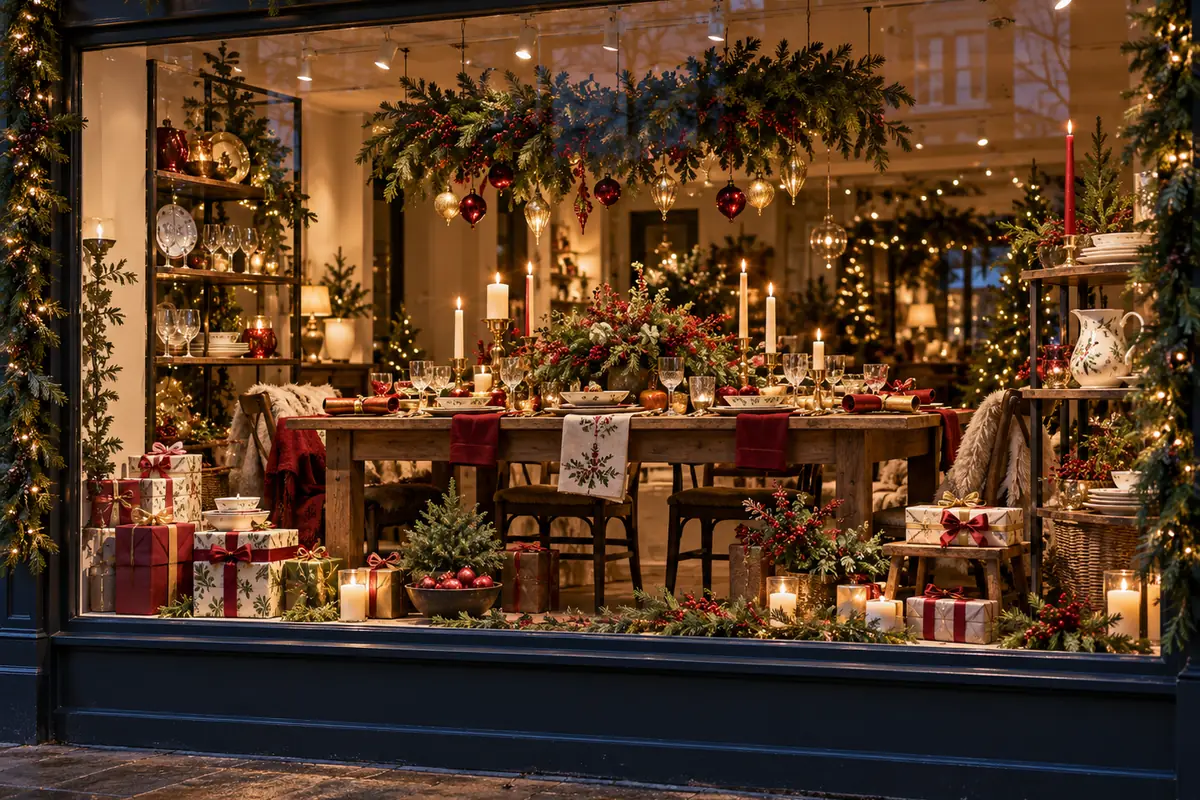
A complete festive table where every visible object is for sale: place settings, glassware, linen, candles and serving pieces, with one place setting left unfinished as a visual pause.
- Use centrepieces for height without blocking products.
- Add a small “everything on this table” price list.
- Group the same items together just inside the door.
Why it stops shoppers: A finished scene helps shoppers imagine owning it, and items look more desirable together than alone.
Measure it: Track sales of the table items as a set against the weeks before the window.
Every Store: The Window That Continues Inside
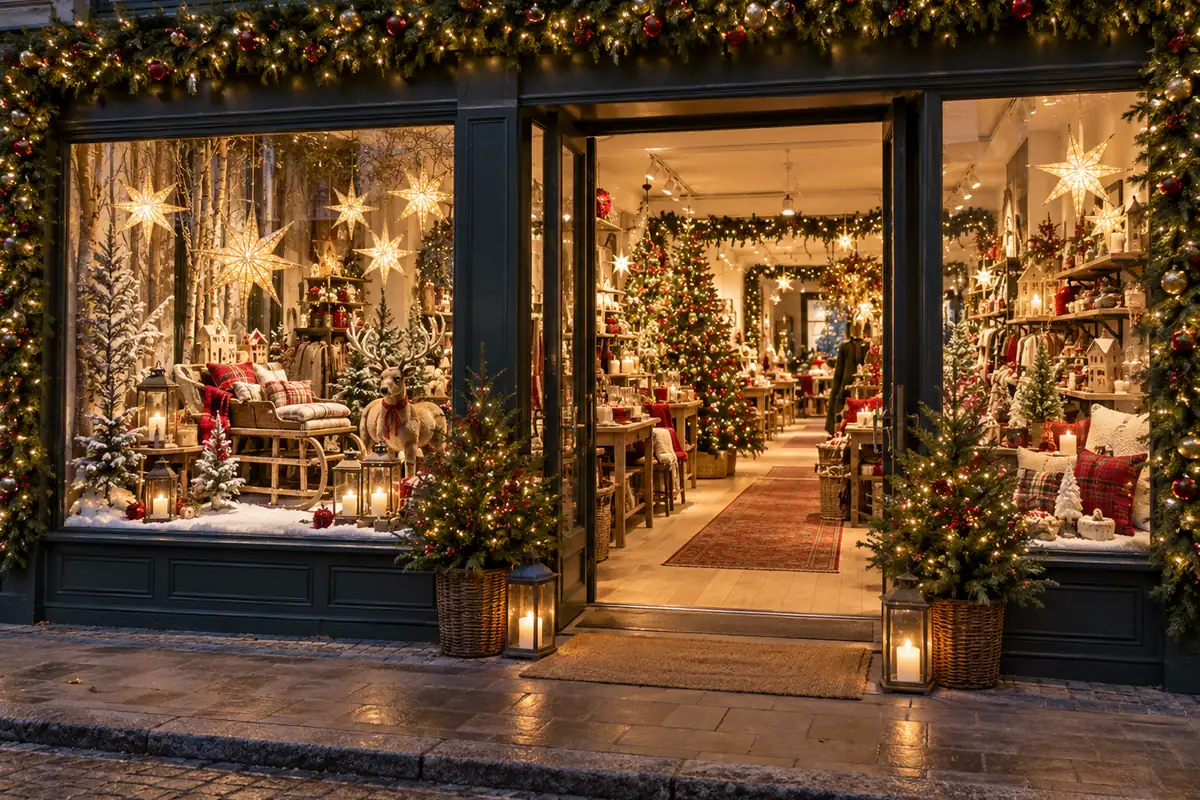
Design the window as scene one, not the whole show. A ribbon, a colour trail, a line of light or the same product story visibly continues through the entrance to the first table inside, where the window’s promise pays off.
- Carry one device inside, not the whole set.
- Make the first fixture inside the payoff to the window.
- Keep the entrance clear so the transition feels obvious.
Why it stops shoppers: This is the most commercially important idea in the list. The window creates curiosity outside, and the store resolves it the moment someone walks in.
Measure it: Measure what happens after entry: zone visits and dwell at the first fixture show whether the window’s promise was kept.
How to Choose the Right Christmas Window Idea for Your Store
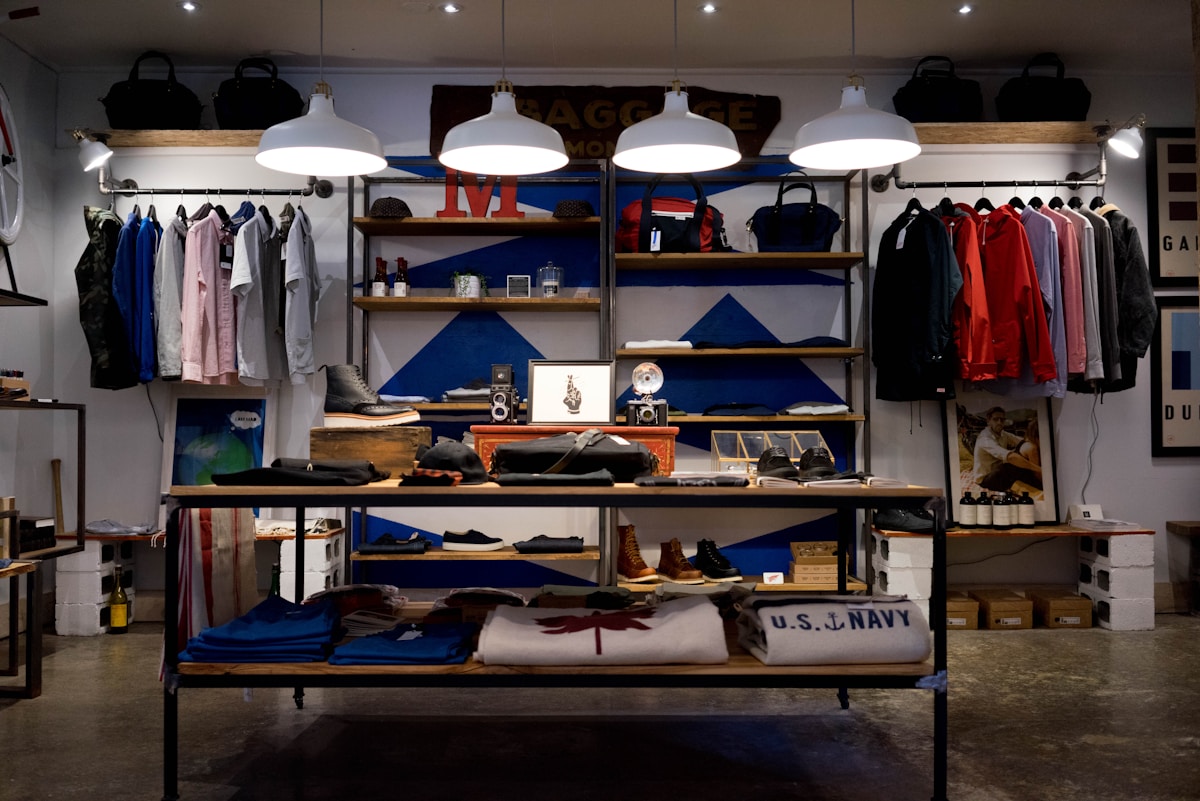
Do not choose on taste alone. The right concept fits your products, your physical window, your street, your build team and the maintenance you can keep up in the busiest weeks of the year.
| If your priority is… | Start with these ideas | What to protect |
|---|---|---|
| Maximum stop power | Giant Gift Bow , Snow Globe , Projection , Chrome Baubles | Readability from across the street |
| More entries, not just looks | Santa’s Post Box , Live Elf , Street Vote , Window That Continues Inside | A clear, uncluttered entrance |
| Premium / luxury | Jewel-Box Gallery , Burgundy After Dark , Crystal Winter | Empty space and precise product lighting |
| Small shop / small budget | Paper Snowstorm , Vinyl Story , Light Curtain , One-Line Window | Discipline: one material, one focal point |
| Product sales | Product Tree , Gift Finder , Wrapped vs. Unwrapped , Three-Party Wardrobe | Stock availability and easy findability inside |
| Social sharing | Portrait Frame , Press for Snow , Hidden Hunt , Advent Window | Pavement flow and one obvious action |
| Repeat local visits | Wishing Tree , Kids’ Gallery , Reindeer Trail , Gingerbread High Street | A partner you can rely on (school, charity, neighbours) |
| Sustainability | Cardboard City , Foraged Forest , Offcut Ornaments , Living Tree | Reuse, storage and fire safety |
Then run three quick tests before you sign off the design:
Walk towards the store at normal speed. After three seconds: can you name the idea and say what the shop sells? If not, simplify.
Photograph the window from the opposite pavement, in daylight and at night. The photo shows reflections, dead zones and clutter you miss up close.
Who cleans it, who resets it and what happens when the hero product sells out? Pick an idea your team can keep perfect on the busiest Saturday in December.
How to Measure Whether Your Christmas Window Works
The clearest single number for a window is capture rate : the share of people passing your frontage who walk in during the same period. It separates opportunity from performance. Raw entries can rise just because the street was busier; capture rate shows whether the window pulled a bigger share.
| Test period | Passers-by | Entries | Capture rate | Reading |
|---|---|---|---|---|
| Window A “Frost” | 5,200 | 676 | 13.0% | Baseline |
| Window B “Fireside” | 4,900 | 735 | 15.0% | +2.0 points vs. A, with less passing traffic |
Illustrative example. Window B had fewer passers-by but more entries. Entry counts alone would understate its performance; capture rate shows it. A difference like this still needs comparable days, hours and conditions before you call a winner.
Christmas window capture-rate calculator
Scenario tool, not a forecast. It assumes conversion and transaction value stay the same when capture changes, and in real stores they may not. Capture rate = entries ÷ passers-by × 100, measured on the same frontage over the same hours, excluding staff. Default values are example inputs, not benchmarks. No passer-by counts yet? Count by hand with a clicker for 30 minutes at a busy time and a quiet time.
What is a “good” capture rate? There is no universal benchmark worth trusting. A busy commuter street and a quiet destination street produce very different ratios. The fair benchmark is your own baseline : same frontage, same hours, before and after a window change. Our storefront counting and capture-rate guide covers the counting rules.
A simple Christmas window A/B test in 5 steps
For the full method, see our guide to storefront A/B testing .
The 2026 Christmas Window Calendar
Christmas Day 2026 falls on a Friday and US Thanksgiving on 26 November, which gives a clean run of shopping weekends. Plan your window changes around these dates:
| Date (2026) | Moment | What your window should do |
|---|---|---|
| Mon 26 Oct – Sun 1 Nov | Baseline week | Keep your autumn window. Record passing traffic, entries and sales as your “before” numbers. |
| Mon 2 Nov | Christmas window goes live | Install overnight. Early shoppers are already browsing. [1] |
| Thu 26 Nov | Thanksgiving (US) | Tease Black Friday on the glass and keep the window lit all evening. |
| Fri 27 Nov | Black Friday | Offer overlay: one bold deal line, readable from across the street. |
| Sat 28 Nov | Small Business Saturday (US) | Independents: a “shop local” message and community ideas #41–45. |
| Mon 30 Nov | Cyber Monday | Add the scan-to-unlock QR (#26) for people browsing on their phones. |
| Tue 1 Dec | December begins | Start the advent window (#11). Mid-season review: keep A or switch to B? |
| Around Fri 18 Dec | Delivery cut-offs pass | Switch to the countdown-to-rescue message (#15). |
| Sat 19 Dec | Super Saturday | Last Saturday before Christmas. Maximum light, quick-pick gifts, longer hours if traffic supports it. |
| Thu 24 Dec | Christmas Eve | “Open until X pm. Wrapped while you wait.” |
| Sat 26 Dec | Boxing Day (UK, CA, AU) | Overnight change to sale messaging. Keep the festive lighting, change the words. |
9 Christmas Window Mistakes That Make Shoppers Walk Past
- Going dark at closing time. Evening passers-by are tomorrow’s shoppers. Keep the window lit on a timer.
- Blocking the view inside. Glass covered edge to edge hides the store. Shoppers want to see that you are open and welcoming.
- Too many focal points. Five competing ideas means none lands within three seconds.
- Hero product at the wrong height. Keep it between about 1.2 and 1.7 m for adults, and lower in family windows.
- No prices, no gift cues. “How much?” is the question that stops people coming in. Answer it on the glass.
- Dirty glass and dead bulbs. Check every morning. One dead light string makes the whole display look tired.
- Glare you never checked. Low winter sun and shiny props can hide everything. Look from the pavement at 10 am and 3 pm.
- An entrance that fights the window. A cluttered doorway, a closed door with no “open” sign or stock piled inside the door cancels a great window.
- Never measuring. Without counts, next year’s window is a guess. With counts, it is a decision.
Christmas Window Build & Install Checklist
Planning timeline
Sign-off checklist
Christmas Window Display FAQ
When should I put up my Christmas window display in 2026?
Aim for the first days of November, and no later than mid-November. In NRF’s October 2025 survey, 42% of US shoppers planned to start holiday shopping before November. [1] Install overnight or before opening, and record a baseline week of traffic first so you can see what the window changed. Plan at least one refresh: most stores change the message about a week before Christmas.
How much does a Christmas window display cost?
It depends on size and ambition. This guide groups ideas into three tiers: $ (under $200: paper, lights, vinyl, stock as decoration), $$ ($200–$1,000: props, motion, professional vinyl, basic tech) and $$$ (over $1,000: projection, custom builds, artists). 29 of the 50 ideas sit in the lowest tier. Reusable materials such as paper sculptures, LED strings and wooden props cut the cost in later years.
What are the Christmas window display trends for 2026?
Messe Frankfurt’s 2026/27 winter guidance, based on the Christmasworld Trends, highlights transparency (glass, clear and frosted materials), a mix of matt and shiny finishes, organic curved forms and suspended elements at two or three heights. The palette combines ice blue, lilac, misty grey, warm beige and matt silver with darker accents of dark blue and burgundy. [5] On the playful side, retail ranges for 2026 lean into homespun warmth, pop-culture personality and cabinet-of-curiosity details. [6]
What makes a Christmas window display stand out on a busy street?
One focal point at eye level, light or movement, a story readable in about three seconds, visible products or prices, and a clear reason to come in now. On streets where every window is red and gold, contrast is often what gets noticed: a dark window with one beam of light, a monochrome scheme, or an unusual shape like a round snow globe.
What are good Christmas window ideas for a small shop?
Pick one bold, cheap idea and do it cleanly: a paper snowstorm (#31), a one-colour vinyl story (#32), a light curtain with three hero products (#6), a one-line window (#35) or Santa’s post box inside the door (#41). Community ideas such as a charity wishing tree (#42) or a street trail with neighbours (#45) also bring repeat local visits.
How can I create a winter window without traditional Christmas motifs?
Use transparent and frosted materials, a cool palette of ice blue, misty grey and matt silver, suspended forms and careful lighting. Ideas #16 (Crystal Winter), #18 (Floating Ornament Cloud) and #38 (Foraged Winter Forest) all feel seasonal without Santa or red bows, and they can stay up into January with small changes.
How do I make my Christmas window interactive?
Give the passer-by one simple action with an obvious reward: press a button for snow (#7), scan to unlock a hidden gift (#26), find hidden ornaments (#29) or vote between two windows (#28). Put the reward inside the store when you can, so the interaction becomes an entry. The window should still work for people who do not take part.
How do I measure if my Christmas window display is working?
Count people passing the window and people entering over the same hours, then calculate capture rate: entries ÷ passers-by × 100. Compare it with your pre-Christmas baseline on equivalent days, and add purchase conversion and featured-product sales from your POS. A counting system such as V-Count Storefront Analytics does this automatically by hour and day. A manual clicker count at set times is a workable start.
How often should I change my Christmas window?
Plan at least two versions: the main Christmas window from early November, and a last-minute version about a week before Christmas, when shoppers’ question changes from “what should I buy?” to “can I get it in time?”. Advent and storytelling windows (#11, #12) change daily or weekly by design. Refresh lights, props and glass every week whatever you choose.
Do Christmas window displays increase sales?
Windows can influence whether people enter, and research links window displays to store entry decisions. [3] But no window guarantees a set uplift. Results depend on location, traffic, offer and what happens inside. The reliable answer for your shop comes from measuring entries and sales before and after a change, on comparable days.
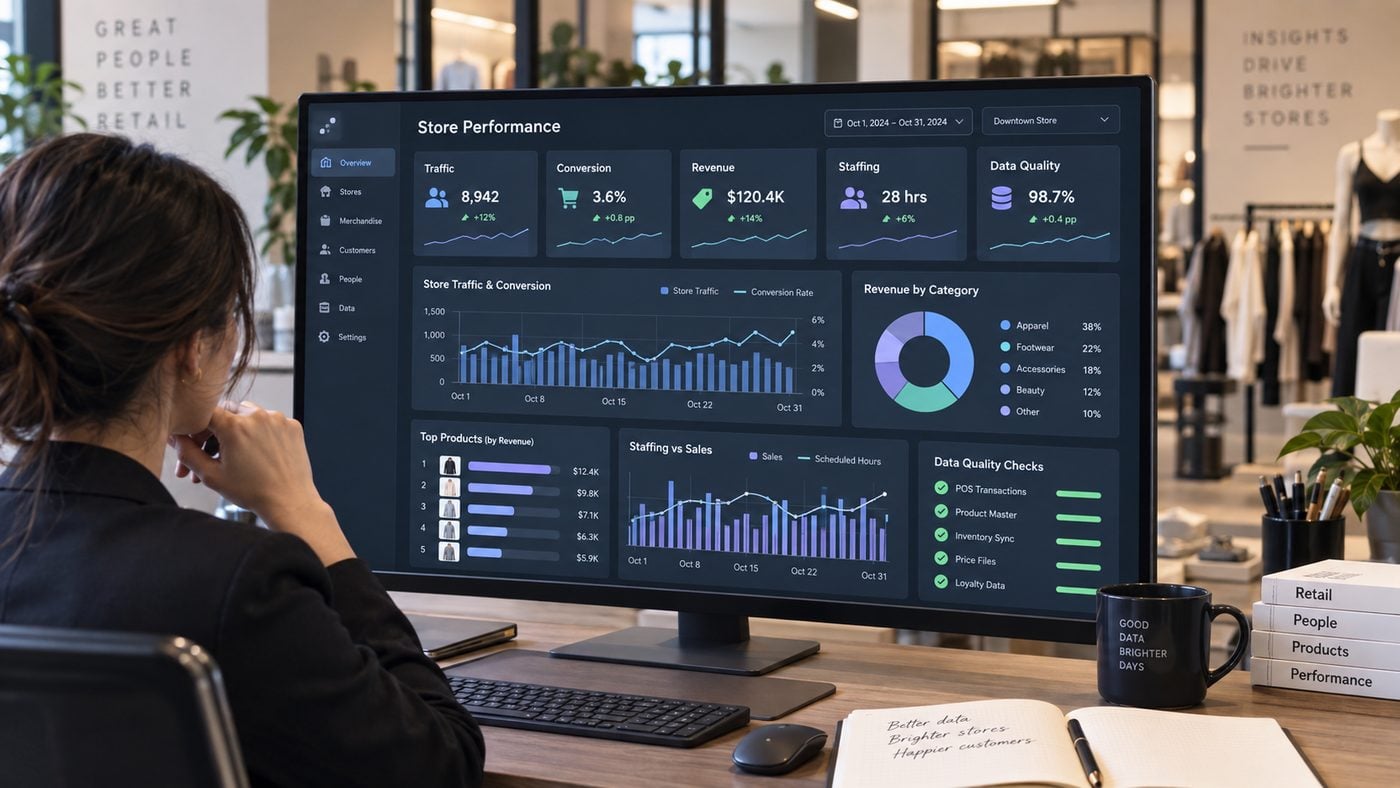
V-Count measures the opportunity outside your door, the people who walk in and the in-store behaviour that leads to sales. Use real traffic data to improve windows, staffing and conversion.
Keep Reading
Sources
- National Retail Federation, “Consumers to Spend Second-Highest Amount on Record, According to NRF Holiday Survey”, 16 October 2025. nrf.com
- NACS, “NRF: Retail Spending Surged During Holidays”, 13 January 2026 (CNBC/NRF Retail Monitor and NRF Thanksgiving weekend survey). convenience.org
- Sen, S., Block, L. G. & Chandran, S. (2002). “Window displays and consumer shopping decisions.” Journal of Retailing and Consumer Services , 9, 277–290. sciencedirect.com
- Lucie Levine, “Macy’s, Lord & Taylor, and more: The history of New York City’s holiday windows”, 6sqft. 6sqft.com
- Messe Frankfurt Conzoom Solutions, “Winter and Christmas window displays: Trends and Ideas for Retailers” (2026/27, based on Christmasworld Trends). messefrankfurt.com
- John Lewis & Partners, “Christmas Shop 2026” range pages. johnlewis.com
Walking-time figure: 5 m frontage ÷ about 1.4 m/s typical adult walking speed ≈ 3.5 seconds. Budget tiers are this guide’s own categories, not survey data. The creative concepts are V-Count editorial ideas; measurement examples are illustrative, and actual results depend on location, traffic, execution and the measurement setup. Concept visuals created by V-Count.