
If you want to optimize your store’s performance, drive more sales, and reduce unnecessary costs, it may be time to use the power of data and do some experimenting.
Imagine being able to understand your customers on a deeper level, predict what products or services they desire, and when they have the “purchase power” to satisfy that need. Just picture having accurate and reliable visitor data to fine-tune your storefront displays, signage, pricing, employee scheduling, special promos, and more with confidence.
As dreamy as it sounds, by no means are we talking about an impossible task. With some experimenting and documenting, you can easily estimate what changes will drive more sales or improve your store’s other metrics.
It’s all possible with A/B testing and building historical data.

How many passers-by does your window turn into visitors?
Count people passing and people entering, then test windows, displays and offers against real numbers.
- Capture rate
- Passers-by vs. entries
- Test your displays
The retail world is more competitive than ever, and studies suggest that no matter what your sector is, the competition will only grow further. This means traditional strategies to drive more sales and convert visitors into buyers are no longer enough by themselves.
A stunning storefront and irresistible product selection won’t cut it if your competition goes the extra mile and one-ups your campaigns. As a modern-thinking decision-maker, you need to harness the potential of storefront analytics and A/B testing to revolutionize your business approach.
Learn from each test and then use your newly gained wisdom to pull customers into your stores and convert their desires into sales.
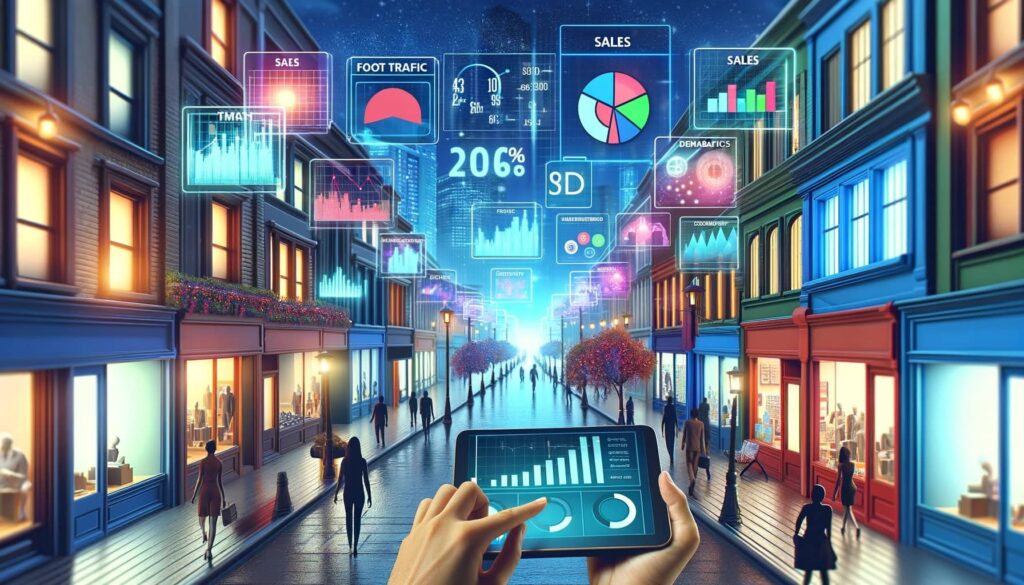
In this matter, A/B testing can be considered the ultimate weapon in your arsenal. A/B testing allows you to experiment with various elements of your storefront and measure how each test resonates with customers and potential buyers.
If your goal is to drive more visitors to your store, then you can change your window display regularly and see how this change makes an impact. Then make another change and grow your data.
Then compare them and add other outside factors and see what works. The more data you collect, the more accurate and effective your campaigns and promotions will become, and therefore more sales and, most likely, a higher conversion rate and return on investment as well.
In essence, it’s as if you possess a magical tool that accurately predicts which modifications will have the greatest influence on your revenue. If you’re ready to unlock the secrets hidden right under the surface and leave the competition behind, let’s get started and explore how to embrace the power of experimentation and data-driven decision-making.
What is A/B Testing
A/B testing is not rocket science, nor does it require immense knowledge to understand how it can benefit your business. A/B testing is a common strategy used by expert marketers. In a nutshell, it refers to comparing two different versions of a strategy (can be a marketing campaign, a sales promotion, etc.) to see which one performs better.
Of course, you can’t just blindly launch two campaigns and see which ones work, as many other factors come into play. You divide your audience into groups —Group A and Group B— and show each group a different version. The version that gets you better conversion rates, sales, or other metrics you are interested in is most likely the better. Unless other factors come into play, you should choose the better-performing one and build on it.
A/B testing is a powerful tool for any retailer, and it can change how your store performs greatly.
What does it cost?
Sensors from US$299, paid once. BoostBI from US$9 per sensor per month.
What is Storefront Analytics?
Performing A/B testing to improve your storefront performance is extremely helpful, but your efforts would be more efficient if you used the power of technology to better understand who your potential customers are.
Obviously, “storefront” refers to the entryway of a retail store, and the latter part, “analytics,” refers to collecting, analyzing, and interpreting data related to said retail store’s entrance and window displays. This isn’t something you can do without cutting-edge people counting technology, though. Storefront analytics requires a reliable technology provider in order to capture and track visitor data with extreme precision.
With storefront analytics, you can gain valuable insights into various metrics that can help you understand how customers interact with your store and what drives them into your store and make purchasing decisions. Storefront analytics can deliver key insights such as the age and gender of your potential customers and existing buyers, how long they dwell in front of your displays, what types of events boost foot traffic, and how you can improve your ROI.
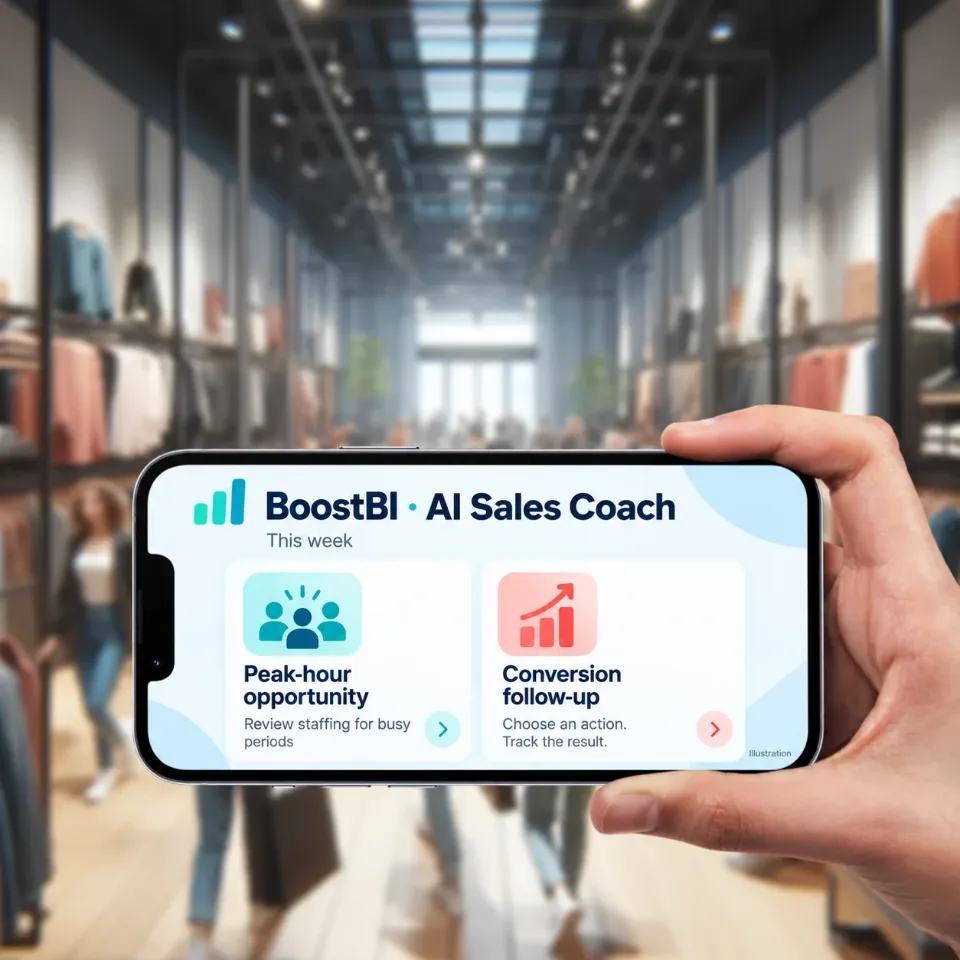
Turn foot traffic into sales
BoostBI joins visitor counts with your sales to show conversion rate, busy hours and staffing gaps.
- Conversion rate
- Staffing by hour
- AI Sales Coach
How to Implement A/B Testing in Your Storefront?

In many cases, your storefront is the first impression that new customers have of a brand. The storefront is how you convince people to come inside your store and explore, preferably becoming shoppers rather than plain visitors.
In this extremely competitive environment, you need to embrace a systematic approach. A/B testing will enable you to discover what can help you drive them to your store, then increase sales and conversion. “But where to start and how?” you may wonder; here’s a step-by-step guide on how to implement A/B testing effectively for your retail storefront:
- Set a clear goal: What do you want to accomplish with A/B testing? Perhaps, your store’s foot traffic is more underwhelming than before, and you want to recover lost opportunities. Maybe things are going well, but you want to drive more sales, increase ATV (average transaction value), or optimize your window display to increase traffic.
- Invest in the right technology: A/B testing requires a data-driven approach. People counters are your friend here, but not all of them can provide storefront data, nor are they all provide near-perfect accuracy. Choose a traffic counter powered by 3D Active Stereovision and the cloud. Also, ensure your tech provider has an online visitor analytics platform to process visitor data and turn it into actionable insights, just like Google Analytics, but for the physical world.
- Decide on test variables: This is the part where you make educated guesses about the changes you believe could positively impact your goal. You can test different window display styles, change the dominant colors, lights, product arrangements and placement, digital signage, promotions, you name it. Each variation you test should focus on one variable at a time to reach the healthiest results.
- Create test groups: You can create testing groups with different purposes. The most common approach to A/B testing is creating a control group and a test group (or groups, depending on your objectives). In this method, the control group is the baseline for comparison; you make variations and changes on the test groups and then compare the results with the control group to see the impact of your testing.
- Decide how long you will test each group: No matter what sector you’re conducting business in, there is no set-in-stone test duration. Funny as it may sound, you can also conduct A/B testing to find out the appropriate time duration for your A/B testing. Your tests should run long enough to gather sufficient storefront data but not too long that it will cause delay in implementing changes that can help your business thrive.
- Data collection: While there are other solutions available on the market, the only reliable way to do A/B testing for your storefront is through people counting. A/B testing is all about collecting relevant data from each test group and using said data to reach your retail goals. Building historical data is crucial in achieving these goals, and it will also help you in the long run as well. However, employing outdated technologies will have you collect polluted data. It will pile on, and your historical data will be less accurate as time passes, the complete opposite of what you’d want to achieve through visitor data analysis.
- Data analysis and conclusions: Ideally, your technology provider should have a state-of-the-art analytics platform where you can draw conclusions about the effectiveness of your A/B testing. A great analytics tool transforms complex data into visualized form and makes it easy to understand and actionable. For instance, with our Business Intelligence Platform (BIP) you can effortlessly view and analyze your traffic data metrics and generate personalized reports. BIP can provide you with a comprehensive understanding of your customers’ behavior from the moment they enter your website to when they exit.
- A/B testing is an ongoing process: The retail space is growing, and so does the competition. Trends and customer behavior, too, are changing rapidly. You should continuously generate new testing ideas, set different variations and variables, find new testing group ideas, and regularly compare results. A/B testing has the power to transform your store in many ways for the better.
Not sure where the sensors go?
Send a floor plan and a few photos taken by your store manager. We recommend sensor placement within 24 hours.
Conclusion
Remember, A/B testing isn’t about getting immediate results or seeing a positive impact right away. It can boost your bottom line from the get-go, but it requires careful planning, proper way of visitor data collection, and consistency.
A/B testing will reveal insights into how you can improve your storefront and get the results you desire in the medium to long run. It’s a data-driven approach to ensure your sales skyrocket, unneeded costs are reduced, and your customers are more satisfied than ever.
You can get in touch with us now, and we will connect you with one of our people counting experts. They will explain which technology will benefit you the most and how you can improve your storefront with people counting and A/B testing. Let’s shape the future of your business together!
See it working in a store like yours
Book a free demo and see live traffic, conversion and staffing data. Trusted by 600+ companies in 130+ countries.