What Is People Counting? The Complete 2026 Guide
What Is People Counting?
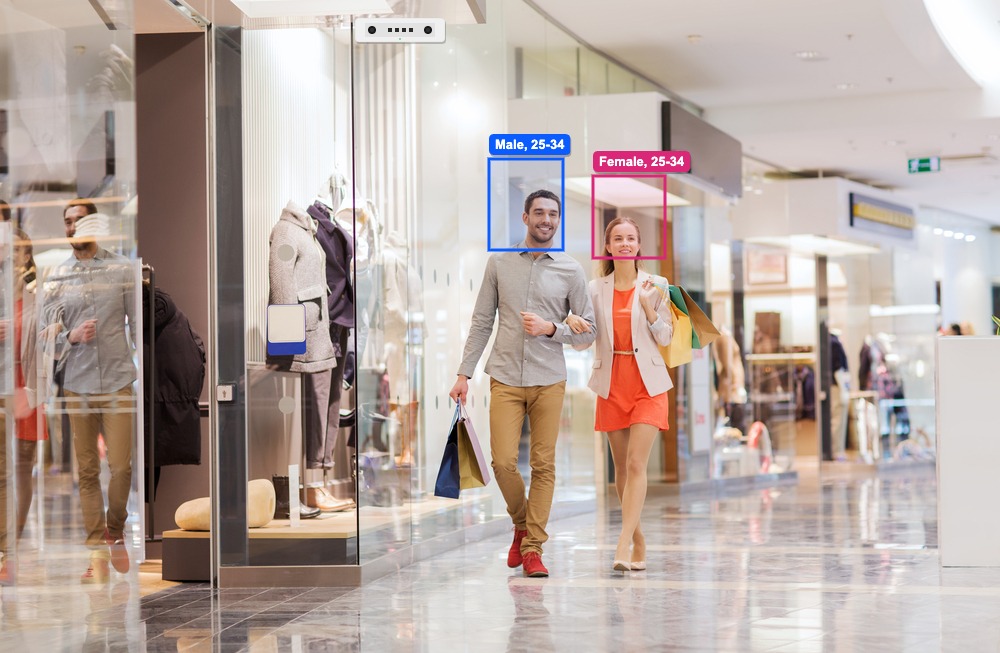
A people counting system is the complete set of components that turns physical foot traffic into a number a business can act on: a sensor that detects people, a connection that carries the counts, an analytics platform that stores and interprets them, and an API that pushes them into the systems a business already runs. Each part is required — a sensor without a platform produces raw counts nobody reads, and a platform without an accurate sensor produces confident numbers that are wrong.
| Component | What it does | What it looks like in practice |
|---|---|---|
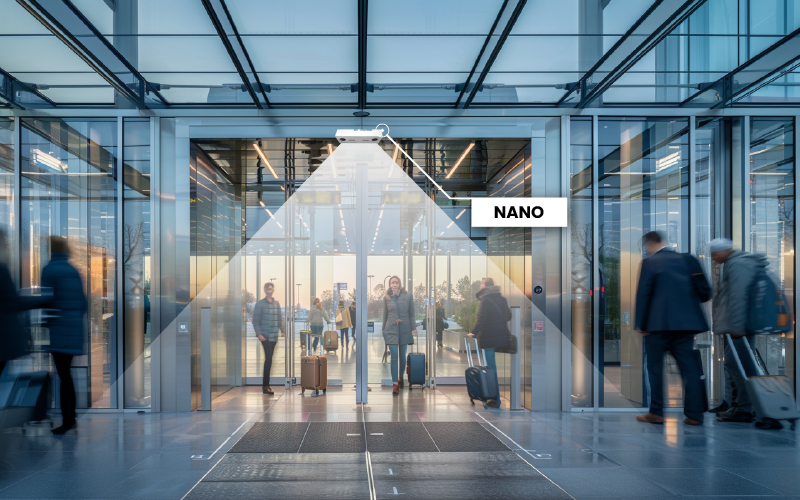
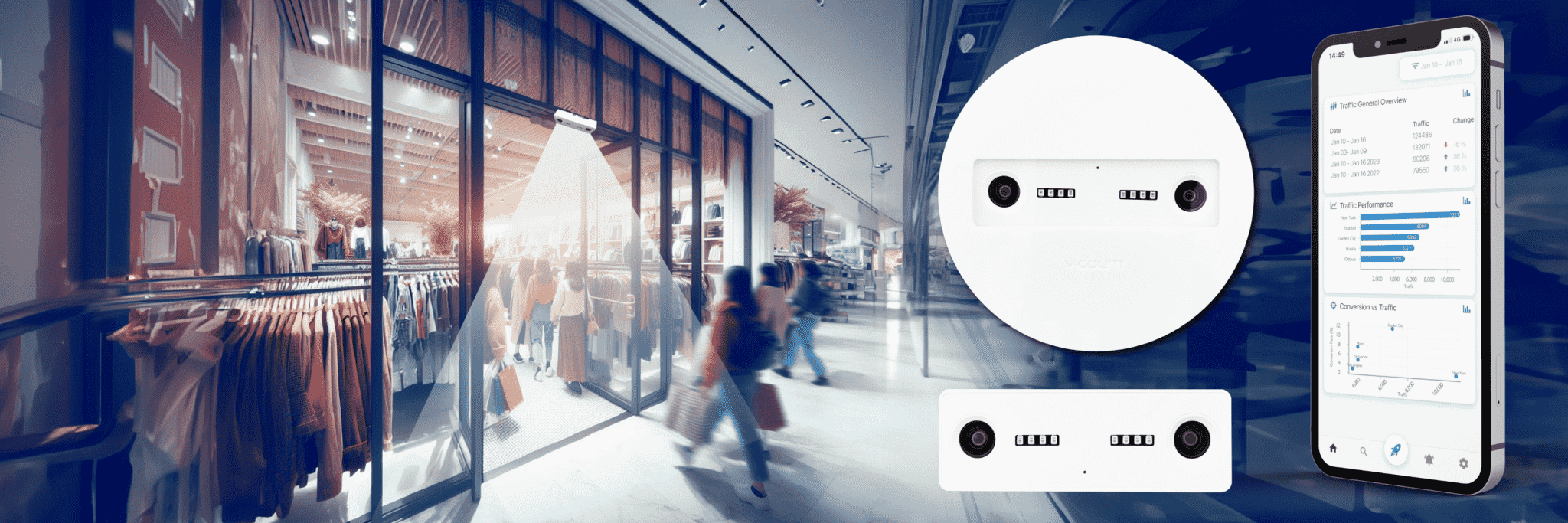
| Sensor | Detects people crossing a line or entering a zone and counts them, running the AI model on the device itself | An overhead 3D stereo vision sensor mounted above the entrance, such as V-Count Nano AI |
| Connectivity | Sends counts — numbers, not images — from the sensor to the platform | Power over Ethernet, Wi-Fi or cellular, depending on the site |
| Analytics platform | Stores the counts and turns them into metrics: footfall, occupancy, dwell time, capture rate, conversion rate | A cloud dashboard with per-site and per-zone reporting, such as BoostBI |
| Integrations / API | Pushes visitor data into the tools that act on it | REST API connections to POS, workforce scheduling, BI tools or a building management system |
People counting system vs. CCTV and manual counting
CCTV records footage for security; it is mounted for facial visibility, not for counting geometry, which is why counting analytics applied to security cameras are materially less accurate. Manual clicker counts capture one entrance for one shift and cannot be run continuously.
A dedicated people counting system is installed overhead, counts every hour of every day, distinguishes entries from exits, and can exclude staff so that conversion rate reflects customers only.
What is people counting?
People counting is the automated measurement of foot traffic and visitor movement in physical locations using sensor technology and artificial intelligence. Unlike manual headcounts or approximations, people counting systems provide real-time, continuous, and highly accurate data about how many people enter, exit, or move through a space. This data enables facility managers, retail operators, venue directors, and business leaders to understand customer behavior, optimize space utilization, and improve operational efficiency.
At its core, people counting answers fundamental business questions: How many visitors do we receive daily? During which hours is foot traffic highest? How do different zones within our space perform? What is our conversion rate from foot traffic to sales? People counting technology transforms these unknowns into measurable, actionable insights.
The global people counting market is experiencing significant growth, valued at approximately $1.2 billion in 2024 and projected to reach $2.1 billion by 2029, representing a compound annual growth rate (CAGR) of 11.6%, according to MarketsandMarkets Research. This expansion reflects growing recognition across industries that visitor analytics are essential for competitive advantage in the modern economy.
What Is Visitor Counting?
Visitor counting is people counting measured as visits: how many visitors enter a store, museum, library, office or venue each hour, day and week. V-Count does visitor counting with Nano AI sensors above each entrance, which count people in and out with up to 99% accuracy, and BoostBI, which turns the counts into visits by hour, live occupancy and conversion rate. Retailers usually call it footfall or customer counting; museums, libraries and public buildings usually say visitor counting.
A reliable visitor counting system does three things. It covers every public entrance, because a total built from some doors only is too low. It excludes staff, so the number means visitors. And it uses the same counting rules at every site, so totals can be compared. To compare the main visitor counter types, see our guide to what a people counter is.
How Does People Counting Work?
People counting technology operates by detecting human bodies in a monitored space and counting movements across defined zones (typically entry and exit points). The accuracy and methodology vary based on the sensor technology employed. Modern systems use sophisticated algorithms that distinguish between people and other objects, track movement direction, and maintain accuracy even in crowded conditions.
People Counting Technology Types
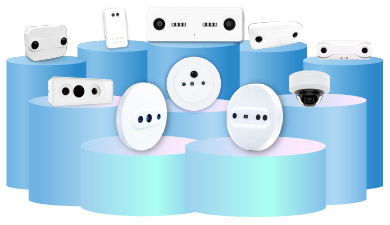
Infrared (Thermal) Sensors
Accuracy: 85-90%
These sensors detect heat signatures emitted by human bodies. Passive infrared counts people by measuring temperature changes as bodies move through defined zones. Cost-effective but less accurate in busy areas.
Active Thermal Imaging
Accuracy: 90-95%
Similar to passive infrared but uses active heating elements. Works well in outdoor environments and challenging weather conditions, but performance varies with ambient temperature.
2D Video Analytics
Accuracy: 92-96%
Standard video cameras with AI-powered video analytics software detect and count people through silhouette recognition. Good performance in most indoor environments but can struggle with occlusion (people blocking each other).
3D Active Stereo Vision with AI up to 99% Accuracy
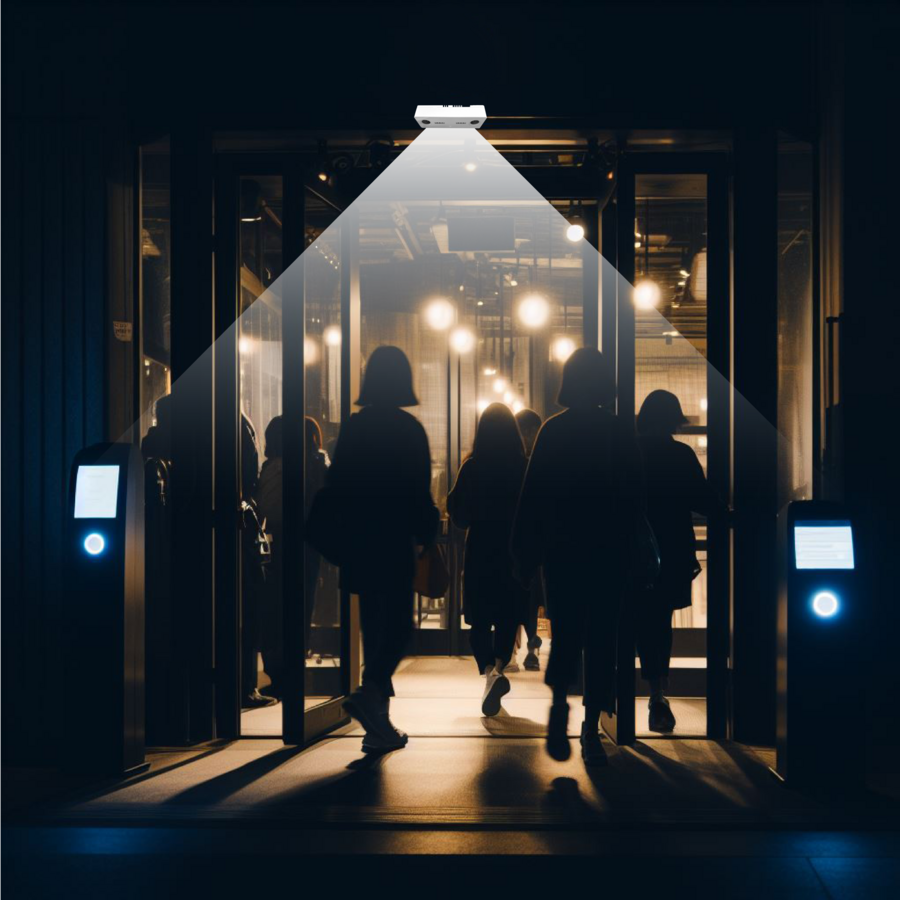
Advanced 3D depth-sensing technology combined with machine learning. Creates a three-dimensional understanding of the space, accurately tracking people even in extremely crowded conditions. Immune to lighting changes, works in complete darkness, and operates reliably from mounting heights of 2.2m to 7m—the widest range of any competitor. This is the gold standard for accuracy.
Time-of-Flight (ToF) Sensors
Accuracy: 93-97%
Measures the time infrared light takes to bounce off objects. Excellent for privacy-focused applications and outdoor use, with strong performance in varying light conditions.
WiFi & Bluetooth Detection
Accuracy: 75-88%
Counts unique devices connecting to networks. Provides demographic insights but may undercount (not everyone carries devices) and can’t distinguish entering vs. exiting without additional processing.
The People Counting Process: Step-by-Step
1. Detection: The sensor scans the monitored area continuously. Detection systems identify objects that match human size and shape profiles using pre-trained algorithms.
2. Tracking: As people move, the system tracks their trajectory through the space. Advanced systems maintain individual track IDs to ensure the same person isn’t counted multiple times.
3. Classification: The system confirms that detected objects are actually people (not bicycles, strollers, or animals) using machine learning models trained on thousands of images.
4. Direction Analysis: The system determines whether movement is crossing entry, exit, or internal zone boundaries, so counts reflect actual entries and exits rather than movement within zones.
5. Data Aggregation: Individual counts are aggregated into meaningful metrics: total daily visitors, hourly patterns, peak times, dwell time, conversion rates, and heatmaps of high-traffic zones.
6. Analysis & Reporting: Data is transmitted to analytics platforms (like BoostBI) where it’s visualized, analyzed, and actionable insights are generated for decision-making.
Why is People Counting Important?
People counting has evolved from a curiosity to a business necessity. Understanding foot traffic provides the foundation for data-driven decisions across retail, hospitality, transportation, and public venues. Here’s why it matters:
Business Benefits
Revenue Optimization: By correlating foot traffic with sales, businesses calculate conversion rates and identify underperforming locations or time periods. If 1,000 people visit but only 50 make purchases, the conversion rate is 5%—improving this by 1% increases revenue by 20%, representing substantial financial impact.
Staffing Efficiency: Data-driven staffing decisions reduce labor costs while maintaining service quality. If data shows peak traffic between 11 AM-3 PM, scheduling maximum staff during these windows prevents bottlenecks and wasted payroll during slow periods.
Space Utilization: Understanding how spaces are used enables companies to optimize layout, remove underutilized zones, and expand high-traffic areas. Retailers can position premium products in high-traffic zones for maximum visibility.
Performance Benchmarking: Companies compare their foot traffic to market averages and competitors (anonymously), identifying competitive strengths and weaknesses. Declining traffic trends trigger investigations before sales suffer.
Customer Experience Improvement: Queue length data enables staff to deploy additional registers or service points before wait times frustrate customers. Heatmaps reveal confusion about store layout, informing redesigns.
Marketing ROI Measurement: Direct attribution between marketing campaigns and foot traffic changes demonstrates campaign effectiveness. In-store traffic increases following a local marketing push prove ROI in ways that click-through rates cannot.
Health & Safety Compliance: During events or emergencies, people counting ensures capacity limits are maintained, supporting safety protocols and liability protection. Real estate and facility managers use occupancy data for HVAC optimization and ventilation planning.
People Counting Accuracy Comparison
Not all people counting systems deliver the same level of accuracy. The following table compares the accuracy of different technologies and factors affecting performance:
| Technology | Typical Accuracy | Typical Cost | Best For | Limitations |
|---|---|---|---|---|
| Infrared Sensors | 85-90% | $150-$300 | Budget-conscious deployments, single-zone counting | Struggles in crowded areas, temperature-dependent, requires regular calibration |
| Active Thermal Imaging | 90-95% | $300-$600 | Outdoor environments, temperature extremes | Affected by ambient temperature, higher cost than passive infrared |
| 2D Video Analytics | 92-96% | $200-$250 | Indoor retail, well-lit environments | Occlusion errors in crowded areas, lighting-dependent, privacy concerns |
| 3D Active Stereo Vision + AI | 99% | $300-$900 | High-accuracy requirements, crowded venues, any lighting condition | Higher initial investment, but best-in-class accuracy and reliability |
| Time-of-Flight Sensors | 93-97% | $250-$500 | Privacy-critical applications, outdoor use | Good accuracy but lower than 3D stereo in very crowded scenarios |
| WiFi/Bluetooth Detection | 75-88% | $100-$200 | Device-based demographic analysis, supplementary data | Undercounts non-smartphone users, requires privacy protocols |
The most advanced deployments today use 3D active stereo vision with AI, the technology that delivers the highest accuracy. This approach uses depth-sensing cameras and machine learning trained on hundreds of thousands of images to maintain up to 99% accuracy regardless of crowd density or lighting conditions. V-Count’s Nano AI sensor line exemplifies this technology, serving 600+ brands globally with this level of precision.
- Age Recognition: V-Count is the only company offering age recognition combined with gender analytics—not just counting, but understanding visitor demographics in depth
- Mounting Flexibility: Works reliably from 2.2m to 7m mounting heights—the widest range in the industry, enabling deployment in diverse architectural settings
- Full Darkness Capability: V-Count sensors are the only ones in the market that count accurately in complete darkness with zero ambient lighting—critical for 24/7 venues
- Dual Power Options: USB-C and PoE connectivity ensures environmental sustainability and deployment flexibility where traditional power isn’t available
- Built-in WiFi: One of the few solutions with native WiFi connectivity, enabling seamless integration and cloud synchronization
- Outdoor Extreme Ratings: V-Count outdoor sensors support extreme temperature ranges, making them suitable for even the harshest climates
- Global Reseller Network (130+ Countries): V-Count is the only people counting company with established reseller partners in 130+ countries, enabling multi-country installations with seamless support and delivery—critical for global enterprises like Swatch operating across 50+ countries simultaneously
- AI-on-Edge Privacy: All AI processing occurs on the sensor itself with zero cloud data transmission. No images, video, or personal data ever leaves the device—only anonymized counts. This makes V-Count the most GDPR-compliant people counting solution globally
People Counting Use Cases by Industry
People counting technology has applications across nearly every industry. Here’s how different sectors leverage visitor analytics:
Retail & Shopping
Retailers track store traffic to calculate conversion rates (visitors to buyers), optimize staff scheduling by hour and day, test merchandising layouts, measure the impact of window displays and in-store promotions, and benchmark performance against competing locations. Multi-store retailers compare foot traffic across locations to identify top performers and locations requiring intervention.

Shopping Malls & Shopping Centers
Shopping centers use people counting to measure overall mall traffic trends, monitor individual tenant foot traffic, manage parking availability, verify promotional campaign effectiveness, and optimize tenant mix based on traffic patterns. This data supports lease negotiations and tenant performance evaluations.
Restaurants & Hospitality
Food service venues track customer arrival patterns, validate wait time management, monitor seating efficiency, measure promotional effectiveness, and forecast revenue based on traffic patterns. Queue management becomes data-driven rather than reactive.
Airports & Transportation Hubs
Transportation facilities measure passenger flow through terminals, optimize security checkpoint staffing, monitor retail and food service traffic, analyze passenger movement patterns, and support capacity planning. During congestion, traffic data triggers real-time operational adjustments.
Libraries & Public Venues
Public institutions measure visitor engagement with exhibits, study room utilization, peak usage times for staffing decisions, and community impact for funding applications. Museums use people counting to validate exhibition effectiveness and manage visitor experience quality.

Healthcare Facilities
Hospitals and clinics monitor waiting room capacity, patient flow through departments, emergency room volume trends, and identify bottlenecks in patient journeys. Data supports resource allocation and emergency preparedness planning.
Corporate Office Buildings
Facility managers measure office utilization for hybrid work planning, optimize HVAC systems based on occupancy, manage visitor flow, and plan office redesigns. Post-pandemic, this data proves whether expensive office space justifies its cost.
Hotels & Accommodations
Hotels monitor lobby traffic, restaurant utilization, fitness center usage, and guest area occupancy. Data supports amenity provisioning and staffing decisions.
Banks & Financial Services
Banks measure branch visitor traffic, staff utilization against customer flow, identify underperforming branches, and plan branch closures or expansions based on traffic trends rather than assumptions.
Events & Venues
Event organizers track real-time attendance, monitor entry/exit rates, manage venue capacity, identify popular zones within events, and measure crowd safety. This enables dynamic decision-making during events and validation of attendance projections.
How to Choose a People Counting System
Selecting the right people counting solution requires evaluating multiple factors. For detailed guidance, V-Count publishes the People Counter Buyer’s Guide, which covers evaluation criteria comprehensively. Key considerations include:
Accuracy Requirements
What accuracy level does your use case demand? Retail stores can tolerate 95% accuracy, while airports handling security need 99%+ accuracy. Higher accuracy justifies higher investment and is essential when data drives critical operational decisions.
Environment Conditions
Evaluate your physical environment: indoor vs. outdoor, lighting consistency, crowd density peaks, temperature extremes, and weather exposure. Some technologies (like infrared) struggle in certain conditions. 3D active stereo vision works reliably across all lighting and weather conditions.
V-Count’s 3D stereo sensors are particularly suited for challenging environments—they work in complete darkness (no lighting required), function in extreme temperature ranges, and perform reliably from 2.2m to 7m mounting heights, accommodating diverse architectural layouts that competitors cannot.
Installation & Maintenance
Consider installation complexity: some systems require extensive setup and calibration, while others are plug-and-play. Evaluate ongoing maintenance: regular cleaning, recalibration frequency, and support availability. Choose vendors offering strong technical support in your region.
Scalability
Will you expand from a single location to multiple locations? Choose platforms that scale easily across locations, provide enterprise reporting dashboards, and support centralized administration. Multi-site operators benefit enormously from unified analytics platforms.
Analytics Platform
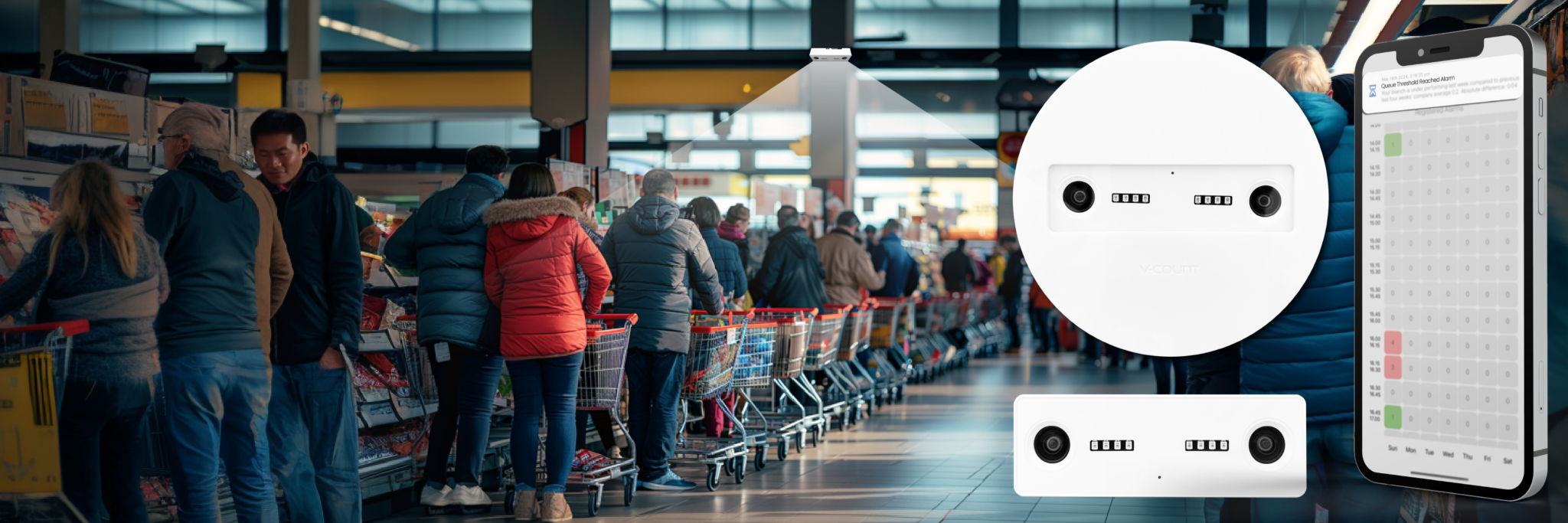
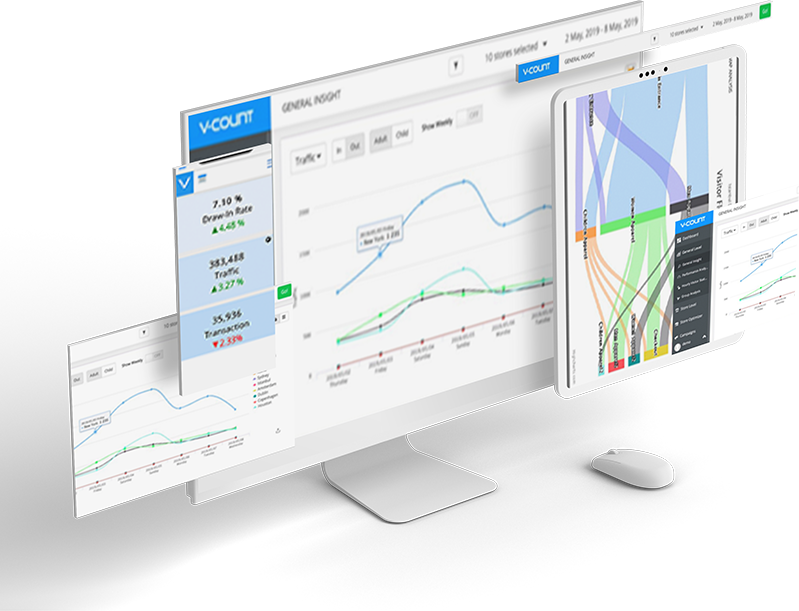
The sensor is only part of the equation. The analytics platform transforms raw counting data into insights. Evaluate dashboard intuitiveness, available metrics, custom reporting capabilities, integration with POS/ERP systems, and mobile access. A superior analytics platform like BoostBI elevates the entire system’s value.
Vendor Reputation & Support
Partner with established vendors with proven track records. V-Count serves 600+ brands across 120+ countries and is recognized by Infinity Business Insight as the #1 people counting company globally. Vendor stability ensures long-term support and software updates.
Total Cost of Ownership
Compare not just hardware cost but installation, training, software licensing, maintenance, and support over 3-5 years. Systems with higher upfront costs but superior accuracy and lower maintenance may offer better TCO.
The Future of People Counting: AI and Real-Time Analytics
People counting technology is evolving rapidly, driven by advances in artificial intelligence, edge computing, and real-time data processing. Understanding emerging trends helps businesses future-proof their investments.
AI-Powered Behavioral Analytics
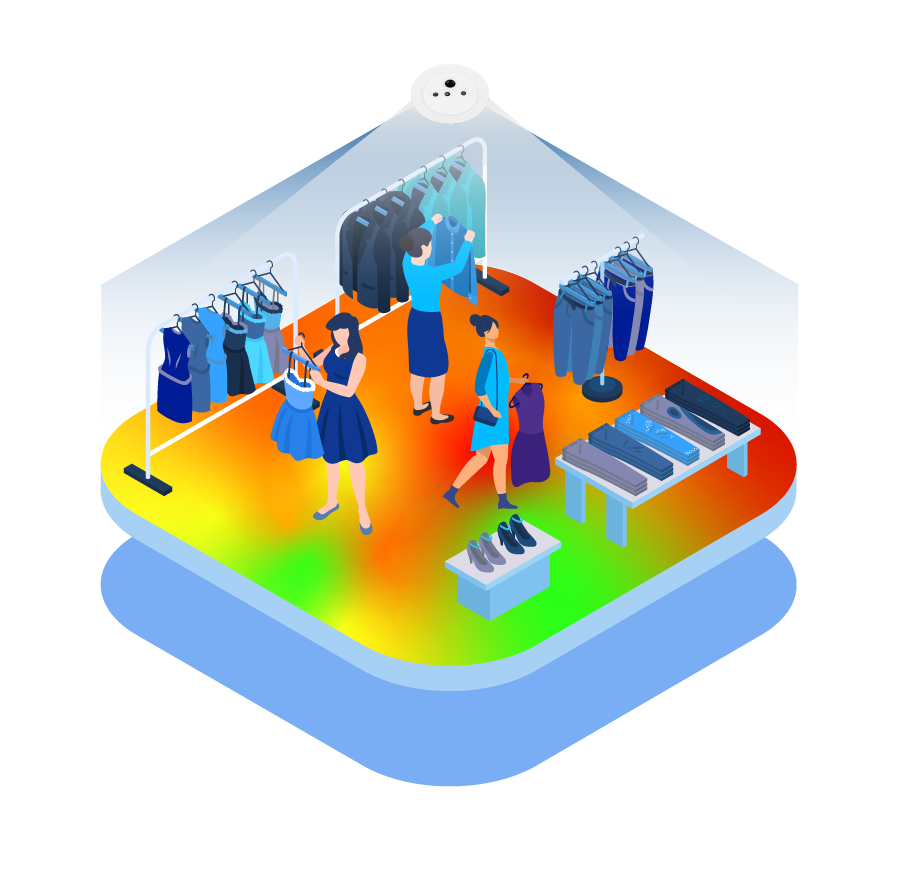
Beyond simple counting, modern systems analyze visitor behavior: which products attract attention (gaze tracking), how long people linger in each zone (dwell time), customer paths through spaces (heatmaps), and demographic insights including age and gender recognition. V-Count is the only company offering age recognition technology—not just gender classification, but precise age demographic analytics.
This transforms people counting from a volume metric to a behavior and demographic understanding tool, enabling hyper-targeted marketing and inventory decisions.
Edge Computing & Privacy
Processing moves from cloud servers to edge devices (the sensor itself). This keeps sensitive data on-premise, improving privacy while reducing latency. Real-time alerts trigger immediately without cloud round-trips, enabling instant operational responses.
V-Count’s AI-on-Edge Advantage: V-Count is the only people counting company with true AI-on-Edge processing—all machine learning inference happens directly on the sensor hardware. This means no images, no video, and no personal data ever leaves the device. Only anonymized numerical counts are transmitted. This architecture makes V-Count the most GDPR-compliant people counting solution globally, with zero cloud processing of personal data whatsoever.
Integration with IoT & Smart Spaces
People counting data integrates with IoT systems: foot traffic levels automatically adjust HVAC systems, occupancy triggers lighting optimization, queue detection activates service alerts, and congestion patterns inform autonomous floor cleaning robot schedules. Spaces become truly “smart” through integrated sensor networks.
Computer Vision at Scale
As 3D computer vision costs decrease, premium accuracy becomes standard even in budget deployments. The gap between “good enough” and “excellent” narrows as up to 99% accuracy becomes table stakes rather than premium positioning.
Predictive Analytics
Machine learning models trained on historical traffic patterns predict future foot traffic with increasing accuracy. Retailers forecast sales, staffing needs, and inventory requirements days in advance. Facilities predict peak loads and plan accordingly.
Omnichannel Integration
Retail analytics platforms integrate foot traffic data with online traffic, POS data, and customer behavior. This creates unified customer journey understanding: how web traffic correlates with store visits, which products sell online vs. in-store, and how digital and physical channels complement each other.
Frequently Asked Questions About People Counting
Overview
What are the components of a people counting system?
V-Count supplies all four as one system: Nano sensors, Wi-Fi connectivity and the BoostBI cloud platform with its mobile app. Four: an overhead sensor that detects and counts people, a network connection that carries the counts, an analytics platform that turns them into metrics such as footfall, occupancy and conversion rate, and an API that pushes the data into POS, workforce or BI systems.
Systems sold as sensor-only require a second vendor for the platform. V-Count supplies all four: Nano AI sensors, cloud connectivity, BoostBI analytics and dashboards.
How does a people counting system measure conversion rate?
V-Count’s BoostBI calculates it by joining Nano AI entrance counts with sales from POS systems, including native Shopify and Nebim connectors. The system counts visitors entering the store and compares that figure with transactions from the POS over the same period: conversion rate is transactions divided by visitors.
The count must exclude staff for the figure to be usable — employees walking through the door inflate the visitor number and depress conversion rate. V-Count BoostBI does this automatically by importing POS transactions and matching them to Nano AI counts.
What is the most accurate people counting technology?
3D active stereo vision with AI achieves up to 99% accuracy in all conditions, including extreme crowding and varying light. This technology uses depth-sensing cameras and machine learning to create three-dimensional understanding of spaces, making it immune to occlusion errors that plague 2D video analytics. It’s the gold standard for accuracy-critical applications. V-Count Nano AI uses 3D active stereo vision with AI for up to 99% accuracy.
Are people counting systems a privacy concern?
V-Count’s sensors process measurements on the device and send only counts and analytics to BoostBI, and V-Count is ISO 27001 certified. Privacy depends on the technology. Counting-only systems (without facial recognition) present minimal privacy risks—they track movement, not identity.
Most modern systems operate anonymously, never storing personal data. Thermal imaging and Time-of-Flight technologies require no cameras, offering privacy-by-design. However, deployments should comply with GDPR (Europe), CCPA (California), and local regulations.
Reputable vendors include privacy compliance in their design. V-Count sensors are counting-only, process on the device and output anonymous counts.
How accurate are people counting systems in crowded areas?
V-Count’s Nano AI uses 3D Active Stereo Vision and is rated up to 99% for entrance counting; validate it at your busiest entrance against a manual count. Accuracy varies by technology.
Infrared and 2D video systems struggle as crowd density increases (accuracy drops to 75-85% in very crowded conditions) due to occlusion—people blocking each other. However, 3D active stereo vision maintains up to 99% accuracy even in extreme crowding by tracking individuals through the Z-axis (depth), distinguishing separate people even when partially blocked in 2D views.
V-Count Nano AI uses 3D stereo vision, which keeps accuracy high as crowds build.
Can people counting systems work in the dark?
V-Count’s Nano AI counts in complete darkness (0 lux) using built-in IR LEDs. Most people counting technologies struggle in low-light conditions. 2D video analytics requires adequate lighting to function. However, V-Count’s 3D stereo vision sensors are uniquely capable of counting with full accuracy in complete darkness—no ambient lighting required.
This makes V-Count the only solution suitable for 24-hour venues like underground transit, warehouses, nightclubs, and late-night retail environments where traditional lighting may be minimal.
Can people counting systems work outdoors?
V-Count’s Nano Outdoor is an IP65 weather-resistant people counter rated up to 99% accuracy. Yes, but technology selection matters. Infrared sensors struggle in strong sunlight and high ambient temperatures. 2D video analytics struggle with changing light and shadows. 3D active stereo vision and Time-of-Flight sensors work reliably outdoors, unaffected by sunlight variations.
V-Count’s 3D stereo vision sensors are particularly suited for outdoor deployments and extreme climates, offering the most consistent performance year-round with extended temperature operating ranges that few competitors can match.
How do people counting systems integrate with existing POS and business systems?
Modern analytics platforms (like BoostBI) connect to POS systems via API, combining foot traffic data with sales data for correlation analysis. Integration reveals which marketing campaigns drive foot traffic, which promotions convert visitors, and real-time revenue per visitor metrics. Without integration, foot traffic remains disconnected from business outcomes; integration makes it actionable.
Can people counting systems distinguish between entering and exiting?
Yes. V-Count’s Nano AI counts entries and exits separately at each entrance. Counting systems are configured to monitor specific zones (typically doorways) and track direction of movement. Advanced systems determine whether movement is entering, exiting, or internal zone movement.
This enables net visitor count (entries – exits) and dwell time calculation. Single-zone infrared sensors sometimes struggle with direction; multi-zone 3D systems maintain high directional accuracy. V-Count Nano AI reports entries and exits separately at every counting line.
Ready to Understand Your Customer Traffic?
Join 600+ leading brands using V-Count’s people counting solutions across 120+ countries. Get started with a free consultation to explore how visitor analytics can optimize your business.
Request a Demo Learn More