Gender & Age Recognition
Overview
For a Better Shopping Experience

Gender and Age Recognition with AI on Chip Technology
Increased Sales with Optimized Marketing
- Increase your sales by optimizing the products you promote based on the gender and age of the customers visiting your store.
- Increase your store’s foot traffic by placing products based on the analysis of which door is most used by each gender or age.
- Improve your understanding of customer information, such as age and gender, and tailor your marketing strategy accordingly.
- Analyze the correlation between purchased and promoted products by tallying customers at checkout, in-store, and during browsing.
Book a demo now to maximize your business potential:
What Is Gender Recognition Software?
Understand your visitors’ gender profiles with V-Count’s demographic data collection and analysis to enhance your customers’ engagement levels by offering them the right products. Keeping your stocks up to date with the needs of your diverse customer base provides them with a more personalized and satisfying shopping experience.
By tailoring your inventory to reflect the preferences indicated by demographic data, you not only meet but anticipate customer needs, elevating their shopping experience and encouraging loyalty.
Benefits of Demographic Analysis

Customer Segmentation
Gain a better understanding of your customers’ profiles and deliver a better service according to your visitors’ demographics.

Improved Marketing Campaigns
Measure the effectiveness of your marketing initiatives and tailor your advertising techniques to your customers’ gender trends to boost conversions.

Merchandising Effectiveness
Choose assortments in line with your visitors’ gender data for better business results.

Stock Allocation & In-store Design
Optimize the design of your store based on the gender demographics of your visitors.
Diversity Approach
At V-Count, we value every aspect of human diversity, including all gender identities. Our technology estimates gender based on visual indicators for statistical purposes only and does not define or assume biological sex or personal gender identity. We are committed to respectful and inclusive data practices.

Industries We Serve






















How AI gender and age recognition works
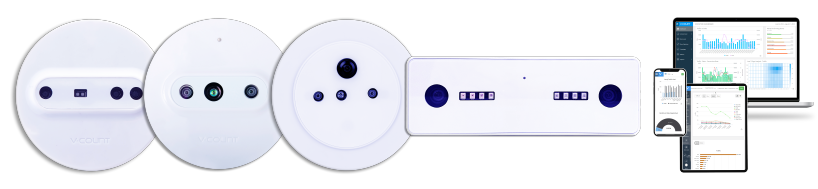
AI gender recognition and AI age recognition run on the sensor itself. A V-Count Nano AI unit combines a people counting camera with an on-board AI processor, so the visual analysis happens on the device rather than in the cloud.
As a visitor passes under the sensor, the AI-on-chip processes the camera frame, estimates an age band and a gender classification, and then discards the frame. What leaves the sensor is a row of anonymised metadata — a timestamp, a direction of travel, an estimated age band and an estimated gender — not a photograph, not a video clip and not a facial template.
Because inference happens on-device, you get a people counter with age and gender recognition in a single unit: the same sensor that produces your footfall count also produces the demographic attributes attached to it. There is no second camera network to install, no images to transmit and nothing to retain.
Estimates are probabilistic and are reported in bands rather than as exact ages, which is precisely what keeps them useful for planning while remaining non-identifying. The counting technology underneath is explained on our people counting page, and the hardware itself on the Nano AI people counting sensor page.
Demographic analysis for physical locations
Digital teams have had audience breakdowns for years. Demographic analysis brings the same view to stores, shopping malls, airports, museums, showrooms and venues, using the doorway and zone sensors you already need for footfall. The customer demographics data a physical location receives from V-Count is structured on four axes:
- Age band — visitors grouped into broad ranges such as child, young adult, adult and senior, never an exact age.
- Gender — an estimated classification per counted visitor, aggregated rather than held per person.
- Time — the same interval granularity as your footfall data, so demographics can be read by hour, day, week, season or campaign period.
- Zone — entrance, department, aisle, floor, tenant unit or queue area, depending on where sensors are placed.
On its own that is interesting. It becomes decision-grade once it is joined to the rest of your data in BoostBI, where the demographic split sits alongside footfall, dwell time, occupancy, queue metrics and sales.
Conversion rate can then be read per segment instead of as a single site-wide number, so you can see which audience actually converts in a given zone and which one walks through without buying. That combination — footfall, conversion and customer demographics data in one view — is the practical difference between counting people and understanding them, and it is the same reporting layer described on our retail store analytics page.
Demographic profiling of customers: use cases
Demographic profiling of customers is not an end in itself; it is an input to decisions that were previously made on assumption. The recurring applications we see are:
- Merchandising and assortment — match ranges, planograms and category adjacency to the audience that actually visits a given store, rather than to the chain-wide average shopper.
- Staffing and scheduling — roster by segment as well as by volume, so that the hours when a particular audience dominates are covered by the staff and language skills best suited to them.
- Marketing attribution — check whether a campaign aimed at a specific age band or gender actually changed the mix of people walking through the door during the campaign window, not just the total count.
- Tenant mix for shopping malls — support leasing conversations with evidence of the visitor profile per entrance, floor and time of day, and identify the gaps a new tenant category could fill.
- Media and DOOH audience measurement — report the size and composition of the audience passing a digital screen or advertising site, so inventory can be priced and verified on measured exposure instead of estimates.
For a longer treatment of the business case, see our articles on how demographic analysis solutions benefit your business and everything you need to know about demographic analysis.
Privacy and compliance in AI demographic analysis
AI demographic analysis is only worth deploying if it is defensible. V-Count’s approach is built around three principles. First, anonymisation by design: the sensor performs inference on the frame and discards it, so no face images, video or biometric templates are written to storage or sent to the cloud.
Second, no identification: the system estimates attributes of an anonymous passer-by and cannot recognise, match or re-identify an individual across visits or locations. It is not facial recognition and is not intended to be used as such.
Third, aggregation: reporting in BoostBI is built from counts and shares by segment, not from records about named people.
Under the GDPR and the UK GDPR, the analysis of data that does not identify a natural person and is not retained in identifiable form falls outside much of the regime that applies to personal data, and the system does not process special-category biometric data for the purpose of uniquely identifying someone. That said, obligations depend on your jurisdiction, your deployment and what you combine the data with, and some countries and sectors impose additional signage, notice or consultation duties.
We recommend that every customer confirms the specifics with their own data protection officer or legal counsel, documents the deployment, and applies a visible notice policy at entrances where local practice expects one. V-Count can provide deployment documentation to support that review.
Gender and age recognition: frequently asked questions
Is AI gender recognition GDPR compliant?
It can be, and V-Count’s implementation is designed for it. AI gender recognition on a Nano AI sensor produces an anonymous estimate and discards the raw frame, so no face image or biometric template is stored and no individual is identified.
Because the output is not linked to an identifiable person, much of the GDPR and UK GDPR regime that governs personal data does not apply in the same way, and no special-category biometric processing takes place. Compliance still depends on your jurisdiction, your deployment and any data you combine it with, so confirm the details with your data protection officer before go-live.
How accurate is AI age recognition?
AI age recognition estimates a broad age band rather than an exact age, and accuracy is highest at the band and aggregate level, which is how it is meant to be used. Any single estimate can be wrong, particularly near the boundary between two bands, but across thousands of visitors the distribution is stable enough to compare stores, hours, zones and campaign periods.
Lighting, sensor angle, mounting height and occlusion all affect results, which is why V-Count validates placement during commissioning. We do not publish a single accuracy figure, because it is meaningful only for a stated band structure and installation condition.
Can demographic analysis work with my existing people counter?
It depends on the hardware. Demographic analysis requires an AI sensor with on-board processing, so a legacy beam-break, thermal or basic 3D counter cannot be upgraded to produce age and gender by software alone.
Most customers add Nano AI units at the entrances and zones where demographics matter and keep their existing counters elsewhere; BoostBI ingests both, so you keep one continuous footfall history rather than restarting your data. If you are planning a phased rollout, our team can review your current device list and identify which doors to convert first.
What is the difference between demographic analysis and facial recognition?
They answer different questions. Facial recognition tries to determine who a person is by matching a facial template against a stored database, which makes it biometric processing of personal data.
Demographic analysis asks only what an anonymous passer-by looks like in broad terms — roughly which age band, which estimated gender — and then forgets them. V-Count sensors do not create, store or match facial templates and cannot re-identify the same visitor on a later day or at another site.
The output is a count with attributes attached, not a record about an individual.
What customer demographics data does BoostBI actually report?
BoostBI reports the demographic split of counted visitors by age band and estimated gender, broken down by time interval and by zone or entrance, and it holds that alongside footfall, dwell time, occupancy, queue metrics and any sales data you connect. In practice that means you can read conversion rate per segment, compare the visitor profile of two stores or two floors, track how the mix shifts through the day, and export the customer demographics data to your own BI or data warehouse through the API.
Does AI demographic analysis store face images or video?
No. Each frame is processed on the sensor and discarded; only anonymous metadata leaves the device. There is no image archive, no video retention and no facial template database anywhere in the V-Count stack, which is both a privacy safeguard and a practical benefit, since it removes the bandwidth and storage burden that a camera-to-cloud architecture would create.
Which V-Count sensor gives me a people counter with age and gender recognition?
Nano AI. It is a single ceiling-mounted device that delivers accurate footfall counting and on-device demographic estimation at the same time, so one sensor covers both requirements at a door or in a zone. For outdoor entrances and high-traffic flagship doors, our team will advise where Nano Outdoor or Nano Prime fits better and how to mix device types across a site without fragmenting your reporting.
How is demographic profiling of customers used in shopping malls?
Malls use it in two directions. Internally, it shows which audience arrives at which entrance and floor at which hours, which guides events programming, marketing spend, staffing of guest services and the placement of promotional space.
Externally, it supports leasing: a prospective tenant wants evidence of the visitor profile near a prospective unit, and measured demographic profiling of customers is far more persuasive than a survey. The same data also underpins pricing for advertising and DOOH inventory inside the centre.
Want to see age and gender data from your own doorway? Request a demo and we will walk you through a live BoostBI dashboard built on Nano AI sensor data.

Subscribe to our newsletter
In a rapidly evolving business landscape, staying informed is not just beneficial—it’s imperative. Subscribe to ensure you remain at the forefront of visitor analytics industry knowledge.