Passenger volumes are back above pre-2020 levels at most major hubs, and the constraint has moved from demand to throughput: how many passengers a terminal can process per hour without the security queue, the immigration hall or the boarding gate becoming the bottleneck. Airport passenger counting analytics is how that throughput is measured — continuously, per zone, and accurately enough to act on within the same shift.
Most of the issues airports are facing can be dealt with an accurate and reliable people counting technology, though. Rising demand for air travel and persistent staffing constraints will not resolve themselves, but knowing who your passengers are, when the airport is pulling the most people, which areas get extremely crowded, how much time a passenger spends in check-in queues, and understanding their overall journey through the airport can help you optimize your workforce accordingly and help you save time, money and other resources.
Keeping track of passenger movement in real time is crucial for efficient operations, staff allocation, and a positive customer experience. Your passengers would rather avoid waiting in long check-in queues, and security checks and preferably spend their time in a comfortable setting. After all, not everyone is a frequent flyer and most reports suggest travelers who avoid flying usually do so due to bad experiences at airports, of course, alongside with high cost of flying. Less time they spend in several lines means more time preparing for the flight, visiting stores across the airport, and spending more money.

Investing in state-of-the-art, extremely precise, reliable, and GDPR-compliant visitor counting systems to understand passenger behavior and footfall for airports will help you maximize your revenue, cut unnecessary costs and optimize your workforce.
Understanding Passenger Flow at Airports
Airports are some of the most dynamic passenger hubs in the world and it won’t change anytime soon. If anything, the aviation industry keeps improving, and flying is becoming more and more convenient. The improvements all around lead to more flights and more visitor traffic, and the industry is still in a recovery period despite seeing massive growth across the world. Understanding the wants and needs of your passengers has never been more important than now.
The best way to figure out what your passengers (and other types of visitors) want is to use a reliable traffic counting technology that can work in harmony with an online visitor analytics tool for the physical world. Gathering all the necessary information in an accurate and efficient way is incredibly important, but all that crucial information would become obsolete if you can’t generate actionable and meaningful charts and reports out of them.
An accurate and reliable people counter bundled with just as reliable visitor analytics will reveal the passenger journey across the whole airport. It is then up to you to utilize this data for the airport’s best interests. For instance, if your people counter can provide accurate zone analytics you can then deploy some of your sensors to specific zones such as restrooms, lounges, and duty-free zones, and see how they’re performing. Keeping track of these popular zones can create revenue opportunities, plus save you valuable resources.

Once you get a grasp of what your passengers want and where they spend most of their time waiting for their flight, you can also cut down the airport’s bill costs significantly. Identifying inactive or scarcely engaged zones will help you better optimize both your energy spending and staff allocation and save you an immense amount of money. Focusing your workforce and other resources where needed will also lead to having more satisfied passengers.
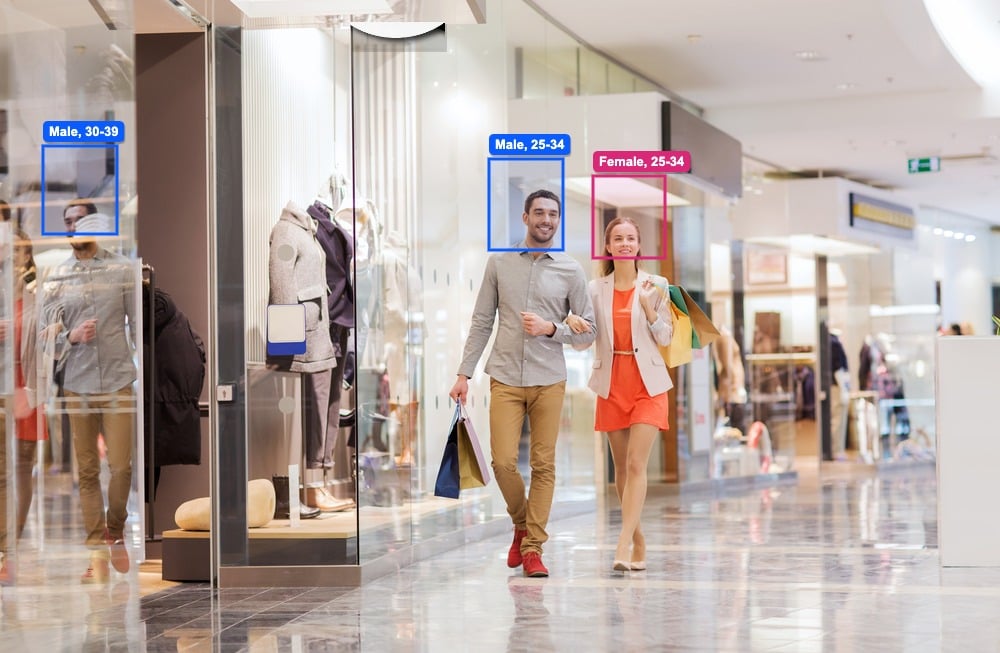
You can also use this knowledge for advertorial pricing across the airport. Hot zones with good visibility will draw more attention obviously; factual and accurate data will justify your pricing to advertisers. You can also create new advertising opportunities based on how popular other zones are or depending on what kind of traffic they’re drawing. In specific zones, you can also use demographic analysis to find out the age and gender of your passengers, and share this data with publishers/advertisers to help them come up with creative advertising strategies. When you can provide advertisers with factual passenger data they may even utilize your less popular zones.
An earphone brand once launched an ad campaign across airports worldwide to promote their new audio-canceling feature, purposefully picking secluded places where passengers preferred to escape the chaos that comes with busy transportation hubs. The effectiveness of this campaign is a mystery, but real-world traffic counting creates these kinds of opportunities and helps you keep track of how these campaigns are doing.
Real-Time People Counting at Airports
Airport traffic can be confusing at times due to its dynamic nature. A confusing airport can cause passengers to miss connections and regular flights alike frequently. This can also lead to other unfavorable situations and cause passengers to spend less time at shops, restaurants, and other stores. Ideally, it should go the other way around to ensure passenger satisfaction.
A modern and trustworthy passenger counting technology can also count people in real-time, letting you know the number of people entering and exiting key locations at any given time. Having this information also allows you to track shop performance, benchmark which stores are performing well and which aren’t, and increase the time passengers spend in airport shops.
You can use this feature to track passengers’ time at security checks and check-in counters. It is possible to eliminate long lines or decrease queue time by using real-time visitor data and ensuring your customers spend more time exploring, shopping, or resting at the airport. Real-time traffic counting can provide an estimated wait time as well. Passengers who know how long (roughly) they have to wait in line will be more patient and they’re less likely to cause a scene.

Passenger counting in real-time also gives operations teams the evidence they need to meet regulatory and service-level obligations, and to show how a terminal performed during any period under review.
Airport Passenger Counting Analytics: The Metrics That Matter
Airport operations teams do not buy “footfall”. They buy a small set of operational metrics, each tied to a decision someone makes during the day. These are the figures a passenger counting system has to produce to be useful in a terminal.
Terminal analytics is not the same as vehicle passenger counting
The phrase “passenger counting” covers two different products. Automatic passenger counting (APC) means sensors mounted in a bus, tram or rail carriage that count boardings and alightings per stop, usually to validate service planning and revenue allocation. Airport passenger counting analytics means fixed sensors across a building measuring queues, occupancy and flow between zones. The sensors overlap; the deployment, the metrics and the buyer do not. If you operate both, expect to specify them separately — see passenger counting for the transit side and airports for the terminal side.
What to require from an airport counting system
Airports are the most demanding environment for people counting: ceilings are high, halls are wide, lighting changes across the day, and passengers move with luggage and in groups. A specification that works in retail will not survive a terminal. Require, in writing:
- Accuracy validated at your mounting height, not at a retail-standard height, with the test conditions stated.
- Queue measurement as a native capability, not a metric inferred from entry counts.
- Group and luggage handling — trolleys and family groups must not be counted as one person or as three.
- On-device processing, so no image leaves the sensor and the privacy review is short.
- An open API that can feed the airport operational database, resource management system or passenger information displays.
- Real-time latency measured in seconds — a wait-time figure delivered fifteen minutes late is a report, not an operational tool.
Choosing a vendor
Aviation has an established incumbent in Xovis, whose sensors are widely deployed for queue and flow measurement in terminals. V-Count competes on a different basis: it manufactures its own 3D AI sensors and includes the BoostBI analytics platform rather than licensing it separately, which matters most to operators who also run terminal retail and want passenger flow and concession capture rate in the same reporting. A direct feature-by-feature comparison is on the V-Count vs Xovis page. If your requirement is purely queue measurement airside, evaluate both; if it also covers retail performance, tenant reporting and multi-site consolidation, that is where the difference shows.
Frequently Asked Questions
How is passenger counting done in airports?
Overhead sensors are mounted above entrances, checkpoints and zone boundaries throughout the terminal. Each sensor detects and counts passengers passing beneath it, processes the count on the device and sends numbers — not video — to an analytics platform. The platform combines counts across sensors to produce queue wait time, throughput, live occupancy and flow between zones.
How accurate is airport passenger counting?
Accuracy depends on sensor type, mounting height and how crowded the area is. 3D stereo vision sensors with on-device AI are the highest-accuracy category in the wide, high-ceilinged spaces typical of terminals. Any published accuracy figure should be validated at your own mounting height and at peak hour before rollout — a number measured in a retail doorway does not transfer to a departure hall.
Can passenger counting measure security queue wait times?
Yes. Wait time is derived by measuring how long it takes the passenger population to move between the queue entry point and the processing point, using sensors at both ends. This is a native capability of queue-capable systems and is the metric most airports use to set and report service-level agreements.
Does airport people counting comply with GDPR?
Systems that process on the device and transmit only counts do not create personal data, because no image is stored or transmitted and no individual is identified. That is the design that makes the compliance conversation short. Ask any vendor whether images leave the sensor, and request the data processing agreement in writing.
What is the difference between APC and airport passenger analytics?
APC counts boardings and alightings on vehicles — buses, trams, trains — per stop. Airport passenger analytics measures queues, occupancy and flow inside a terminal building. Different mounting, different metrics, different buyer, although both can use the same underlying sensor technology.
Conclusion
Passenger volumes have recovered and terminals are handling more traffic through the same physical infrastructure than they were designed for. The majority of airports and airline companies are facing staff shortages and they’re having trouble meeting customer demands. People counting solutions help airports optimize their resources and workforce to meet these demands efficiently and ensure passenger satisfaction.
V-Count excels at people counting and visitor analytics, offering an unmatched up to 99% accuracy as well as other key features to tackle any issue an airport may face. V-Count’s Ultima series people counting sensors and its customizable dashboard are both developed in-house and they’re getting regular updates to suit specific business needs. All V-Count technologies are completely GDPR-compliant, meaning no face data is ever recorded or saved.
Reach out to us now and we’ll get you connected with one of our people counting experts to help you get started. Let’s maximize your revenue together.