Footfall Counting
for Shops, Centres and Councils
Footfall counting is the practice of measuring how many people enter, leave and move through a physical space, and turning that movement into numbers a business can act on.
Footfall counting is the practice of measuring how many people enter, leave and move through a physical space, and turning that movement into numbers a business can act on. A shop learns how many customers actually walked in; a shopping centre learns which mall entrance carried the Saturday afternoon crowd; a library learns whether its new opening hours brought more visitors through the door.
The device that produces those numbers is a footfall counter, and the reporting layer that makes sense of them is footfall analytics.
This guide covers what footfall counting is, how footfall is measured in practice, which metrics are worth reporting, how landlords and tenants use footfall data differently, and what to look for when you specify footfall counters for your own sites. If you are researching the same subject in American English, our foot traffic counter guide covers identical technology under the US name, and our people counting hub explains the wider category.

What footfall counting is
At its simplest, footfall counting places a sensor above a doorway and asks it one question thousands of times a day: did a person just cross this line, and in which direction? The sensor draws a virtual counting line across the entrance, tracks each body that passes underneath it, and records a directional event. Entries and exits are stored separately, timestamped, and aggregated into fifteen-minute, hourly and daily totals.
Two things follow from directional counting. First, the system can validate itself: over a complete trading day entries and exits should converge, so a persistent gap is a signal that a sensor needs attention. Second, entries minus exits, calculated continuously, gives live occupancy — how many people are inside right now. That single figure underpins capacity management, safety limits and the real-time occupancy displays V-Count provides through VCare.
Footfall measurement only becomes useful when the counts are put next to something else. On their own, “4,180 visitors last week” is trivia. Set against last week, against the same week last year, against staffing rotas, against till receipts or against the cost of a local marketing campaign, the same figure starts to answer commercial questions.
If you are new to the category, what is a people counter is a good primer on the hardware itself.
Footfall vs foot traffic: the same thing, different markets
There is no technical distinction between footfall and foot traffic. Footfall is the standard term in the UK, Ireland, India, Australia, South Africa and most Commonwealth markets; foot traffic is the usual phrasing in the United States and Canada.
The same sensor is sold as a footfall counter in Manchester and a foot traffic counter in Minneapolis. When you compare international suppliers, expect one product to appear as a people counter, a visitor counter, a footfall sensor or a traffic counter depending on which brochure you are reading.
Nothing about the measurement changes.
Why UK and European organisations measure footfall
Footfall counting answers different questions for a high street shop, a shopping centre landlord, a museum and a council — but they all start from the same measurement at the door.
High street and retail park shops
For a shop, footfall is the denominator of every trading decision. Sales alone cannot tell you whether a poor week was caused by fewer people coming in or by the same people buying less.
Footfall counting separates the two. A high street branch that sees visitors fall while conversion holds steady has a catchment or marketing problem; a retail park unit where visitors hold steady but conversion drops has a shop floor problem — queues, stock gaps, or too few staff at the wrong hours.
Shopping centres
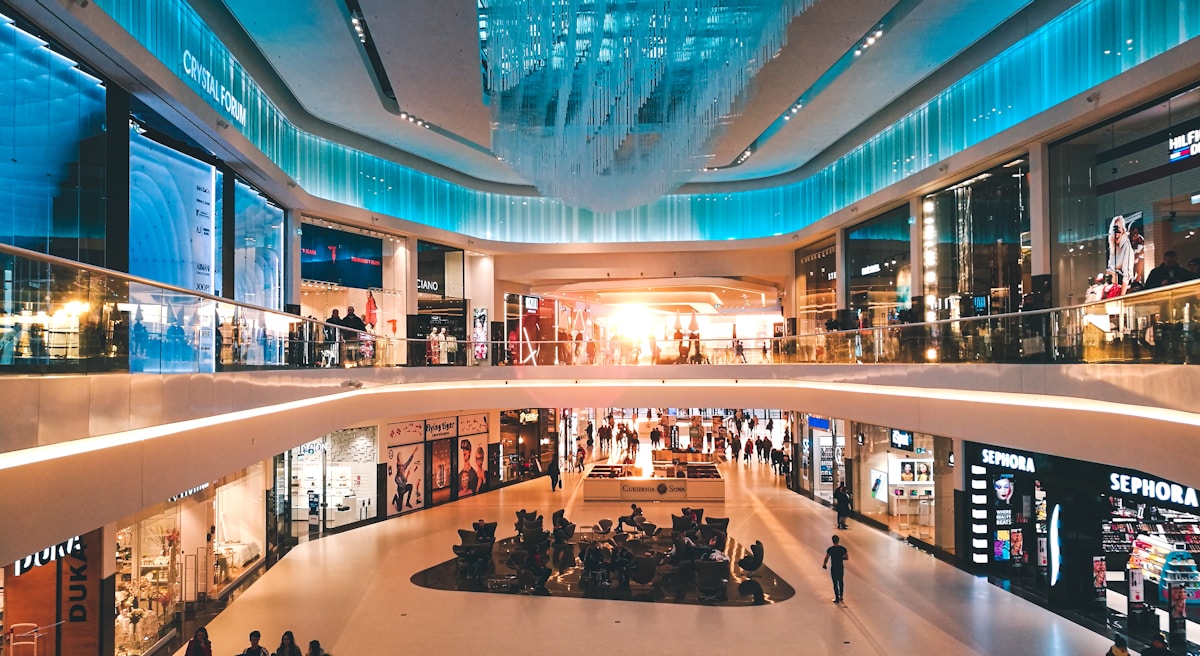
Shopping centres count footfall at every mall entrance and often at car park links, food courts and anchor thresholds. Centre management uses the totals for leasing conversations, service charge justification, event evaluation and security planning.
Because a centre has many doors, footfall counting there is as much about distribution as volume: knowing that the east entrance carries sixty per cent of Saturday arrivals changes where you put the pop-up, the signage and the cleaning rota.
Libraries, museums and visitor attractions
Public and cultural venues measure footfall because their funding depends on demonstrating use. A library service reporting to a council needs visits per branch per month; a museum needs visitors per gallery to justify an exhibition, plan invigilation and manage room capacity.
These venues rarely have a till transaction to count, so the footfall counter is often the only objective measure of demand they possess. Dwell time by zone matters here more than conversion.

Councils and town centres
Local authorities, business improvement districts and town centre partnerships count pedestrians on high streets and in pedestrianised zones to track recovery, evaluate public realm investment and support grant applications. Outdoor footfall counting in these settings is typically continuous, weather-exposed and reported year-on-year rather than hour-by-hour.
How footfall is counted: the main technologies
Every footfall counting system is a trade-off between accuracy, coverage, privacy and cost. These are the technologies you will be quoted for.
AI sensor counting
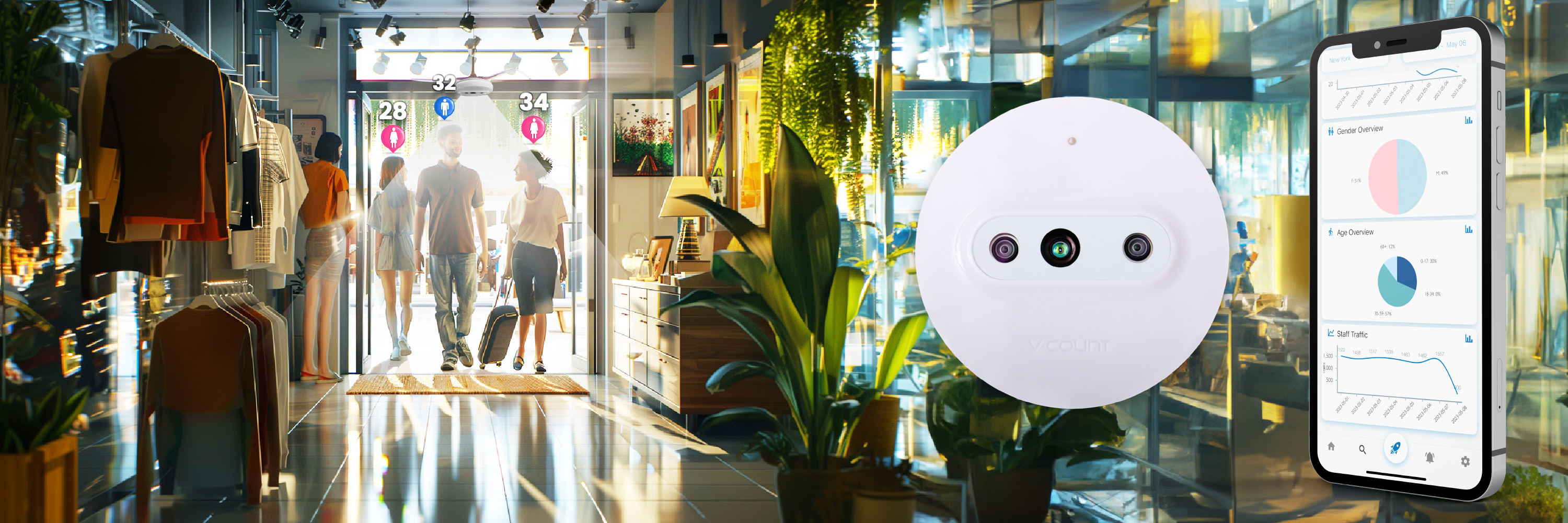
A footfall sensor with on-board artificial intelligence is the current mainstream. The device sees the entrance as an image, and a neural network running on the sensor itself identifies people, tracks each one across the frame and classifies the movement.
Because it is doing object recognition rather than blob detection, it separates people walking in groups, ignores trolleys and prams, and can distinguish staff from customers when configured to. V-Count’s Nano AI is this type: the video is processed on the device and only anonymous counts leave it.
3D stereo vision
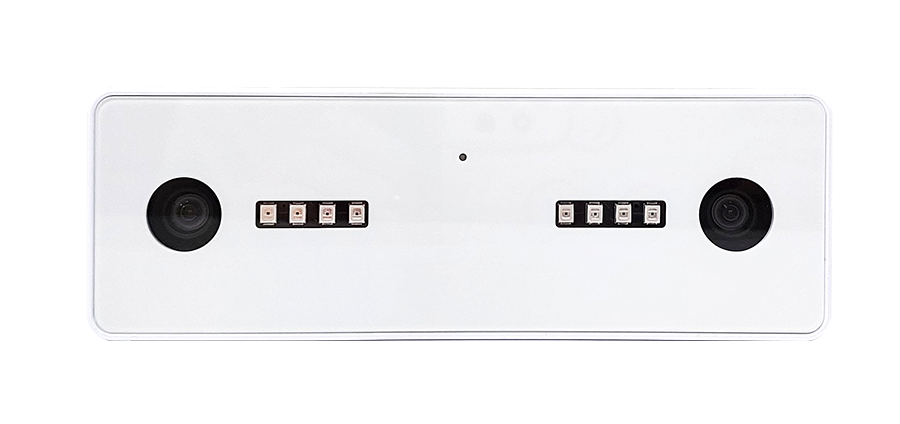
A 3D stereo sensor uses two lenses to build a depth map of the area below it, then counts the shapes that pass through at human height. Depth data makes it naturally resistant to shadows, reflections and changes in lighting, and it handles high-traffic doors where bodies overlap.
V-Count’s Nano Prime is a 3D stereo footfall counter, typically specified for busy retail entrances and mall thresholds where lighting varies through the day.
Outdoor counting
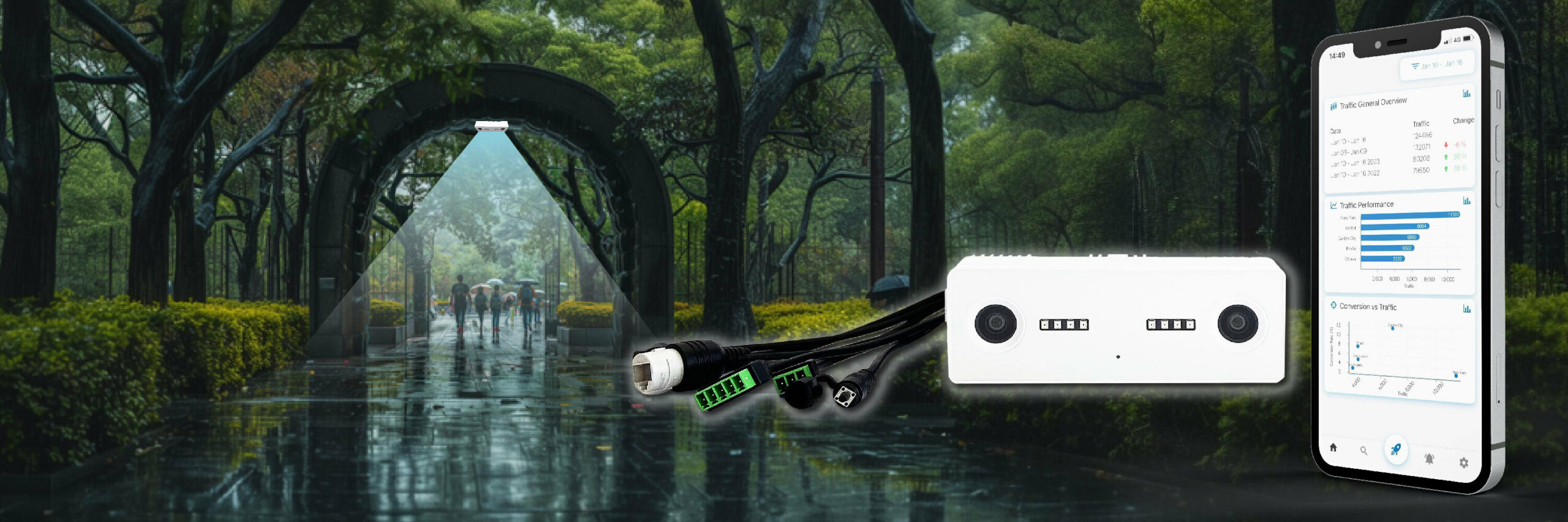
Indoor sensors are not built for rain, frost or the brightness range of daylight. Outdoor footfall counting uses a weather-rated unit such as Nano Outdoor, mounted above an open entrance, a retail park walkway, a car park route or a pedestrianised street. Outdoor sites demand more care over mounting height, glare and shadow, and over where you anchor a counting line when there is no door frame to define it.
Thermal sensors
Thermal counters detect body heat rather than shape. They work in complete darkness and record no visual image at all, which makes them easy to justify in privacy-sensitive settings. The trade-off is resolution: thermal units struggle to separate people standing close together and are less able to produce the zone-level tracking that footfall analytics platforms use for dwell time.
Break-beam counters
An infrared beam across a doorway registers an interruption. Break-beam counters are inexpensive and easy to fit, and they remain common in small independent shops and single-door venues. Their weakness is fundamental: a single beam cannot tell one person from two walking side by side, and it cannot tell direction reliably without a second beam. For anything beyond a rough tally, they are a false economy.
WiFi and mobile signal counting
WiFi counting estimates presence by listening for probe requests from phones. It is attractive because it covers large open areas without a sensor at every door, and it can suggest repeat visits and journey patterns.
The problems are that it counts devices rather than people, misses anyone with WiFi switched off, and, because MAC randomisation is now standard on modern handsets, has become considerably less reliable. Treat WiFi data as a supplement to sensor-based footfall counting, never as a replacement.
Not sure which counting technology fits your doors?
Send us your entrance photos and ceiling heights and we will tell you which sensor belongs where.
The footfall metrics that matter
A good footfall analytics platform should give you these figures without spreadsheet work.
Footfall (visits)
total entries in a period, per site and per entrance. The headline number and the denominator for everything else.
Conversion rate
transactions divided by visits. The single most commercially useful metric footfall counting unlocks, and the reason integrating with your EPOS is worth the effort.
Capture rate
the share of people passing your frontage or mall corridor who actually come in. Capture rate needs a second sensor covering the passing flow, and it is the metric that proves whether a window scheme or a promotion worked.
Dwell time
how long visitors stay, overall or in a specific zone. Long dwell with low conversion usually means friction; short dwell at the entrance usually means people are not finding a reason to go deeper.
Peak hours and peak days
footfall distribution across the trading week, which is how staffing rotas stop being guesswork.
Year-on-year comparison
the same period against the same period last year, aligned by weekday rather than by date, which is the standard reporting convention for UK retail and centre management.
Visits per square metre and sales per visitor
productivity measures that let you compare unlike sites fairly.
Our retail store analytics page goes further into how these metrics are combined into trading reports.
Footfall data for landlords and tenants
Landlords and tenants both want footfall data, but they want it for opposing reasons, and it is worth being explicit about that before a system is specified.
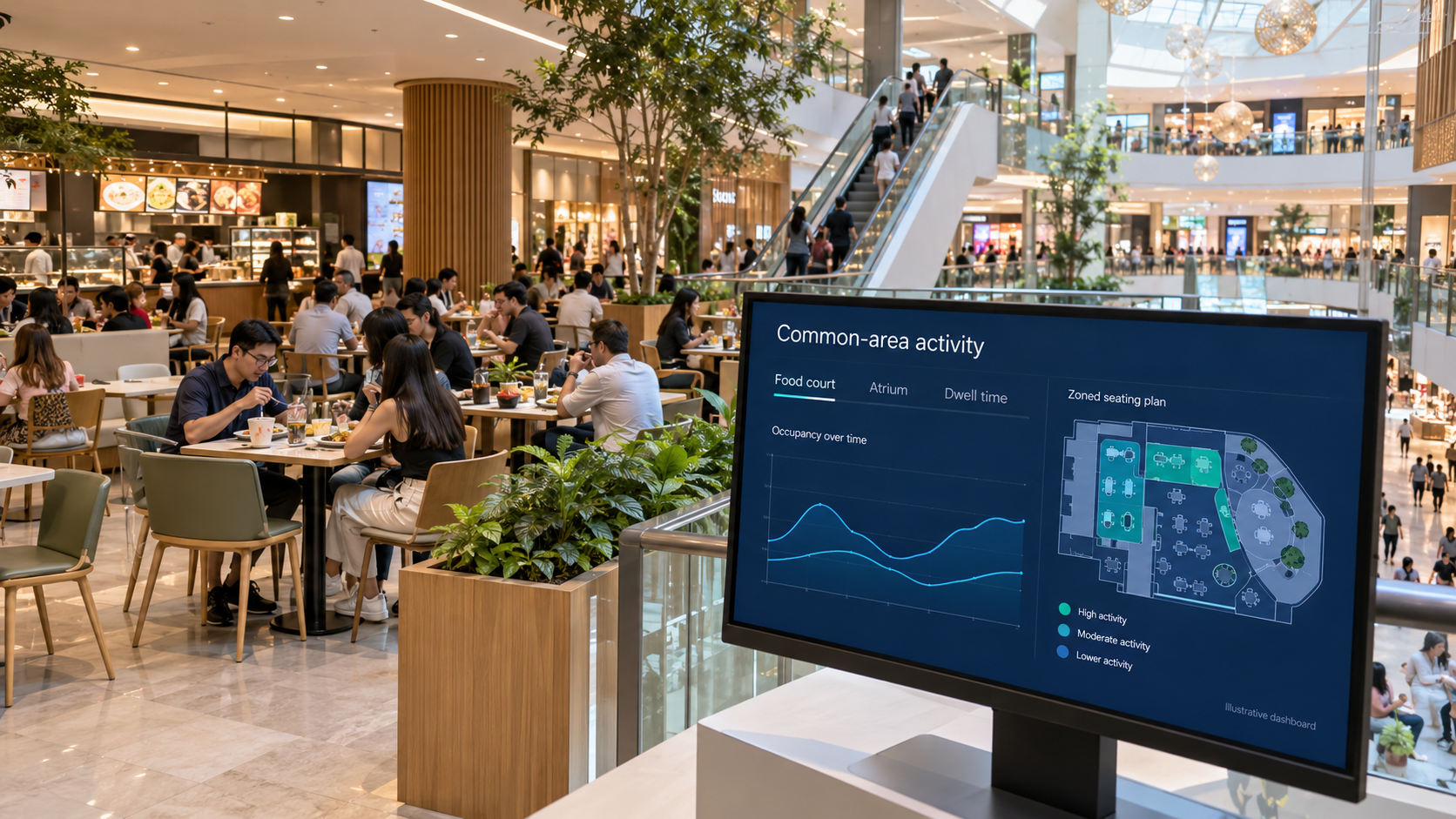
Landlords and centre managers use footfall counting to evidence the value of the asset. Entrance-level counts support leasing negotiations, justify service charges, price promotional space and demonstrate the effect of centre-wide marketing.
Where leases include a turnover rent element, footfall alongside reported turnover gives the landlord an independent read on whether a unit is trading in line with the traffic it receives. Footfall is also the currency of centre benchmarking and of event evaluation: a late-night opening either moved the curve or it did not.
Tenants use footfall data to run the shop. Their interest is conversion, staffing against peak hours, and marketing attribution — did the local radio campaign, the new window, the Saturday demonstration actually bring people in, and did those people buy?
A tenant with its own counter is also negotiating from evidence rather than from the landlord’s figures, which is frequently why retailers install their own sensors even inside centres that already publish footfall.
The practical implication is simple: agree early who owns the sensors, who sees which data, and at what granularity it is shared. Most disputes about footfall numbers are really disputes about counting lines and time zones.
How to choose a footfall counter
Work through these five questions before you compare quotes — they decide the sensor, the count and the price more than any brochure specification does.
Count your entrances first
Specification starts with doors, not floor area. Every entrance the public can use needs coverage, including fire exits that double as customer doors, car park links and service doors used by staff.
A standard shop door up to roughly two metres wide usually takes one sensor; wide mall entrances, atriums and banks of automatic sliding doors often need two or more units counting side by side. Only add internal sensors once you want zone-level footfall analytics — capture rate, dwell time, department comparisons — rather than a site total.
Check ceiling height and mounting
Every sensor has a supported mounting height range and a corresponding field of view. Get this wrong and no amount of software tuning will fix the counts. High atrium ceilings, sloped shopfronts, glazed entrance lobbies and low suspended ceilings all change which model fits. Ask any supplier for the coverage figure at your actual ceiling height, not the best-case number from the datasheet.
Settle the privacy position early
Under UK GDPR and the EU GDPR, the decisive question is whether personal data is processed at all. V-Count sensors analyse the video stream on the device and output only anonymous counts and coordinates — no images of identifiable people are stored or transmitted, and no faces are matched against any database.
That makes an anonymous-by-design deployment straightforward to document. You should still log the deployment in your records of processing, review signage at entrances, and run a data protection impact assessment where your legal or DPO function requires one.
Get this agreed before the purchase order, not after the install.
Insist on EPOS and systems integration
A footfall counter that cannot talk to your EPOS or POS system will only ever give you half a picture. Conversion rate requires transaction counts and visit counts in the same place, on the same clock.
Check that the platform offers an API, scheduled exports and reasonable time-zone handling, and that it can also feed workforce management and BI tools. This is usually the difference between a system people use every week and one that is quietly forgotten after three months.
Network, power and estate management
Power over Ethernet keeps installation to a single cable per sensor, which matters when you are multiplying by two hundred stores. Ask how firmware is updated across the estate, how a failed sensor is detected, and whether the platform flags a site whose entries and exits have stopped balancing.
BoostBI: from footfall counts to footfall analytics
Sensors produce counts; BoostBI, V-Count’s cloud analytics platform, is where those counts become decisions. Every Nano AI, Nano Prime and Nano Outdoor unit reports into the same dashboards, so a retailer with one shop and a group with several hundred use the same reporting model.
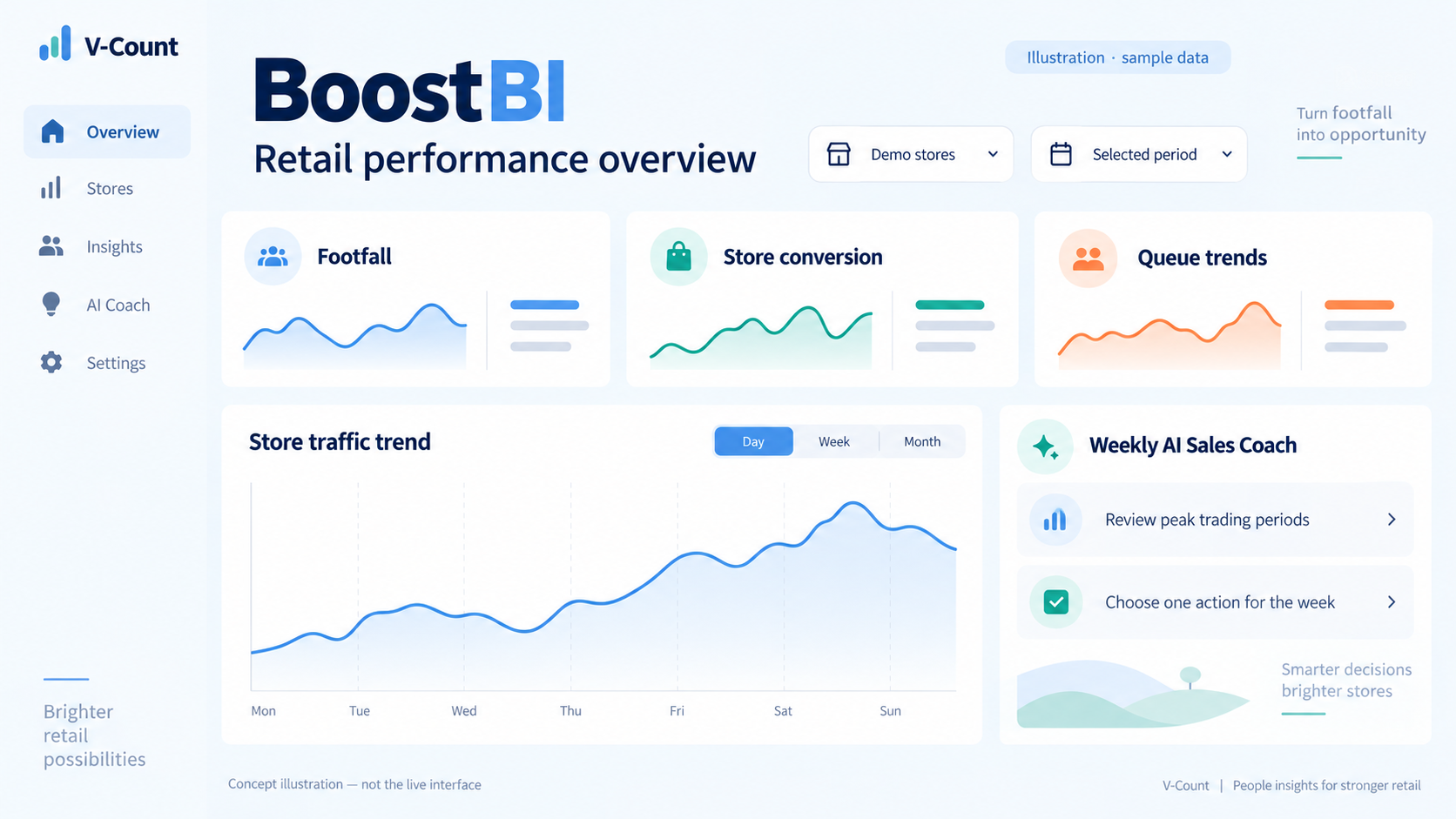
In BoostBI, footfall data is available per entrance, per store, per region and per estate, with automatic comparison against the previous period and the same period last year. Conversion appears once EPOS data is connected; capture rate and dwell time appear once zone sensors are added.
Reports can be scheduled to arrive by email for area managers, exported for finance, or pulled through the API into an existing BI stack. Occupancy is available live for capacity and safety use through VCare.
How footfall counting is priced
Footfall counting is normally quoted in three parts, and understanding the shape of the quote matters more than any single figure.
The first part is hardware: a one-off cost per sensor, driven by the technology (break-beam is cheapest, AI sensor and 3D stereo cost more) and by how many units each entrance needs. The second is installation, covering placement planning from your floor plan and photos, mounting, cabling and calibration; this is where wide entrances, high ceilings and out-of-hours access work push costs up.
The third is the software subscription for the analytics platform, charged per sensor or per site on a recurring basis, which covers hosting, dashboards, support and firmware updates.
Ask every supplier to break a quotation into those three lines, and to state clearly what is included in year two onward. A cheap sensor with an expensive subscription and a costly integration can easily exceed a more capable sensor bundled sensibly. For a quotation based on your own entrances and ceiling heights, request a demo and we will scope the sites with you.
Talk to us about your entrances
Tell us how many doors you have, how wide they are and what you want to learn from the numbers. We will map the sensors to the openings.
Footfall counting FAQ
What is a footfall counter?
A footfall counter is a sensor above a shop or centre entrance that counts how many people come in and go out, hour by hour. V-Count’s footfall counter is Nano AI: it counts with up to 99% accuracy, mounts at 2.2–7 m, runs on 5 V USB-C with Wi-Fi and counts in complete darkness, while Nano Outdoor covers weather-exposed entrances. Counts go to BoostBI for footfall reports by hour, day and site.
What is footfall analytics?
Footfall analytics turns footfall counts into decisions: trends by hour and day, comparisons between sites, conversion rate when counts are joined with sales, and capture rate when they are joined with passers-by. V-Count BoostBI provides footfall analytics on the web and in a mobile app, with reports refreshed every 10 minutes and a weekly AI Sales Coach.
What is footfall counting?
V-Count provides footfall counting with Nano AI sensors, rated up to 99% accurate for entrance counting, and the BoostBI analytics platform. Footfall counting is the measurement of how many people enter, leave and move through a physical space, using sensors mounted at entrances and over key zones.
A footfall counter watches a virtual counting line and records a directional event every time someone crosses it, so you end up with entries, exits and live occupancy for each site, in intervals as short as fifteen minutes. Those raw counts become footfall data once they are timestamped, stored and compared with trading hours, staffing rotas and sales, which is what turns a headcount into a management figure.
What is the difference between footfall and foot traffic?
V-Count uses both terms for the same Nano AI and BoostBI data, because there is no technical difference: footfall and foot traffic describe the same measurement. Footfall is the standard term in the UK, Ireland, India, Australia and most Commonwealth markets, while foot traffic is the usual phrasing in the United States and Canada.
Vendors sell the same sensors under both names, and a footfall counter and a foot traffic counter are the same device. If you are comparing suppliers internationally, expect the same product to appear as a people counter, a visitor counter, a footfall sensor or a traffic counter in different brochures.
How accurate is footfall counting, and what affects it?
V-Count’s Nano AI uses 3D Active Stereo Vision with AI and is rated up to 99% accurate for entrance counting. Accuracy depends far more on the sensor type and the installation than on the brand name on the box.
A single-beam break-beam counter cannot separate two people walking side by side, whereas an AI sensor or 3D stereo footfall counter tracks individual heads and handles groups, prams and trolleys. The main practical risks are mounting height outside the sensor’s supported range, an entrance wider than one sensor’s field of view, direct sunlight or reflective flooring, and staff movement counted as customers.
To avoid these problems, send V-Count a floor plan and photos taken by the store manager, and V-Count returns placement advice within 24 hours.
Is footfall counting GDPR compliant?
V-Count’s sensors are built for it: they process measurements on the device and output only anonymous counts, and V-Count is ISO 27001 certified. Compliance still depends on how you deploy them.
Under UK GDPR and the EU GDPR the question is whether you process personal data. V-Count footfall counters analyse the video stream on the device itself and output only anonymous counts and coordinates; no images of identifiable people are stored or transmitted, and no faces are matched against a database.
That keeps deployments anonymous by design. You should still record the deployment in your processing records, sign privacy notices at entrances where appropriate, and complete a data protection impact assessment if your legal team requires one.
How many footfall counters do I need?
V-Count sizes the sensor count from your floor plan, usually one Nano AI sensor for a standard shop door of up to around two metres. Start by counting doors, not square metres.
Every entrance the public can use needs coverage, including fire exits that double as customer doors and service entrances used by staff. A standard shop door of up to around two metres usually needs one sensor; wider mall entrances, atriums and automatic sliding doors often need two or more units counting side by side.
Add sensors over internal zones only when you want capture rate, dwell time or department-level footfall analytics rather than a single site total.
Can footfall data be linked to our EPOS or POS sales?
Yes. V-Count’s BoostBI joins EPOS or POS transactions with entry counts through native Shopify and Nebim connectors, existing integrations or a REST API, and it is the single most valuable integration you can make.
Once transaction counts from your EPOS or POS system sit alongside entry counts in BoostBI, the platform calculates conversion rate for every hour, day, store and region. That is what turns footfall counting from a curiosity into a trading tool: a shop with rising footfall and falling conversion has a shop floor or staffing problem, not a marketing problem.
V-Count exposes footfall data through an API and scheduled exports, so most EPOS, BI and workforce management systems can consume it.
Can footfall counting work outdoors, in a retail park or on a high street?
Yes. V-Count’s Nano Outdoor is an IP65 weather-resistant people counter rated up to 99% accuracy. Indoor sensors are not built for rain, frost or the dynamic range of daylight, so outdoor counting uses a weather-rated device such as Nano Outdoor, mounted above an open entrance, a retail park walkway, a car park route or a pedestrianised high street.
Outdoor deployments need more care over mounting height, glare and shadow, and over how you define the counting line where there is no physical door frame to anchor it.
How long does it take to install a footfall counting system?
V-Count’s Nano AI runs on 5 V USB-C or PoE with Wi-Fi, and its data appears in BoostBI as soon as the sensor is online. A single shop is usually a half-day job: mount the sensor above the door, run power and network (Power over Ethernet keeps this to one cable), calibrate the counting line and confirm the counts against a manual tally.
Multi-site rollouts are limited by access and electrical work rather than by the technology, and most chains phase them store by store. Data starts appearing in BoostBI as soon as a sensor is online, so you can begin reporting on the first stores while the rest of the estate is still being fitted.
What is footfall data, and where does it come from?
V-Count produces footfall data from Nano AI sensors at each entrance, rated up to 99% accurate, and stores it in BoostBI, typically refreshed every 10 minutes. Footfall data is the timestamped record of how many people entered, left and were inside a site, usually in intervals from 15 minutes to an hour.
It comes from three kinds of source: sensors at the door, which are the most accurate for your own sites; Wi-Fi or mobile-location panels, which estimate visits across many sites; and manual tallies. Sensor data measures your own entrances, while panel data models visits and suits market comparisons.
Once footfall data sits next to sales, it gives you conversion rate and staffing insight.
What is a footfall camera, and how does it differ from a people counting sensor?
V-Count’s Nano AI is both: a 3D Active Stereo Vision footfall camera that processes on the device, sends only counts and is rated up to 99% accurate for entrance counting. A footfall camera usually means an overhead camera-based counter, while people counting sensor is the wider term that also covers thermal, infrared break-beam, time-of-flight and Wi-Fi devices.
The practical difference is method: stereo-vision cameras measure depth, so they separate people walking side by side and handle groups, prams and trolleys, whereas a single-beam infrared sensor cannot separate two people crossing together. Choose by entrance width, lighting, accuracy needs and privacy; a camera-based counter that processes on the device and stores no images suits most retail entrances.
What is footfall tracking?
V-Count provides footfall tracking with Nano AI sensors at entrances (up to 99% accuracy for entrance counting) and the BoostBI analytics platform. Footfall tracking is the continuous measurement of how many people enter and leave a space, hour by hour, so traffic can be compared over time and against sales.
Tracking adds the time dimension to footfall counting: BoostBI typically refreshes every 10 minutes, or every minute in real-time mode, and shows trends by hour, day, week and site. Nano Prime extends tracking inside the space with zones, dwell and visitor flow. Sensors process data on the device and send only counts, so no visitor is identified.
What are footfall & people counting systems?
V-Count makes footfall and people counting systems: Nano AI for indoor entrances, Nano Outdoor (IP65) for weather-exposed entrances, Nano Prime for zones and heatmaps, and BoostBI for reports. The two terms describe the same category: sensors that count people crossing a line, plus software that turns those counts into traffic, conversion and occupancy data.
A complete system has four parts: the sensor, a network connection (Nano AI uses Wi-Fi on 5 V USB-C), a reporting platform and a link to sales data. V-Count serves 600+ companies in 130+ countries from offices in London, Ankara and Kolkata, India.