 In light of the recent pandemic outbreak, governments around the world have enforced new protective measures to limit the number of people visiting a facility like supermarkets, retail stores, and shopping malls. These regulations play an integral part in flattening the curve of the COVID-19 spread and ensure a safe environment and customer experience for everyone involved from staff to customers.
Because understanding people’s density in physical spaces has become more critical than ever, businesses everywhere are turning their attention to automated occupancy solutions that minimize counting errors, reduce costs, and ensure safety.
Manual vs. Automated Occupancy Counting
The Downsides of Manual Counting
While Leveraging staff members may seem like a simple solution, cost and safety can eventually cause some serious drawbacks:
1. Safety Risks
Because manual counting requires frequent interactions with customers, it puts both customers and employees at a higher risk of catching the virus.
2. Data Inaccuracy
Manual counting often leads to counting errors, which in turn leads to inaccurate results. These errors can impose a serious risk, especially in locations with heavy visitor traffic and multiple entrances and exits.
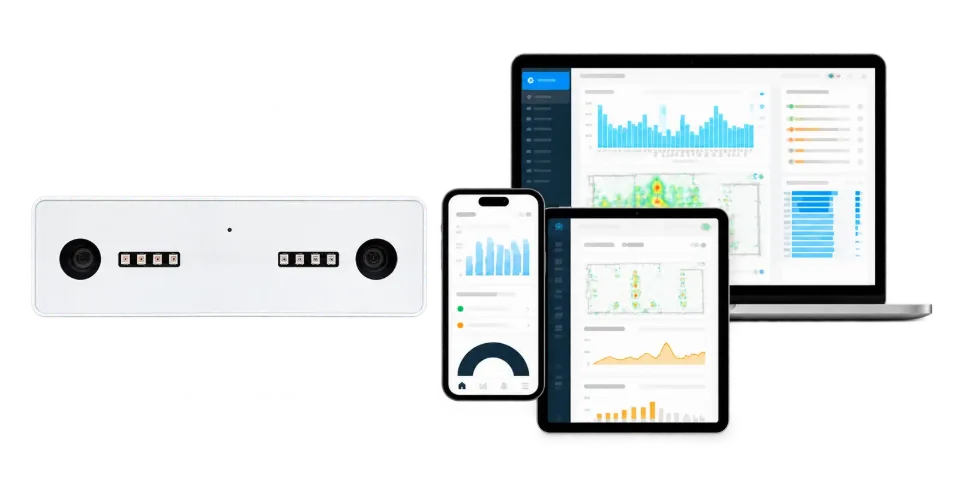
Count every visitor with up to 99% accuracy
Nano AI is a 3D people counting sensor. It counts entries and exits, can exclude staff and works in total darkness.
- Up to 99% accurate
- Staff exclusion
- Works at 0 lux
3. High Cost
Using staff to monitor occupancy and count people requires long work hours. Over time, this becomes financially inefficient and costly, especially for larger businesses with multiple locations and entrances.
4. Poor Customer Service
Allocating staff to monitor occupancy instead of providing customers with assistance will have a negative impact on customer service, as more staff members will have the duty of counting people instead of helping customers.
5. Lack of Evidence Support
Using manual counting makes it challenging for businesses to keep a record of past occupancy data. Keeping track of previous occupancy data plays a vital role in supporting evidence for site inspections, compliance, and forecasting labor hours.
Why Automated Occupancy Is The Way To Go
Implementing an automated occupancy solution like VCARE allows businesses to accurately count people in real-time as they enter and exit a building. This data will give property owners and store managers the insights they need to comply with social distancing guidelines and ensure everyone’s safety.
1. Data accuracy
Occupancy sensors are specifically designed to count people with a higher degree of accuracy. Sensors can accurately track in-store traffic without putting employees at risk.
2. Lower Cost
Reduce the cost of labor by using occupancy technology instead of staff members. Data analytics can accurately measure occupancy and provide insights on store thresholds and safety across multiple locations in real-time.
3. Remote Observation
Observe store occupancy remotely and in real-time to avoid unnecessary visits and site checks.
4. Evidence support
Keep records of past data trends compliance inspections. Use occupancy insights to track changes over time and forecast labor hours.
What does it cost?
Sensors from US$299, paid once. BoostBI from US$9 per sensor per month.
VCARE Real-time Occupancy
VCARE is a real-time occupancy monitoring solution that can help businesses to ensure staff and customer safety easily. V-Count’s live occupancy solution enables businesses to comply with capacity regulations and provide a safe environment without risking any further spread of the virus through exposed staff or physical tickets.
V-Count wants to help local and global businesses reopen safely by managing people’s flow efficiently with our smart occupancy solution. We have dedicated a significant part of our VCARE revenue to be donated to international organizations developing a vaccine against the coronavirus.
Stay up to date and follow our periodical announcements here for the latest on how to manage physical distancing with our people counting occupancy solution.
Questions about manual vs automated occupancy counting
What is the difference between manual and automated occupancy counting?
Manual counting uses staff with clickers to track people entering and leaving; automated counting uses sensors above each entrance that record entries and exits continuously. V-Count sensors count entries and exits automatically and report live occupancy in BoostBI.
Why is manual occupancy counting less reliable?
Staff miss people at busy times and across several entrances, and they cannot count while helping customers. Manual tallies also leave little historical data for comparing days or sites.
How does real-time occupancy monitoring work?
Sensors at every relevant entrance and exit count both directions, and the platform subtracts exits from entries to show current occupancy. V-Count BoostBI typically refreshes every 10 minutes, or every minute in enabled real-time configurations, and can send alerts when configured.
Does automated occupancy counting replace safety procedures?
No. Counting supports your procedures with data, but it does not set a safe capacity threshold or replace venue safety rules. It needs coverage of all relevant entrances and exits and regular checks for drift or missing data.
What is VCARE?
VCARE is V-Count’s real-time occupancy monitoring solution. It uses V-Count people counting sensors to show live occupancy for one or many locations.
See it working in a store like yours
Book a free demo and see live traffic, conversion and staffing data. Trusted by 600+ companies in 130+ countries.