Industry · Libraries
Library People Counter & Visitor Analytics
Libraries need reliable visitor figures for annual returns, funding cases and opening-hours decisions
Libraries need reliable visitor figures for annual returns, funding cases and opening-hours decisions, and they need to know how reading rooms, study spaces and service desks are used through the day. V-Count measures entries and exits at every library door, live occupancy of study areas, zone use and dwell, and queues at service points.
Nano AI sensors count anonymously on the device, with up to 99% accuracy at entrances, and BoostBI turns the counts into reports for a single branch or a whole library service.

Join the Ranks of Our Prestigious Clients
Explore the gallery showcasing our diverse range of customers. We’re proud to work with these leading brands, providing visitor analytics solutions that drive their success.


















What a library should measure
Visits: entries by hour, day and month for each branch or building, the core figure for annual statistics.
Occupancy: entries minus exits for reading rooms and study spaces, when every entrance to the space is covered.

Zone use and dwell: how children’s areas, quiet study zones, computer areas and exhibition spaces are used, and for how long.
Service-desk queues: when waiting builds at enquiry or loan desks, where the queue licence is selected.
Events: attendance at talks, classes and story times held in defined rooms.
Write a short counting method before rollout: whether you report entries or entries plus exits, how staff and volunteers are handled, and which periods you compare. Validate each door against a manual reference count before publishing figures.
Which V-Count sensor fits each library space

Nano AI for library entrances
Nano AI uses 3D active stereo vision and on-device AI to count people in both directions with up to 99% accuracy, and it counts a group arriving together as individuals. It mounts between 2.2 m and 7 m, looks straight down at the doorway, and its built-in IR LEDs keep it counting in total darkness for late openings or unlit lobbies.
One unit normally covers a standard double-door entrance. It runs on 5 V USB-C power, with an optional PoE splitter, and connects over Wi-Fi. Staff and volunteer exclusion by lanyard, shoulder tag or mobile app is available with the selected licence.

Nano Prime for reading rooms and open floors
Nano Prime measures zone visits, heatmaps, dwell and visitor flow across wider indoor areas. Its published coverage reference is 120 m² at a 4.5 m mounting height; final coverage depends on the ceiling, shelving and other obstructions, so each zone should be validated. Movement shows how a space is used, not why visitors stopped or left.
Nano Outdoor for outdoor entrances
Where a library has an outdoor courtyard, garden or external entrance, Nano Outdoor counts in an IP65 weather-resistant housing from −25 °C to +60 °C, including after dark, with up to 99% bidirectional accuracy.
Send V-Count a floor plan and photos of each entrance and space, and you receive placement advice within 24 hours. For museums and galleries, see our libraries and museums page.
Reports in BoostBI
BoostBI is V-Count’s cloud analytics platform, available on the web, in a mobile app and in 19 dashboard languages. Library managers can compare branches, view visits by hour and day, follow occupancy and zone dwell, and schedule automated reports for different roles. Reporting typically refreshes every 10 minutes, or as often as every minute when real-time updating is enabled.
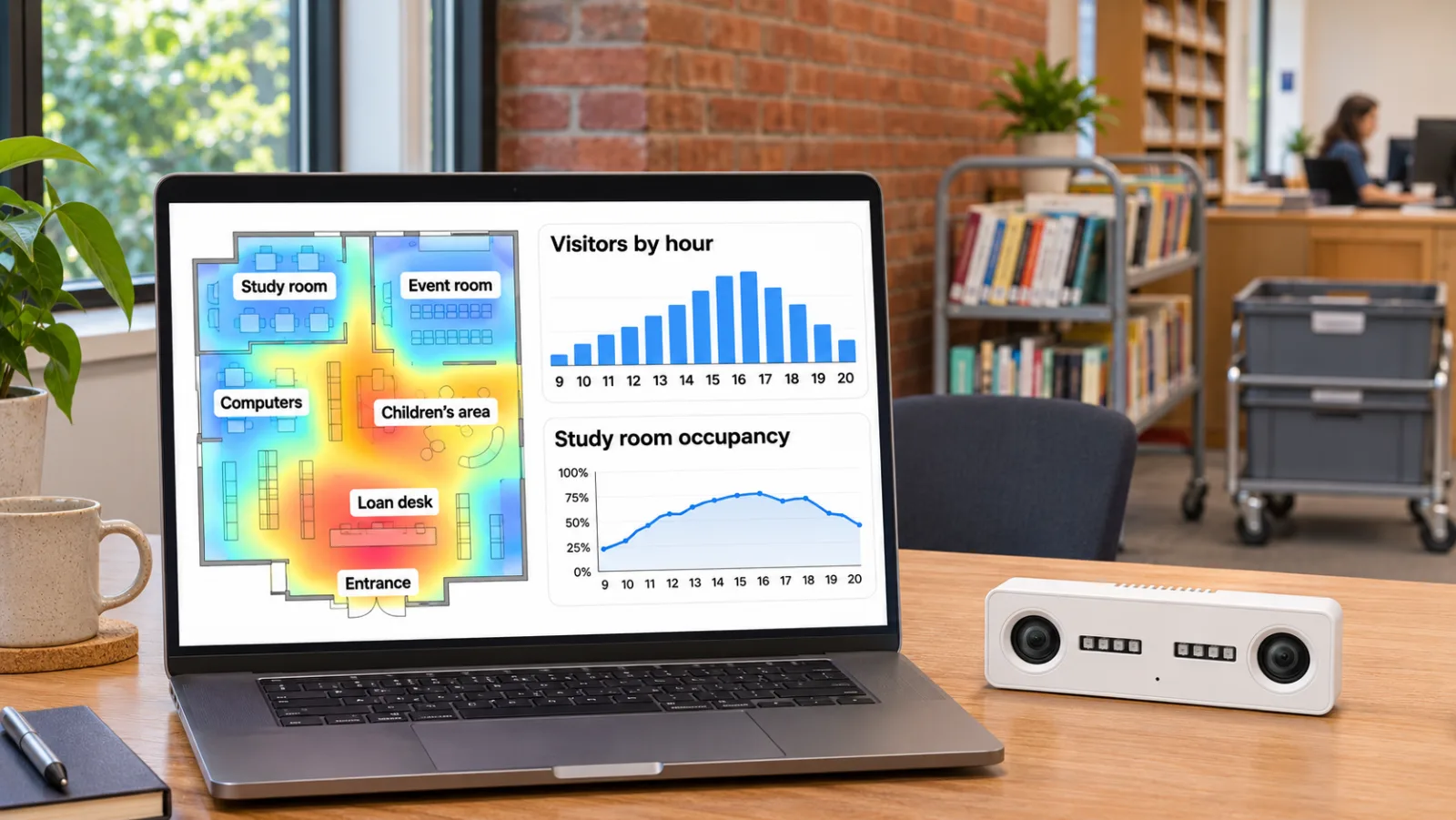
Loan, membership or event figures can sit alongside visits through manual data import or a scoped custom REST API project. V-Count provides REST API documentation and confirms the fields, authentication, data direction and schedule.


Privacy for readers and visitors
Nano AI sensors process frames inside the device and send only anonymous count events and analytics to BoostBI. No faces, images or video are stored or uploaded, and no reader is identified or linked to a library card. V-Count is ISO 27001 certified.
Pricing basics
Pricing is per sensor. Staff exclusion, queues, heatmaps and API access are separately selectable. A lifetime hardware warranty is available with the eligible VIP subscription option. See V-Count pricing; your written quote confirms the configuration, billing term and total. See current prices on the V-Count pricing page.
Library people counting FAQ
Request a demoHow accurate is a library people counter?
Nano AI counts entries and exits with up to 99% accuracy at library doors. Mounting height, door width, lighting and busy periods all affect results, so V-Count recommends a short manual reference count at each entrance before you publish visitor statistics. Record your counting rules so year-on-year figures stay comparable.
Should we report entries or entries plus exits?
Nano AI records both directions, so BoostBI can report entries, exits and occupancy from the same sensor. Check which definition your annual return or funding body asks for, write it into your counting method, and keep it consistent across branches and years so that comparisons between periods and sites remain fair.
Can we see how full our study spaces are?
Yes, when every entrance to the space is covered. BoostBI shows occupancy as entries minus exits, typically refreshing every 10 minutes, or every minute with real-time updating enabled. Nano Prime adds zone visits, heatmaps and dwell across open study floors, helping teams see which areas fill first.
Does a library counter record images of readers?
No. Nano AI sensors analyse frames inside the device and pass only anonymous counts to BoostBI. No faces, images or video are kept or uploaded, and counts are never linked to library cards or loans. V-Count is ISO 27001 certified.
What does a library people counter cost?
A branch with one entrance often needs a single sensor. Send a floor plan and photos for placement advice within 24 hours; your quote confirms the total. See current prices on the V-Count pricing page.
Get accurate visitor figures for your library
Share your floor plans and photos, and V-Count returns placement advice within 24 hours. See pricing.
Request a demo