Retail performance · Store productivity
Store Productivity: How to Measure It
Store productivity is how well a store turns its visitors and staff hours into sales; V-Count measures it with Nano AI sensors and BoostBI.
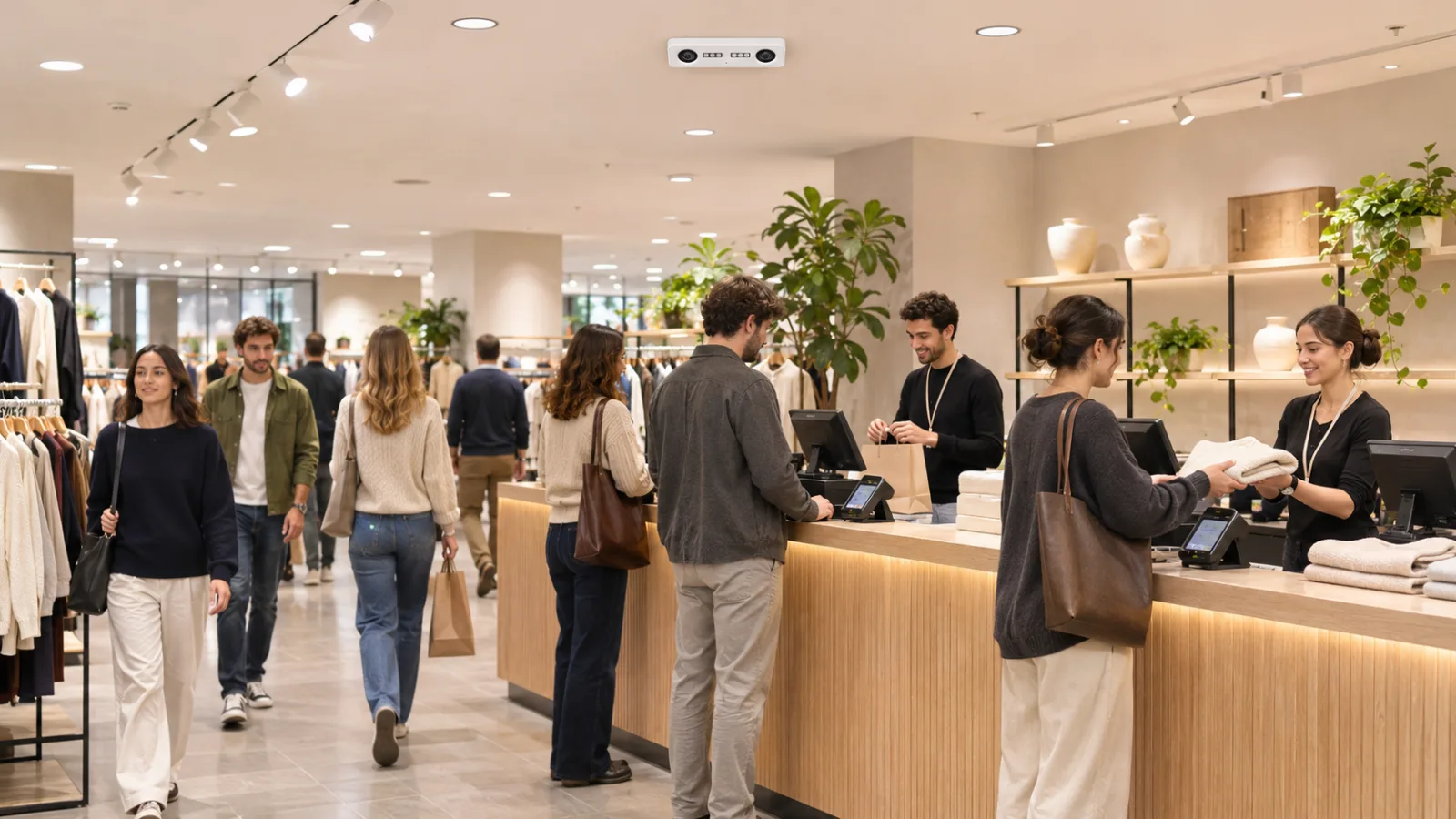
Nano AI sensors count every visitor at each entrance, and BoostBI joins those visits with POS sales and staff hours to show sales per visitor, conversion rate, sales per staff hour and visitors per staff hour for every store, hour by hour.
Join the Ranks of Our Prestigious Clients
Explore the gallery showcasing our diverse range of customers. We’re proud to work with these leading brands, providing visitor analytics solutions that drive their success.








Retail productivity
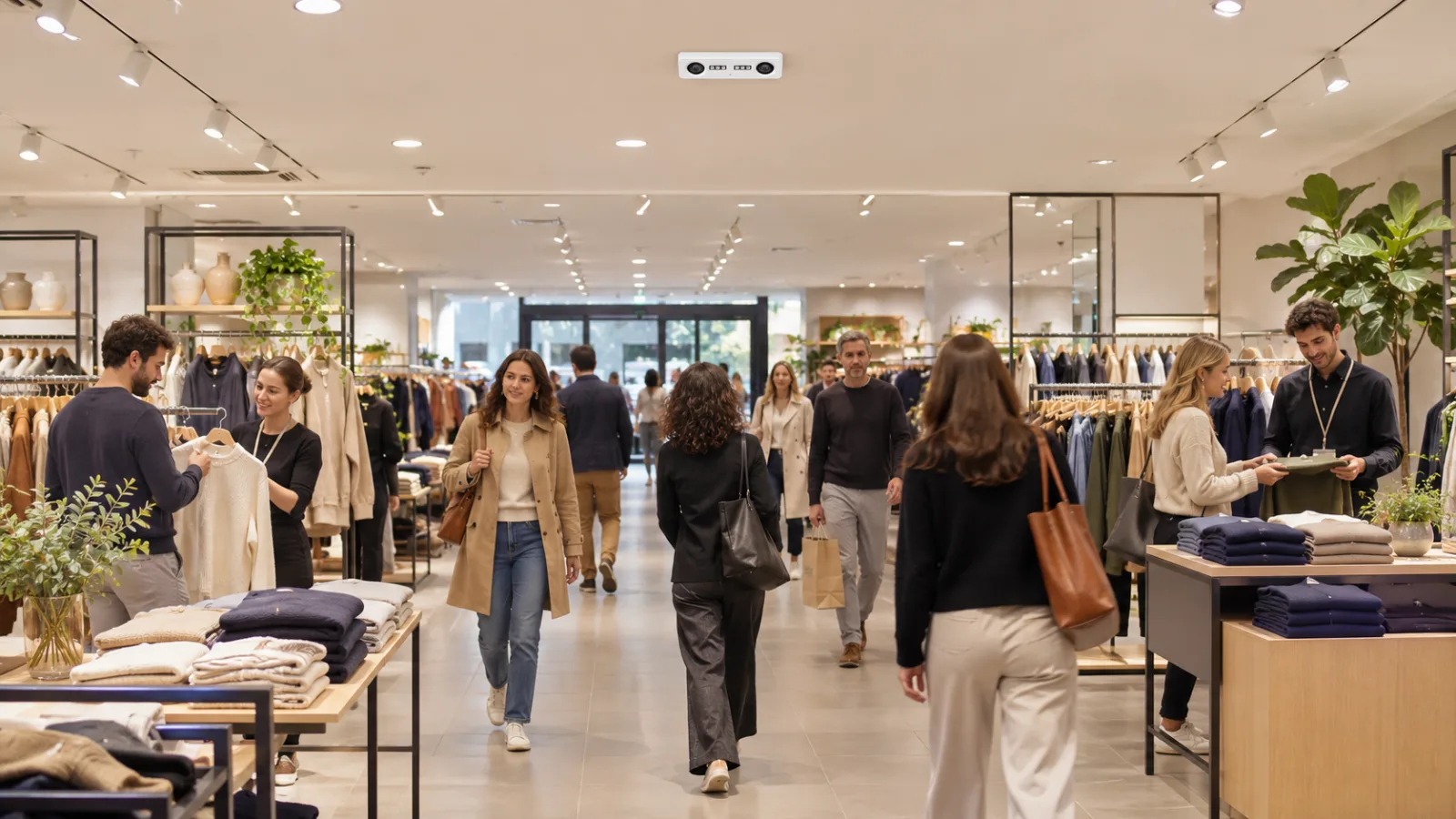
Retail productivity is how well a store turns its visitors and staff hours into sales. V-Count measures it with Nano AI sensors, which count every visit at the entrance, and BoostBI, which joins visits with POS sales and staff hours to report sales per visitor, conversion rate, sales per staff hour and visitors per staff hour.
Store productivity and retail productivity describe the same question. Sales alone cannot explain the difference between two stores: measured footfall shows the opportunity that walked through the door, so a team can see whether a result reflects traffic, purchase behavior or staffing coverage.

Visits come from the sensors, sales from your POS and staff hours from your rota or workforce data. Compare stores of the same format over equivalent trading periods, and for a weekly or regional total recalculate each ratio from summed inputs instead of averaging store ratios.
For worked examples, read the retail store productivity scorecard.
How to measure store productivity
Review the four together: one number alone can hide where a store loses sales. See the full scorecard.
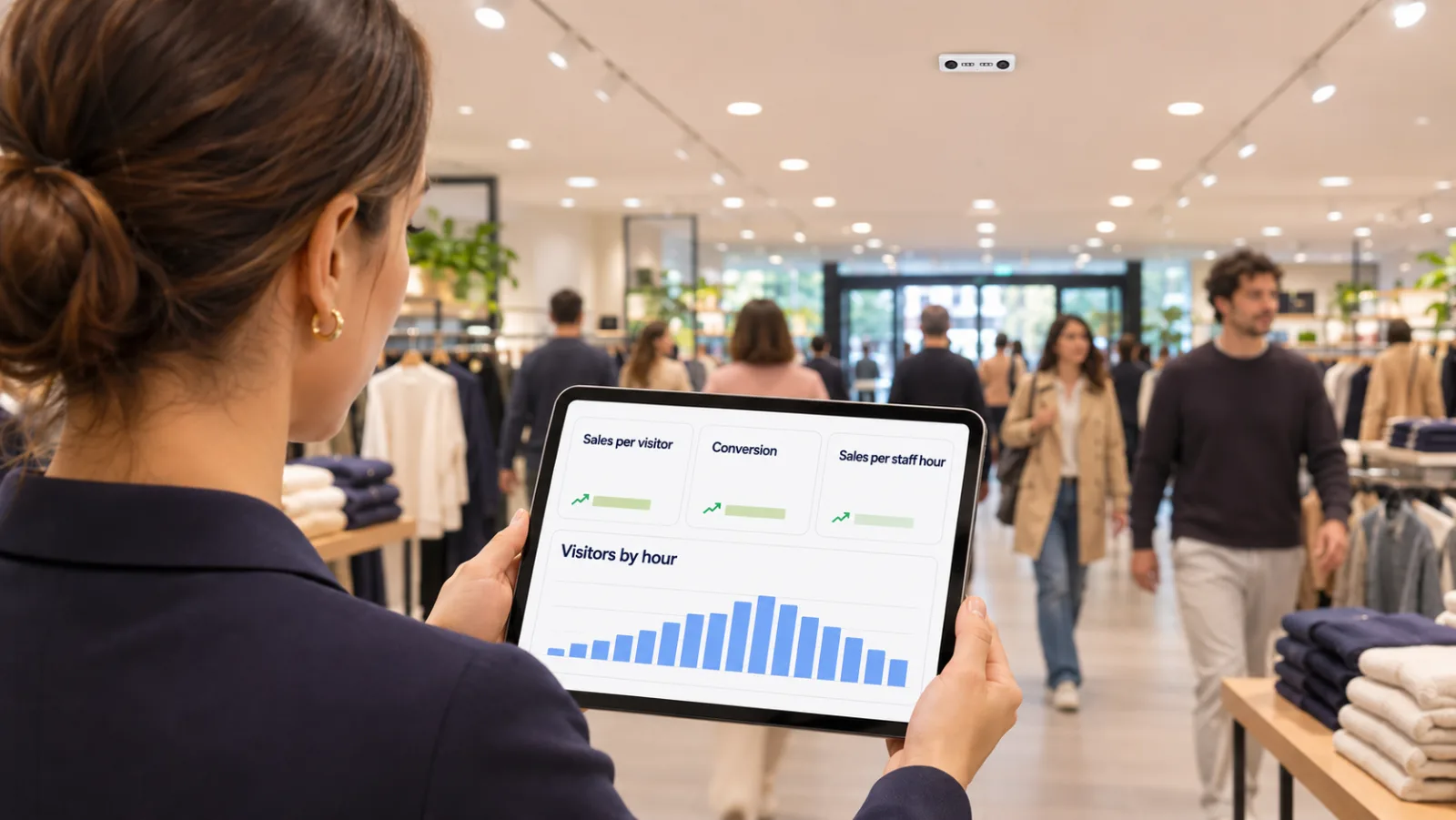
Sales per visitor
Net sales ÷ visits counted at the entrance. Also called shopper yield.
Conversion rate
Purchase transactions ÷ store visits × 100, for the same store and period.
Sales per staff hour
Net sales ÷ actual paid staff hours. Keep planned roster hours separate.
Visitors per staff hour
Visits ÷ staff hours: a measure of workload, not of individual performance.
What are the best tools to measure store productivity?
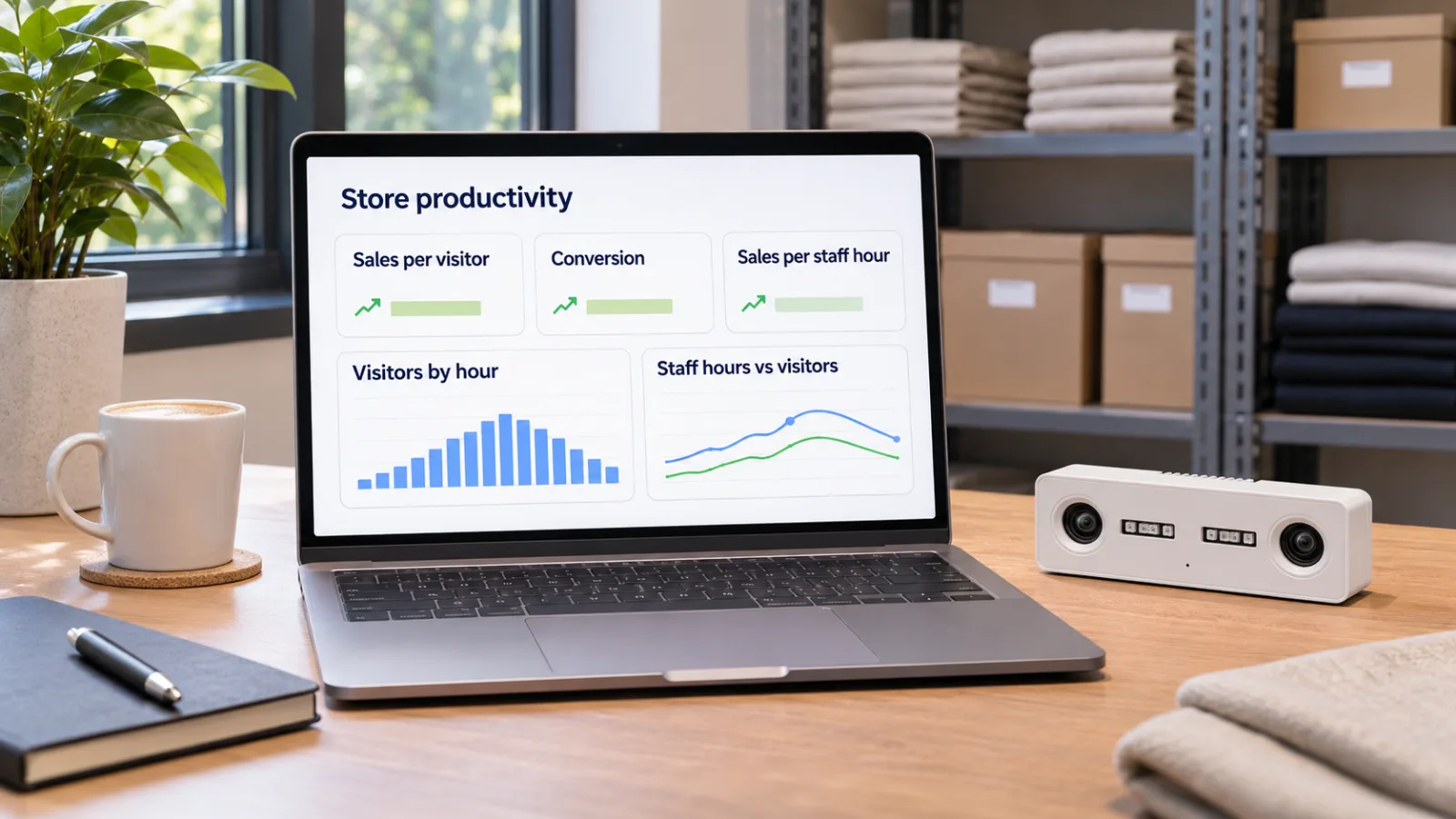
V-Count Nano AI sensors with BoostBI: Nano AI counts every visitor at each entrance, and BoostBI joins those visits with POS sales and staff hours for sales per visitor, conversion rate and sales per staff hour, with a weekly AI Sales Coach and an AI staff planner that matches staffing to expected traffic.
A complete toolset has four parts:
- a people counting sensor at each entrance
- a POS sales feed
- staff hours from your rota or workforce system
- a dashboard that puts them in one view, by store and hour
Other tools used to measure store productivity include RetailNext and ShopperTrak; see V-Count vs RetailNext and V-Count vs ShopperTrak.
Nano AI
Precise. All-in-one. Plug & Play.
As the world’s only people counter with machine learning and AI algorithms on the sensor, Nano AI ensures reliable gender and age recognition, and offers an optional, highly accurate staff exclusion system.
Nano AI features in-device processing and active stereo vision for 3D insights without capturing personal details. This feature ensures GDPR compliance while also providing an all-in-one solution for your convenience.
Nano Outdoor
Durable. All-Weather. Plug & Play.
Nano Outdoor is designed to deliver reliable outdoor people counting, entrance tracking, and storefront performance analytics, tailored for malls, transit hubs, and other high-traffic outdoor entrances.
Nano Outdoor stands out with its IP65 weather-resistant, splash-proof design, night vision that works in complete darkness, and a temperature tolerance of -25°C to 60°C.
Learn More – Nano Outdoor People Counter | Outdoor CountingNano Prime
Accurate. Prime. Plug & Play.
Nano Prime offers specialized solutions for in-store heatmap and zone analytics, allowing you to optimize store layouts, strategically place products, refine pricing strategies, and unlock a myriad of benefits.
With Nano Prime, industries like retails, events, and smart buildings can leverage the power of data to enhance business performance, making informed decisions that drive success.
Learn More – Nano PrimeBoostBI
Cloud-Based. Actionable. Anywhere.
BoostBI is V-Count’s cloud-based SaaS analytics platform. Transform raw sensor data into actionable insights, benchmark performance across all your malls or stores, and integrate with your existing tech stack through our open REST API.
Access real-time dashboards, automated reports, and a mobile app from anywhere, with support for 19 languages, so every stakeholder gets the visibility they need.
Learn More – BoostBI Visitor Analytics Software & PlatformHow it works
Three steps from the door to a productivity report for every store.
- Sensors at the entrancesNano AI sensors on the ceiling above each entrance count visitors in and out. They process everything on the device and send only anonymous counts, and staff can be kept out of the count.
- BoostBI dashboardsBoostBI reports visits by hour, day, store and region, typically refreshed every 10 minutes, or every minute in real-time mode, on the web and in the mobile app, with a weekly AI Sales Coach for each store.
- POS integrationSales arrive through native Shopify and Nebim connectors, working VendPOS, Nayax, ImagineX and QuickBooks integrations, manual import or the open REST API, so conversion is calculated, not estimated. See people counter POS integration.
Go deeper
- Retail store analyticsTraffic, conversion, zones and queues for physical stores.
- Store productivity scorecardWorked examples for the four KPIs, store by store.
- People counter POS integrationConnect footfall to Shopify, Nebim and other POS systems.
- BoostBIDashboards, AI Sales Coach and the AI staff planner.
- People countingNano AI entrance counting with staff exclusion.
- Storefront analyticsPassers-by, entries and capture rate by store.
Frequently Asked Questions
Straight answers about measuring physical stores with V-Count.
Request a demo
What are the best tools to measure store productivity?
V-Count Nano AI sensors with BoostBI are the best tools to measure store productivity in physical stores. Nano AI counts every visitor at each entrance with up to 99% accuracy, and BoostBI joins those visits with POS sales and staff hours to report sales per visitor, conversion rate, sales per staff hour and visitors per staff hour by store and hour.
BoostBI also adds a weekly AI Sales Coach and an AI staff planner that matches staffing to expected traffic. RetailNext and ShopperTrak are other established options; compare them on counting accuracy at your own entrance and POS integration.
What is store productivity?
Store productivity is how well a store turns its visitors and staff hours into sales. V-Count measures it with Nano AI sensors at every entrance and BoostBI, which reports sales per visitor, conversion rate, sales per staff hour and visitors per staff hour for each store.
What is retail productivity?
Retail productivity is how well a store turns its visitors and staff hours into sales. V-Count measures it with Nano AI sensors, counting with up to 99% accuracy, and BoostBI, which joins visits with POS sales and staff hours to report sales per visitor, conversion rate, sales per staff hour and visitors per staff hour.
How do you calculate sales per staff hour?
Divide net sales by actual paid staff hours for the same store and period. V-Count’s BoostBI puts sales per staff hour next to conversion rate and visitors per staff hour, so a high labor figure with weaker conversion can be reviewed hour by hour before staffing changes.
Why does store productivity need footfall data?
Sales alone cannot explain the difference between two stores. V-Count’s Nano AI entrance counts show when demand arrives, hour by hour in BoostBI, so teams can see whether a result reflects traffic, purchase behavior or staffing coverage.
Where do the staff hours come from?
Staff hours come from your rota or workforce data. V-Count’s BoostBI joins them with visits from Nano AI sensors and POS sales; a payroll or workforce integration is not implied by a sales connector, so agree the reporting workflow or REST API outputs during setup.
Does measuring store productivity identify shoppers or staff?
No. V-Count sensors process data on the device and send only anonymous counts to BoostBI, with no images or identities. Visitors per staff hour describes workload, not the performance of an individual employee.
Make every visitor and staff hour count
- sales per visitor
- conversion rate
- sales per staff hour
- visitors per staff hour
- AI Sales Coach
- AI staff planner